

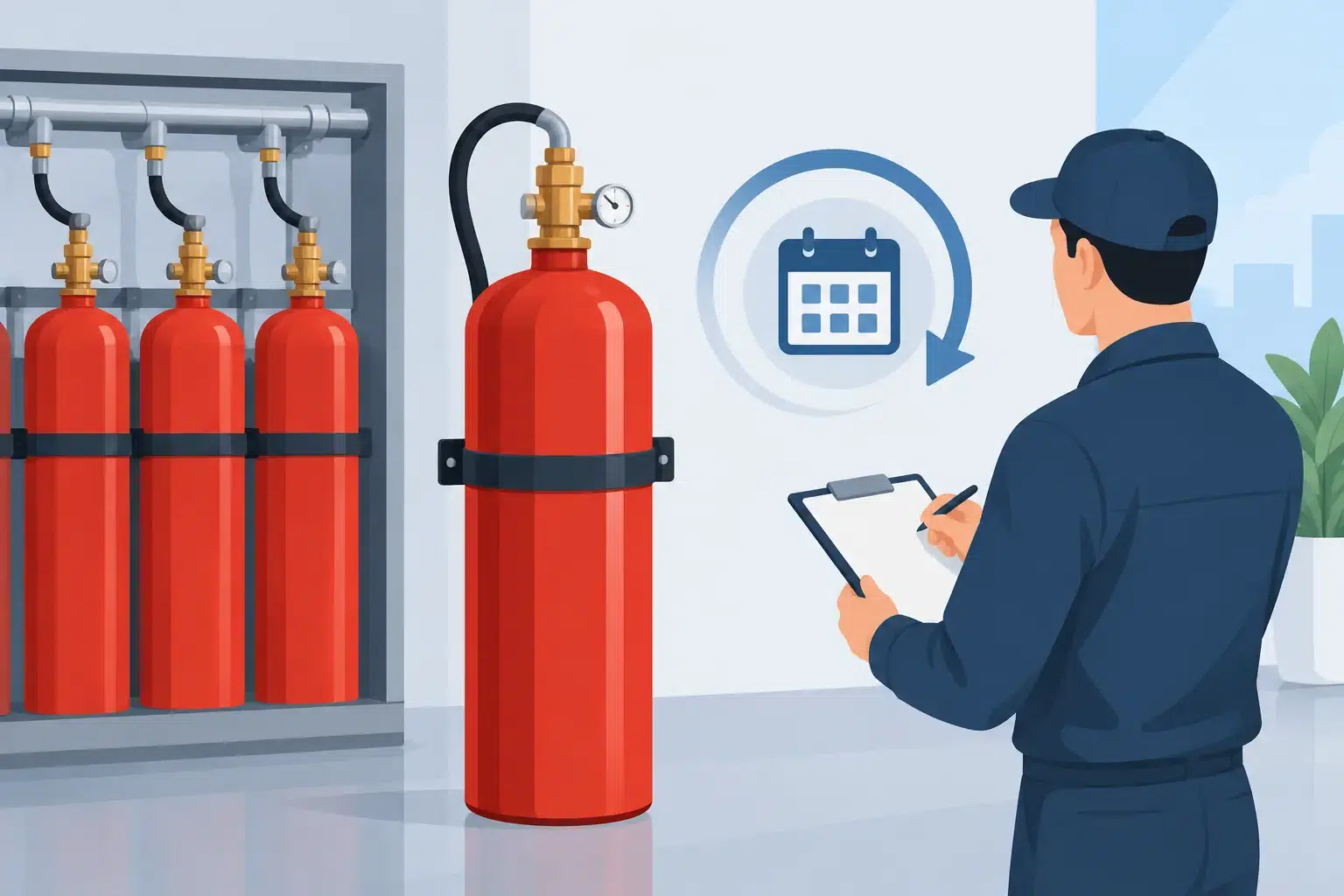
A suppression cylinder can look perfectly serviceable while carrying a problem that only becomes apparent when the system is needed. For a server room, production line, commercial kitchen or battery area, that is not an acceptable risk. Knowing when suppression cylinders should be replaced is therefore less about choosing a fixed age and more about checking their condition, pressure integrity, service history and suitability for the system they protect.
The practical answer is that cylinders should be removed from service and replaced, requalified or exchanged when they fail inspection, reach a required periodic test date, have discharged, show damage or corrosion, or no longer meet the design requirements of the suppression system. The correct action depends on the cylinder type, extinguishing agent, manufacturer instructions and the applicable standards and pressure-system requirements.
When should suppression cylinders be replaced?
There is no universal replacement interval that applies to every gaseous, CO2, dry-powder or wet-chemical suppression cylinder. A fixed protection system is an engineered assembly: its cylinders, valves, actuators, hoses, pipework, detection and control equipment all need to operate together within defined performance limits.
For that reason, a cylinder is not normally replaced merely because it has reached a certain number of years in service. Many cylinders can remain in use for a long period if they pass the required examinations and pressure tests, remain free from damage and are maintained correctly. Conversely, a relatively new cylinder may need immediate replacement if its integrity has been compromised.
The key distinction is between replacement and recertification. In some cases, an approved workshop can inspect, test and refill a cylinder for continued use. In others, a service exchange is the safer and more practical option. If a cylinder fails examination or cannot be returned to its approved condition, it must be condemned and replaced.
Scheduled pressure testing and examination dates
Suppression cylinders are pressure vessels. Their inspection and test regime is set by factors including the cylinder specification, agent, working pressure, manufacturer guidance and the written scheme of examination where applicable. The Pressure Systems Safety Regulations 2000 can apply to installed pressurised systems in the UK, and the responsible person must ensure the required examination is planned and completed by a competent person.
A periodic test date is not an administrative detail. It is evidence that the cylinder has been examined for continued safe service. Depending on the system, this may involve visual inspection, valve maintenance and hydraulic pressure testing. The cylinder must be taken out of service before the due date where the required examination cannot be completed on time.
For inert gas systems such as IG55, IG541, IG01, IG100 and INERGEN®, cylinders operate at high pressure. Their test and handling requirements must be followed closely. The same principle applies to clean-agent cylinders containing agents such as Novec 1230 or HFC227ea, although their storage arrangements and pressures differ. A competent suppression engineer should confirm the applicable interval rather than applying a generic rule from a different cylinder type.
Damage, corrosion and unauthorised alterations
Any physical defect should be assessed promptly. Cylinders are often installed in plant rooms, under raised floors, service corridors and industrial locations where they can be exposed to moisture, vibration, impact or poor access. Superficial dirt is not necessarily a concern; corrosion beneath labels, deep scratches, dents and damaged threads are different matters.
A cylinder should be isolated and assessed if there is evidence of:
- corrosion, pitting, bulging, dents or damaged paintwork that exposes the vessel;
- leakage, pressure loss or a damaged pressure indicator;
- damaged valves, actuators, hoses, brackets or discharge connections;
- heat exposure, impact, poor storage conditions or an unauthorised modification.
Do not repaint, repair or move a cylinder without appropriate technical control. A change that appears minor can obscure corrosion, affect identification markings or compromise the way a cylinder is secured and actuated. In a discharge, an inadequately restrained cylinder presents a serious safety risk as well as jeopardising extinguishing performance.
Replacement after a discharge or loss of pressure
A cylinder that has discharged, either during a genuine fire event or through accidental activation, must not simply be reset. It needs to be removed from service, inspected and returned through an approved refill, test or exchange process before the system is reinstated.
This is particularly important where several cylinders operate as a bank. The protected enclosure must receive the designed quantity of agent within the required discharge time. Returning only part of a bank to service, or fitting a cylinder with the wrong fill quantity or operating pressure, can leave the system unable to achieve the required concentration.
The same applies when a cylinder has lost pressure without discharging. Pressure loss may point to a valve, seal or cylinder issue. It should be investigated, not corrected by topping up in isolation. The engineer needs to establish why the loss occurred and confirm that all associated equipment remains suitable for service.
For occupied spaces, this work also needs to consider warning devices, abort arrangements, ventilation shutdown, over-pressure relief and room integrity. Recharging the agent alone does not prove that the whole suppression system will perform as designed.
Changes to the room can make existing cylinders unsuitable
Cylinders may be physically sound but no longer adequate for the risk. This commonly happens after changes to a room or process. A new cable route, altered ceiling void, additional server cabinets, replacement ventilation plant or partition change can increase the volume to be protected or create new leakage paths.
A room-integrity test can reveal whether a gaseous extinguishing agent will be retained for the required holding period. If integrity has deteriorated, the answer may be to improve sealing rather than add cylinders. If the enclosure volume has increased, however, the system may require additional agent capacity, revised pipework or a new cylinder arrangement.
Agent selection can also change over the life of a site. Environmental policy, insurer expectations, occupancy, protected hazards and equipment sensitivity may lead an organisation to reassess whether its current system remains the right solution. A CO2 system, for example, requires particularly careful consideration where people may enter the protected space. A kitchen protection system may need adjustment following an appliance replacement or layout change. The cylinders cannot be considered separately from the risk assessment and system design.
Maintenance records provide the early warning
A well-maintained system should not leave cylinder decisions until an emergency repair is needed. Routine visits provide an opportunity to inspect cylinder condition, check pressure or weight where appropriate, verify restraint and label condition, confirm service dates and identify changes in the protected area.
Accurate records should show the cylinder serial number, agent type, fill quantity, manufacture and test dates, inspection findings, discharge history and any work undertaken. These records are valuable for compliance, insurer discussions and business-continuity planning. They also help prevent a common problem on older sites: an apparently matching replacement cylinder that is not compatible with the installed valve, actuation method or system approval.
For systems designed to BS EN 15004 or related recognised standards, component compatibility matters. Mixing parts from different manufacturers or substituting cylinders without formal design review can invalidate performance assumptions. The system must be assessed as a complete, listed and approved arrangement.
Avoid extending cylinder life on assumption
The cost of cylinder testing, refilling or replacement can encourage organisations to defer work, particularly where the system has never discharged. That approach creates avoidable exposure. A cylinder that cannot be demonstrated as safe and serviceable may place people, property and insurance cover at risk, while an unavailable suppression system can turn a small fire into a major interruption.
Equally, replacing every cylinder solely on age can create unnecessary cost and waste. The right approach is evidence-led: inspect the equipment, follow the manufacturer and test requirements, review the system design and make the decision with a competent suppression specialist.
Where there is uncertainty over a cylinder’s condition, due date or compatibility, arrange an assessment before the next maintenance visit becomes overdue. Active Fire Suppression can review the cylinders alongside the enclosure, controls and protected risk, then provide a clear route to testing, service exchange, repair or system upgrade without leaving a critical area unprotected.
Leave A Comment
You must be logged in to post a comment.