

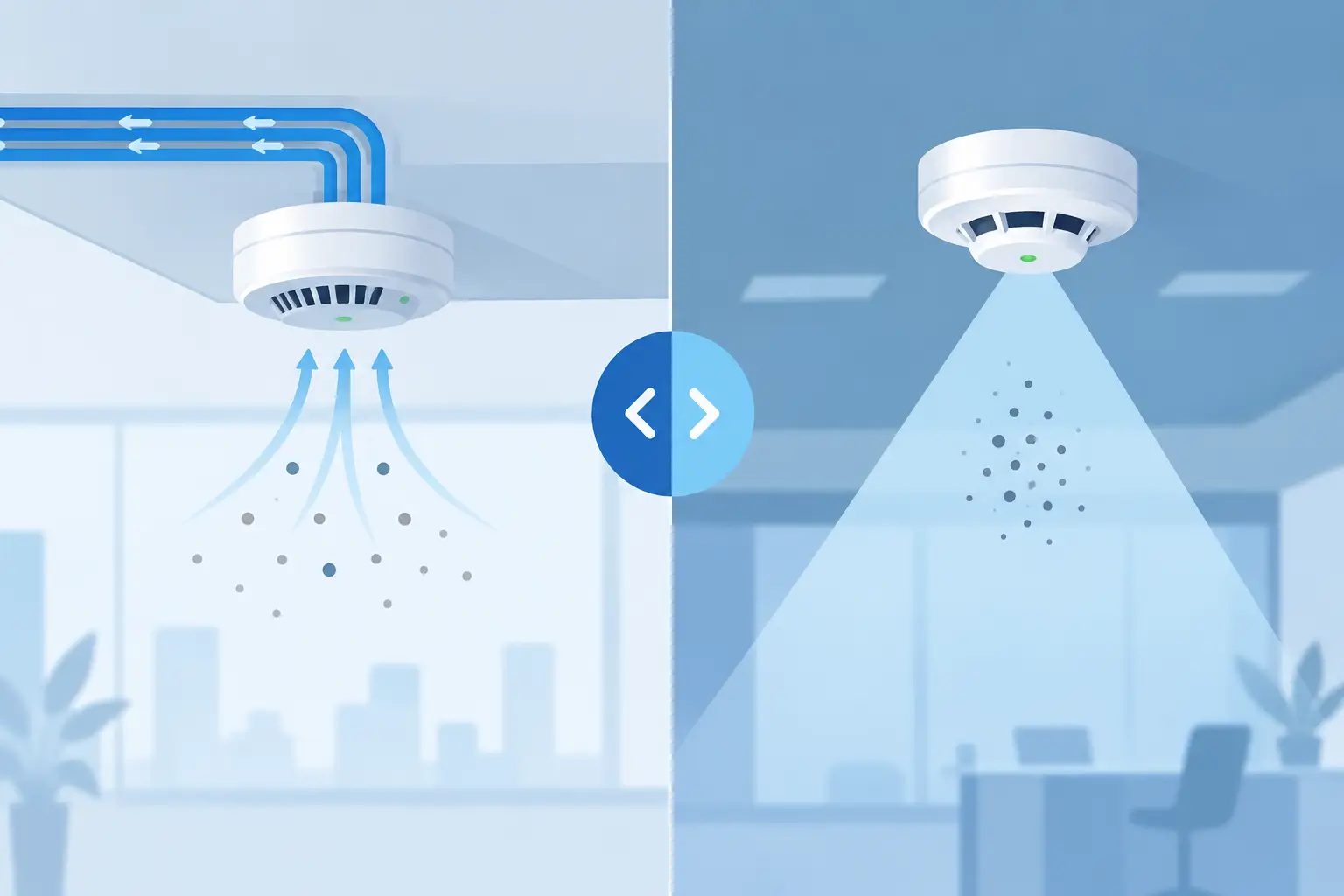
A fire in a server rack, electrical panel or production enclosure rarely starts as a dramatic event. It may begin as a minute rise in airborne particles, well before visible smoke reaches a ceiling-mounted detector. That is why the choice between aspirating versus point detection deserves proper engineering consideration wherever asset damage, operational interruption or a false alarm carries a high cost.
Both technologies have a valid place in commercial fire protection. The right choice depends on the risk, the room environment, the speed of response required and how the detection system will interact with alarms, shutdowns and automatic suppression. Treating either solution as a default can leave gaps in protection or add unnecessary complexity.
What point detection does well
Point detection is the familiar approach used across many commercial buildings. Individual automatic fire detectors, commonly optical smoke, heat or multi-sensor devices, are installed at calculated positions throughout a protected area. Each detector monitors the air immediately around it and signals the control panel when its alarm threshold is reached.
For conventional offices, circulation areas, stores and many plant rooms, point detection is a practical and cost-effective solution. Devices are readily visible, straightforward to access for inspection and replacement, and can be integrated into an addressable fire alarm system. A well-designed point detection layout can provide dependable life-safety warning and support the release logic for a fire-suppression system.
However, a point detector normally needs smoke or heat to travel to its location before it can respond. In rooms with high ceilings, strong air movement, cold aisles, extraction systems or contained equipment, this travel time may be significant. By the time a detector operates, a developing fire may have already produced damaging smoke contamination or caused equipment failure.
Point detectors can also be unsuitable in visually sensitive spaces, very dirty environments or inaccessible voids. They remain an effective answer in many applications, but their performance must be assessed against the behaviour of the specific fire risk rather than assumed from a standard ceiling plan.
Aspirating versus point detection in critical rooms
Aspirating smoke detection works differently. A network of small-bore sampling pipes draws air from defined locations back to a central detector unit. The detector continuously analyses the sampled air, often at sensitivity levels substantially higher than conventional point smoke detection.
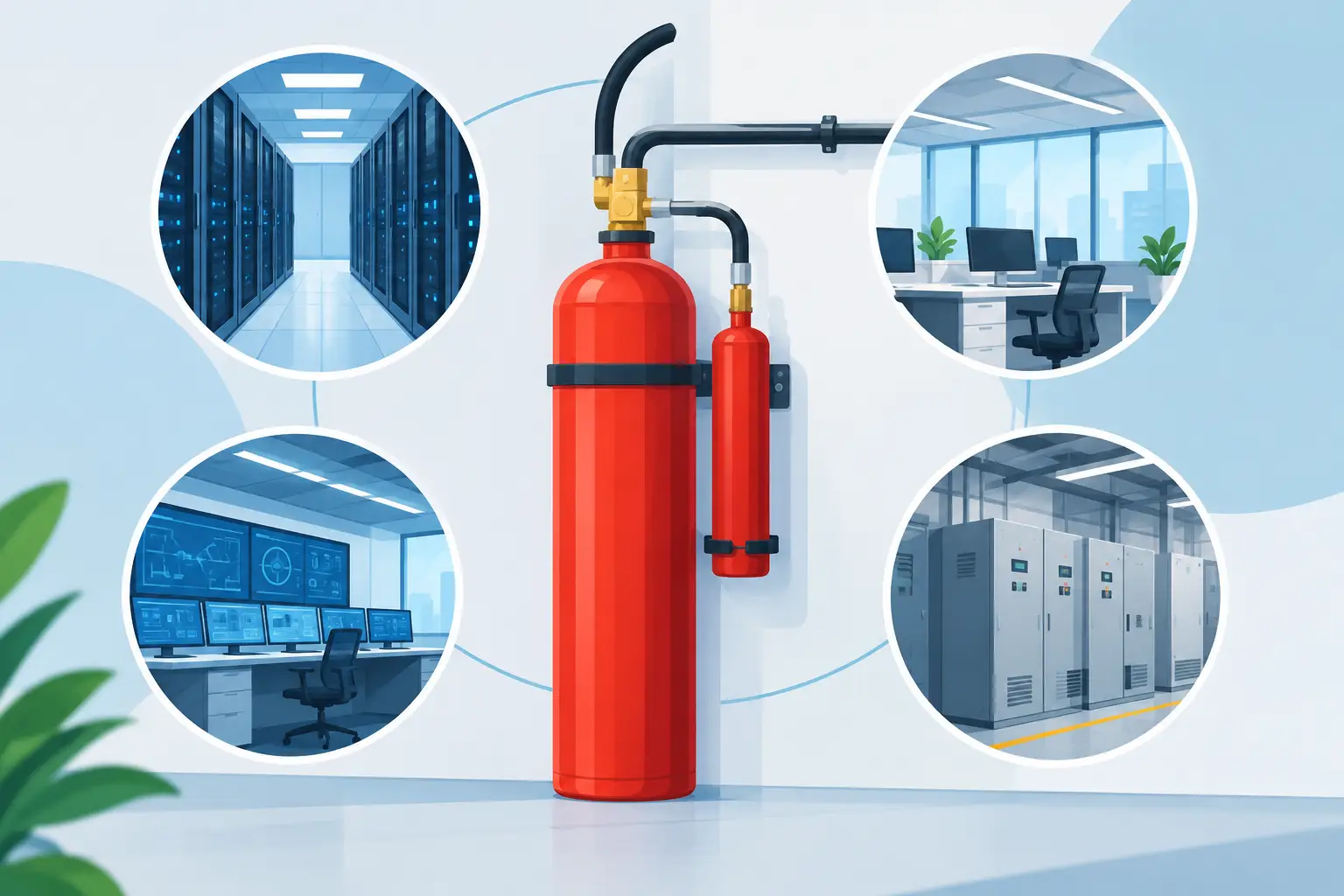
This makes aspirating detection particularly valuable where the earliest practical indication of incipient fire is needed. Data centres, communications rooms, control rooms, battery areas, electrical switchrooms, museums, clean environments and high-value manufacturing spaces are common examples. In these locations, the goal is often to investigate a developing fault before it becomes a fire event requiring discharge of a suppression agent.
Aspirating systems are widely associated with VESDA technology, although the underlying principle is broader than one manufacturer. Sampling points can be positioned close to likely ignition sources, inside equipment cabinets, in ceiling or floor voids, and within return-air paths. This gives the designer more control over where air is sampled than a ceiling-only detector arrangement.
The practical benefit is time. An early alert can allow a facilities or operations team to isolate a failing power supply, inspect a cabinet, stop a process or investigate overheating before smoke levels reach a higher alarm stage. For a business dependent on continuous computing, production or communications, this extra decision time can be more valuable than the detector technology itself.
That does not mean aspirating detection should automatically replace point detection. It is a more specialised system with design, installation and maintenance requirements that need to be understood from the outset.
Detection stages and suppression control
Aspirating detection can be configured with several alarm thresholds. A very early warning stage may prompt investigation, followed by action, fire and higher alarm levels as particle concentration rises. This staged approach is useful where the first objective is to protect continuity without causing avoidable disruption.
Where clean-agent, inert-gas or CO2 suppression is installed, release logic is especially important. Automatic discharge will usually require a carefully designed confirmed-fire condition, often using coincident detection or a combination of independent signals. A very sensitive aspirating pre-alarm should not, by itself, lead to agent discharge unless the risk assessment and system design specifically require it.
The detection system must therefore be considered alongside the suppression control panel, alarm devices, manual release stations, abort controls, ventilation shutdowns, damper operation and any equipment shutdown sequence. Detection and suppression are not separate purchases. They are one coordinated protection strategy.
Where aspirating detection has the advantage
Aspirating systems are often selected when smoke dilution, air movement or restricted access could delay conventional detection. Underfloor voids in data centres are a good example. Smoke from a cable fault may be carried by cooling air before it rises into the room, so sampling the void or return-air path can provide much earlier warning than relying on ceiling-mounted devices alone.
They are also useful in high-airflow rooms. Cooling systems can disperse smoke particles rapidly, making it harder for a localised plume to reach a point detector in predictable quantities. A properly designed aspirating pipe network can sample at locations informed by the airflow pattern, rather than depending solely on smoke rising naturally.
In dusty, cold or difficult-to-access spaces, the detector unit can be placed in a serviceable location while the pipework reaches the protected area. Filters, monitored airflow and suitable sampling arrangements can help maintain reliable operation, although they do not remove the need for planned maintenance.
Aspirating detection can also reduce the visual impact of detection in customer-facing interiors or heritage settings. Only discreet sampling points may be visible, while the central detector remains outside the protected room.
Where point detection is the better choice
For many commercial areas, point detection offers the correct balance of performance, simplicity and cost. A standard office, low-risk store, conventional plant room or corridor may not require the ultra-early warning provided by aspirating smoke detection. Installing a specialist system where a well-designed addressable point system meets the risk may add cost without materially improving resilience.
Point detection may also be more economical where a large number of rooms require ordinary fire alarm coverage, particularly if access is uncomplicated and environmental conditions are stable. Individual devices are familiar to building teams and are generally easier to expand during minor alterations.
There is also a useful middle ground. A site may use aspirating detection in its server rooms and electrical switchgear areas, while relying on point detection elsewhere. This targeted approach directs investment towards the spaces where early intervention has the strongest operational value.
Design factors that decide the outcome
The decision should begin with the consequences of a small fire, not the detector catalogue. Ask how quickly smoke needs to be identified to avoid service loss, whether the room has significant air movement, where a fire is most likely to begin and what happens after the first alarm.
For critical assets, the following factors normally shape the design:
- the nature of the combustible materials and likely ignition sources;
- ceiling height, airflow, containment, extraction and ventilation arrangements;
- voids, cabinets, ducts and other concealed spaces requiring coverage;
- the need for pre-alarm investigation before operational shutdown or suppression discharge;
- access for testing, cleaning and maintenance throughout the system life;
- relevant standards, insurer requirements and the performance criteria of the chosen suppression system.
In the UK, point and aspirating equipment should be selected and installed within an appropriate fire detection and alarm design framework, with consideration given to applicable British and European standards. Aspirating smoke detectors are commonly assessed to EN 54-20 classifications, while the complete design must still reflect the building, use, fire strategy and any suppression-system requirements. Certification of individual products is not a substitute for competent system engineering.
Maintenance is part of the decision
Neither method is fit-and-forget. Point detectors require periodic functional testing, inspection and cleaning where contamination is likely. Aspirating systems require verification of detector response, pipe integrity, airflow at sampling points, filters and any changes that affect the protected environment.
Aspirating pipework should be clearly documented and protected from accidental alteration during refurbishment. A blocked or damaged sampling point can compromise detection performance, just as a painted-over point detector can. Changes to cooling layouts, equipment cabinets, ceiling voids or ventilation should trigger a review of the detection design.
For suppression-protected rooms, maintenance visits should also confirm that the detection, releasing controls and interfaces remain aligned. The most technically capable detector provides limited value if an altered shutdown circuit, failed damper or untested release configuration prevents the wider system from performing as intended.
Choose warning time that matches the risk
The choice is not simply aspirating good, point detection basic. Point detection is a proven and appropriate solution for a wide range of premises. Aspirating detection provides a higher level of sensitivity and design flexibility where early warning can prevent costly downtime, equipment damage or unnecessary suppression discharge.
A risk-led survey will establish whether the priority is conventional fire alarm coverage, very early warning, confirmed fire detection for automatic suppression, or a combination of all three. Active Fire Suppression can assess the room conditions, operational consequences and agent-release requirements together, so the final system is designed to give people and critical operations the response time they genuinely need.

Leave A Comment
You must be logged in to post a comment.