

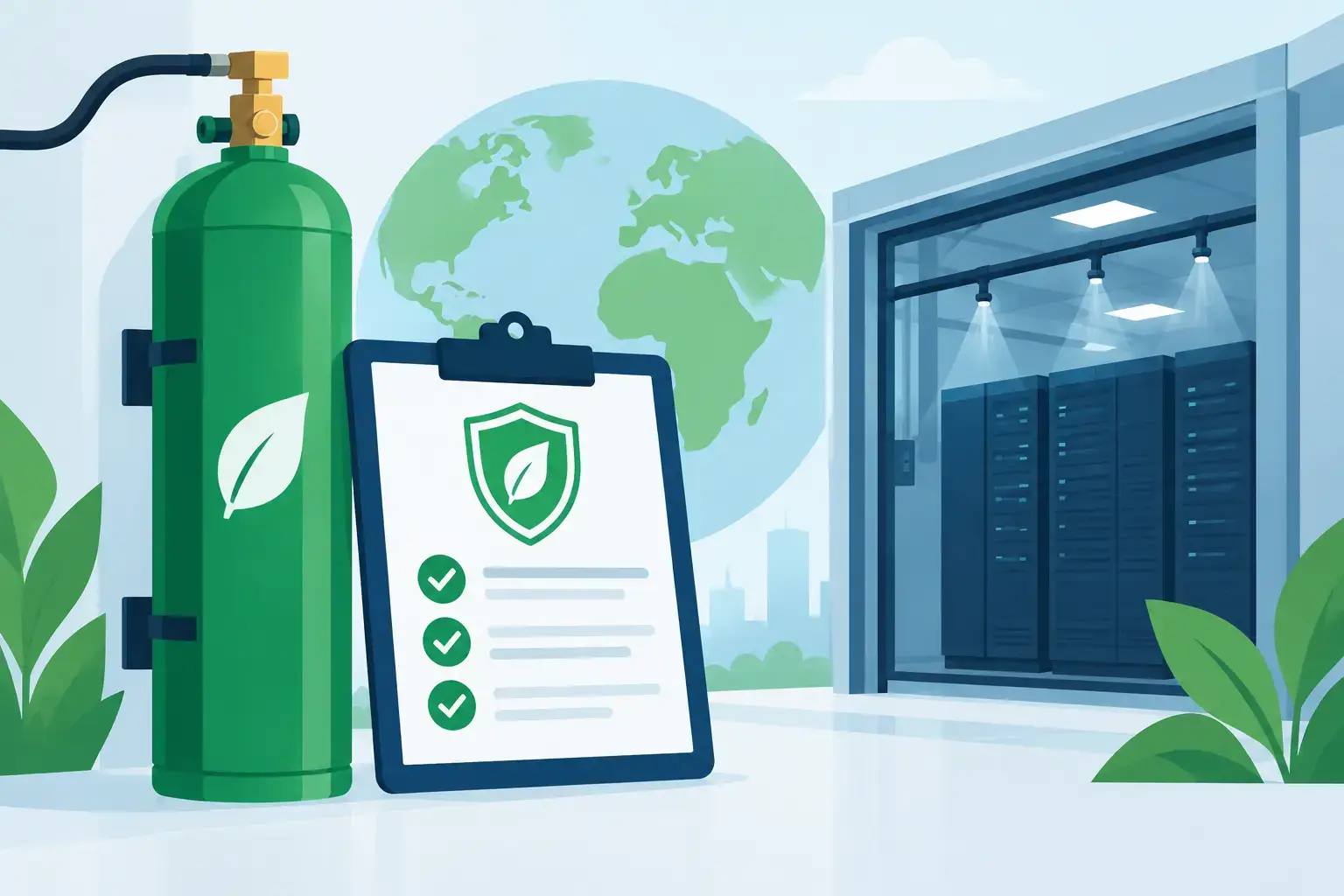
A gaseous fire-suppression system is often expected to sit quietly in the background for years, ready to protect a server room, control suite or critical process within seconds. That expectation makes future clean agent regulations a practical business issue, not simply an environmental-policy discussion. If an agent becomes difficult to source, restricted for new installations or less acceptable to an insurer, decisions cannot wait until a cylinder needs replacing.
For UK operators, the right response is not to remove a working system prematurely. It is to understand the regulatory direction, establish the remaining life and supportability of the existing installation, and make an informed plan for maintenance, upgrade or replacement. This protects continuity while avoiding a rushed specification decision later.
Why future clean agent regulations matter now
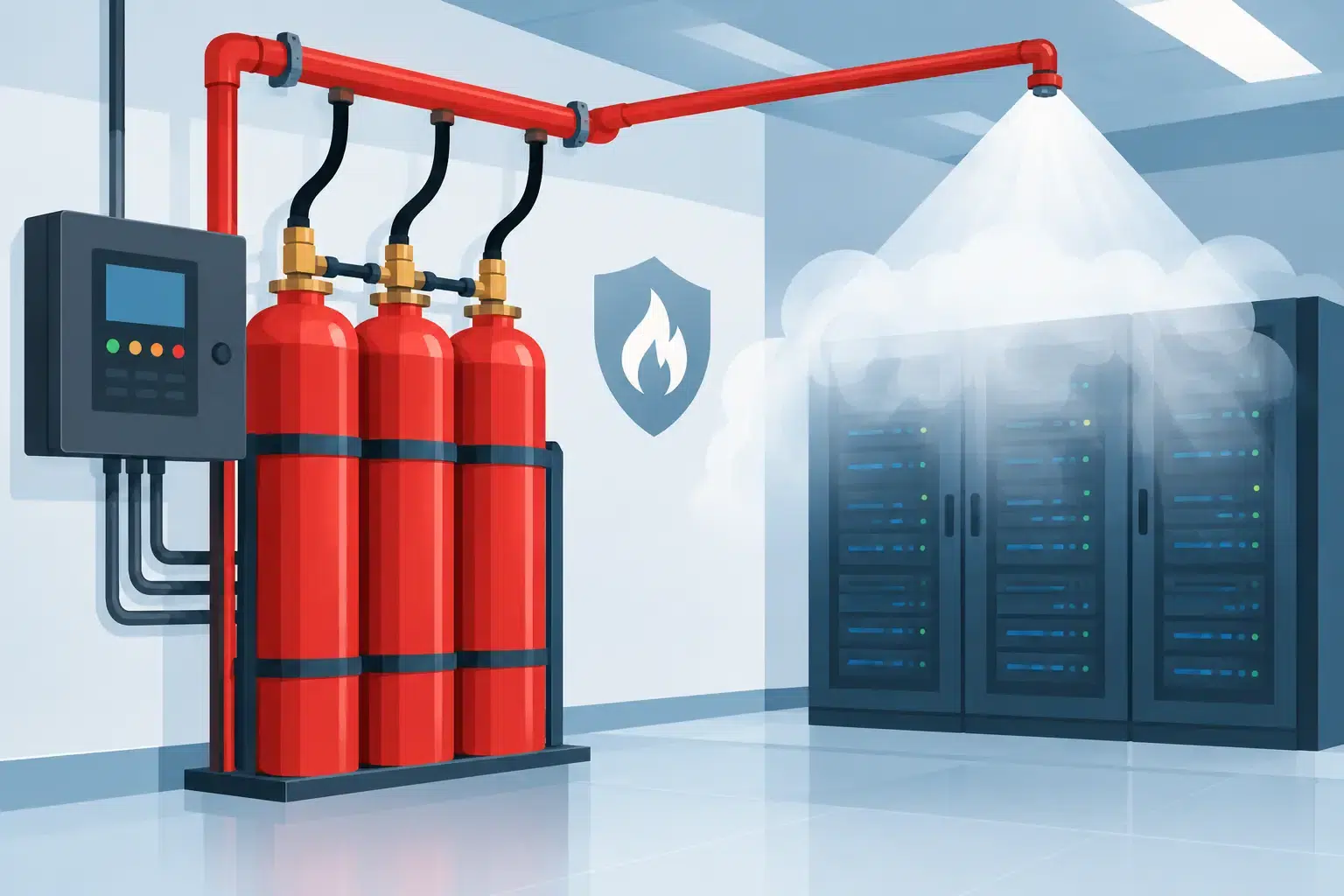
Clean agents are used where water damage could be as disruptive as the fire itself. They are common in data centres, server rooms, switch rooms, archives, laboratories, industrial control areas and other enclosures containing high-value or safety-critical equipment. A correctly designed system detects a developing fire, gives occupants time to evacuate and discharges an extinguishing agent before the incident causes extensive heat, smoke or water damage.
The regulatory pressure affecting these systems is mainly environmental. Fluorinated gases with high global warming potential are being progressively reduced under F-gas policy, while wider concern around PFAS chemistry is influencing product availability and future restrictions. These developments affect agent selection, long-term servicing arrangements, spare-cylinder strategy and the financial case for retaining an older installation.
The rules do not create a single deadline that applies identically to every protected room. Requirements depend on the agent, the application, the date of installation, the availability of alternatives and the detail of UK legislation as it develops. However, sites with HFC-based systems or installations reliant on fluorinated clean agents should be planning ahead rather than assuming that past choices will remain straightforward indefinitely.
The regulatory direction for clean agents
HFC agents face the clearest long-term pressure
HFC 227ea, often known as FM-200 or FE-227, has a long record in total-flooding fire suppression. It is effective, electrically non-conductive and suitable for many occupied spaces when designed within the required safety limits. Its challenge is environmental rather than firefighting performance: it has a high global warming potential.
UK F-gas requirements have historically mirrored much of the European direction, while UK policy and enforcement now operate separately from the EU following Brexit. The detail of future controls may therefore differ, but the overall trajectory is clear: the use of high-GWP fluorinated gases is under increasing scrutiny. New-system specifications are likely to face greater pressure to justify HFC selection where suitable alternatives exist.
That does not automatically mean an installed HFC 227ea system is unlawful or ineffective. A well-maintained system may remain an appropriate means of protecting a critical risk. The key question is whether the owner has a credible plan for agent availability, cylinder testing, recharge following discharge and eventual replacement.
FK-5-1-12 systems require a supply and policy review
FK-5-1-12, widely recognised through the Novec 1230 name, has been selected by many organisations because of its very low global warming potential and favourable characteristics for occupied spaces. It has offered an important alternative to high-GWP HFC agents.
However, fluorinated chemistries are also part of the wider PFAS debate. Restrictions proposed and discussed in Europe have increased uncertainty around the future use of certain fluorinated substances, and UK REACH develops through its own process. In addition, the withdrawal of branded Novec 1230 manufacture has made supply-chain planning more relevant for owners of existing systems.
This is an area where headlines can be misleading. PFAS policy is evolving, exemptions may be considered for essential uses, and a chemical classification does not by itself determine whether an installed system must be removed. Nevertheless, an organisation considering a new FK-5-1-12 installation should require clear information on the agent supply route, future maintenance support, available refill arrangements and the implications of any changing regulation.
Inert gas systems avoid fluorinated agent concerns
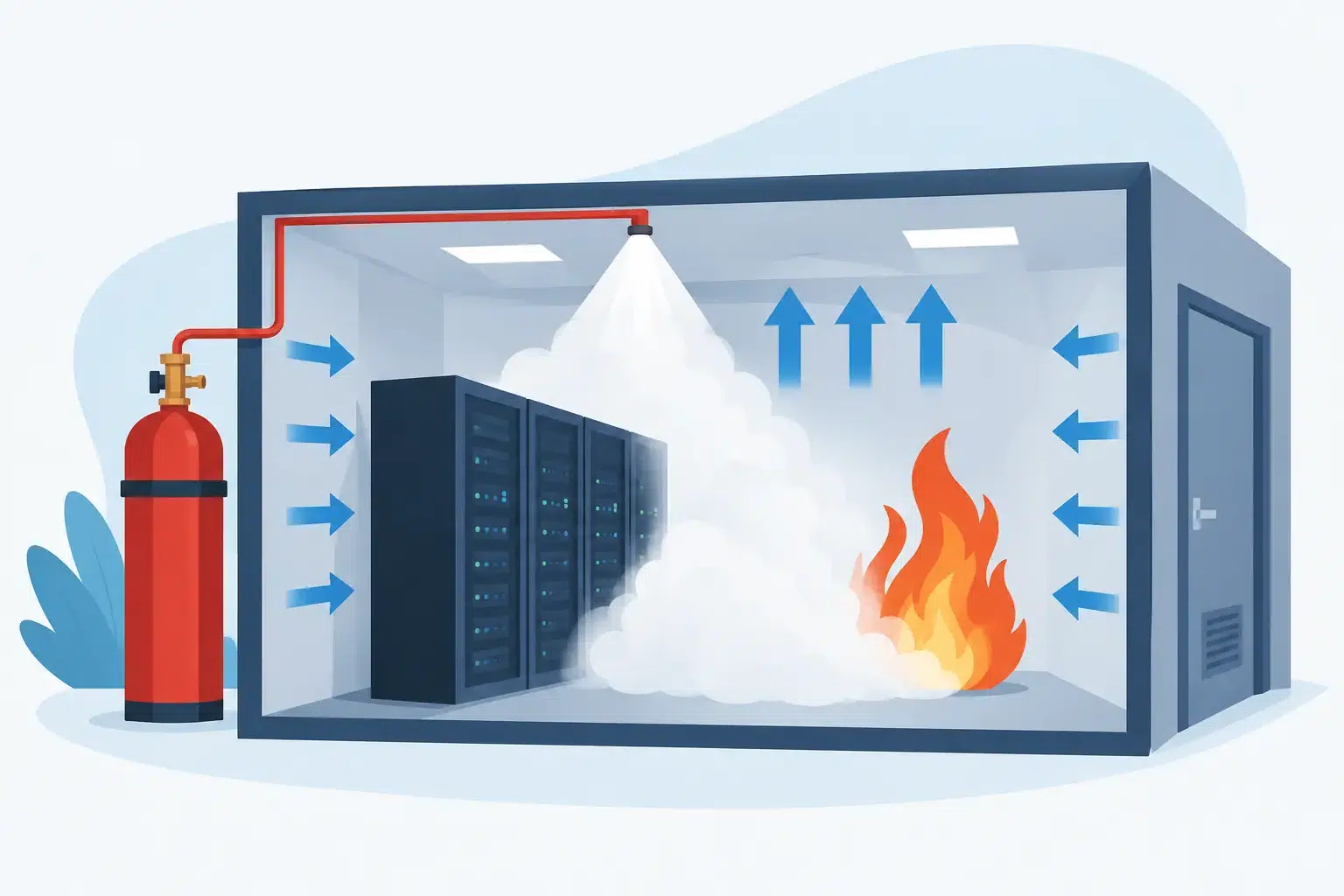
Inert gas systems use naturally occurring gases, including IG-55, IG-541, IG-01 and IG-100. They suppress fire primarily by reducing oxygen within a sealed enclosure to a concentration that prevents combustion while allowing people to evacuate safely under the designed conditions.
Their principal advantage in this regulatory landscape is that they do not rely on fluorinated extinguishing agents. For a new project with a long operating horizon, this can make inert gas an attractive option from an environmental-policy and supply-security perspective.
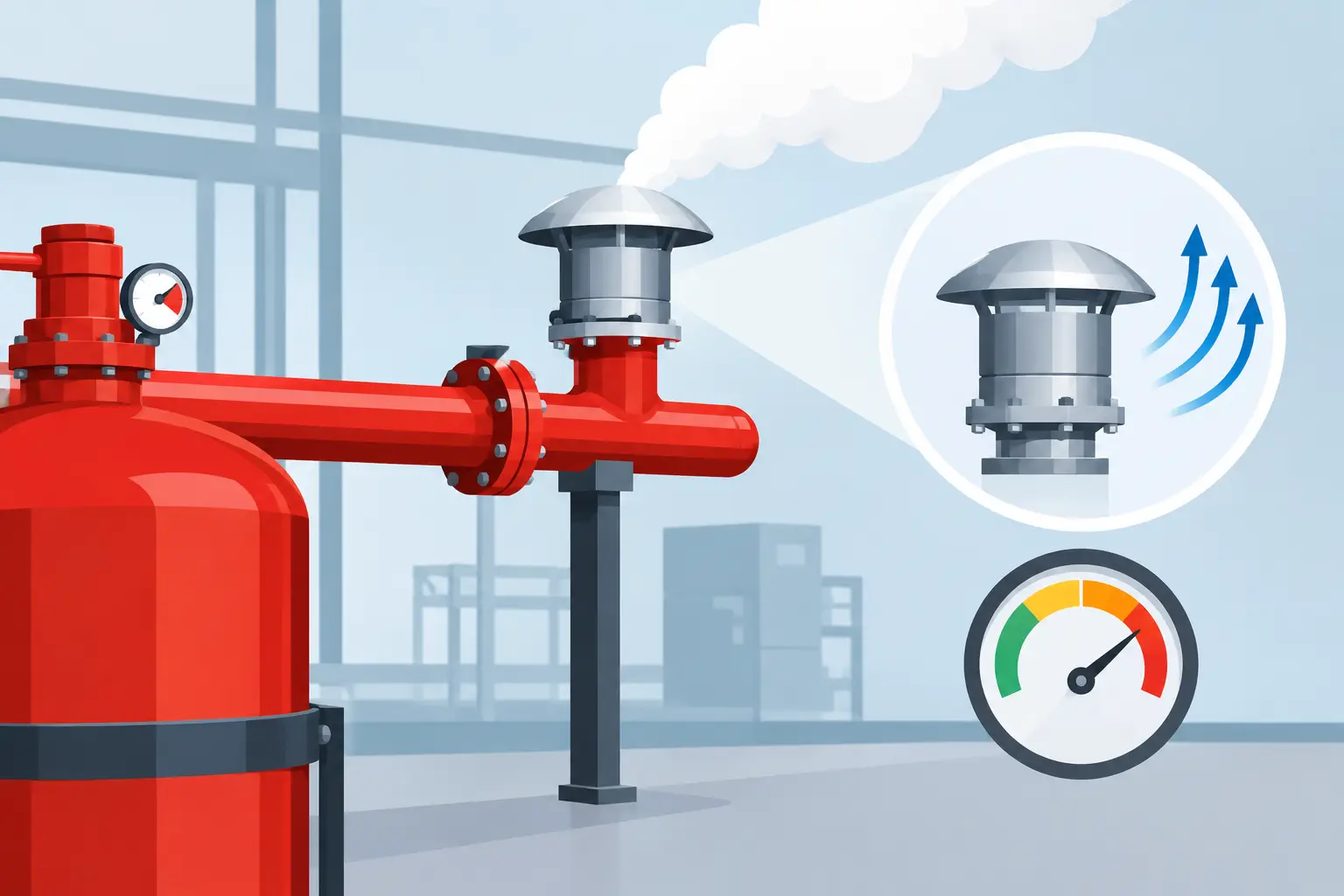
The trade-off is engineering. Inert gas systems require cylinder storage space, suitable distribution pipework, structural assessment and correctly sized pressure-relief venting. The protected room must also hold the required concentration for the specified duration. These are manageable requirements, but they must be considered early, particularly in constrained city-centre buildings, live data centres and retrofit projects.
What this means for existing suppression systems
A regulatory change does not remove the need to protect the risk. In fact, replacing a system without a proper transition plan can introduce more risk than retaining it temporarily under a controlled maintenance regime. Existing systems should be assessed on their condition, compliance status, agent supportability and suitability for the current use of the room.
Start by confirming exactly what is installed. The system documentation should identify the agent, cylinder quantities, design concentration, protected volume, detection interfaces, control panel configuration, pressure-relief provision and room-integrity test history. If the room layout, cable penetrations, air-conditioning arrangements or occupancy has changed since commissioning, the original design may no longer perform as intended.
Room integrity deserves particular attention. Total-flooding systems depend on the enclosure retaining extinguishing concentration for the required hold time. A system can have serviceable cylinders and control equipment yet fail to protect the room if leakage through raised floors, ceiling voids, dampers, doors or new penetrations has increased. Integrity testing and remedial sealing are central to reliable protection, irrespective of the agent chosen.
Owners should also ask whether they can obtain a like-for-like recharge after an accidental or genuine discharge. This is not only a procurement question. It affects business-continuity planning, insurance discussions and the time required to return a protected area to normal operation.
A practical response to future clean agent regulations
For most organisations, the sensible route is a staged review rather than an immediate wholesale replacement programme. A specialist assessment should bring together fire risk, asset criticality, room construction, occupancy, environmental policy and insurer expectations.
The review should establish four clear points:
- whether the installed system remains compliant, maintained and suitable for the current risk;
- how secure the agent, cylinder and spare-parts supply is over the expected life of the system;
- whether another agent would offer a better long-term fit for the site; and
- what work would be required to change agent without compromising protection during the transition.
This process often identifies options that are less disruptive than expected. In some rooms, an existing system can remain in service with improved integrity testing, documentation and a defined replacement horizon. In others, an upgrade to inert gas is commercially sensible when a cylinder replacement, room refurbishment or equipment refresh is already planned.
Designing a replacement system for the next decade
Agent selection should never be made on global warming potential alone. The fire hazard still comes first. A battery room, diesel-generator enclosure, electrical switch room, data hall and archive can each present different fuel loads, ignition sources, ventilation arrangements and recovery priorities.
The design also needs to consider whether the space is normally occupied, how quickly people can evacuate, whether the enclosure is sufficiently sealed, and whether the building can accommodate cylinders and pressure vents. For example, inert gas may be an excellent strategic choice for a new data-centre build with dedicated cylinder storage. A compact legacy communications room may require a different solution, particularly where structural alterations are limited.
A compliant design should be developed to the relevant standards, including BS EN 15004 and applicable fire-detection, control and installation requirements. It should include cause-and-effect programming, pre-discharge warning, manual release and abort arrangements where required, shutdowns for ventilation or equipment, pressure-relief calculations, room-integrity testing and a clear commissioning demonstration. These details determine whether the system performs safely when it is needed, not just whether it looks acceptable on a drawing.
Plan before a fault or discharge forces the issue
The most expensive replacement decisions are often made after an unexpected discharge, a failed cylinder test, a change in insurer requirements or a major room refurbishment. By then, time pressure can limit the available choices and leave operations exposed while work is completed.
A planned review gives facilities and engineering teams time to align suppression work with capital programmes, shutdown windows and IT or process changes. It also allows the existing system to be maintained properly until the new arrangement is commissioned and accepted.
Future clean agent regulations will continue to shape the market, but the operational objective remains constant: stop a fire early, protect people and preserve the systems the business relies upon. The most useful next step is a site-specific discussion that turns regulatory uncertainty into a practical, properly engineered protection plan.



Leave A Comment
You must be logged in to post a comment.