

A fire starting in a server rack, electrical switchroom or commercial kitchen can become a major business interruption before the Fire and Rescue Service arrives. The question of automatic suppression versus sprinklers is therefore not simply about how to put a fire out. It is about protecting people first, then limiting damage, preserving critical equipment and returning the operation to service with minimum delay.
Sprinklers remain one of the most effective and widely proven forms of building fire protection. Yet they are not automatically the right answer for every room, asset or process. Where water discharge could create severe secondary damage, or where a fire must be controlled within seconds, a designed special-hazard suppression system may offer a more suitable response.
Automatic suppression versus sprinklers: the practical distinction
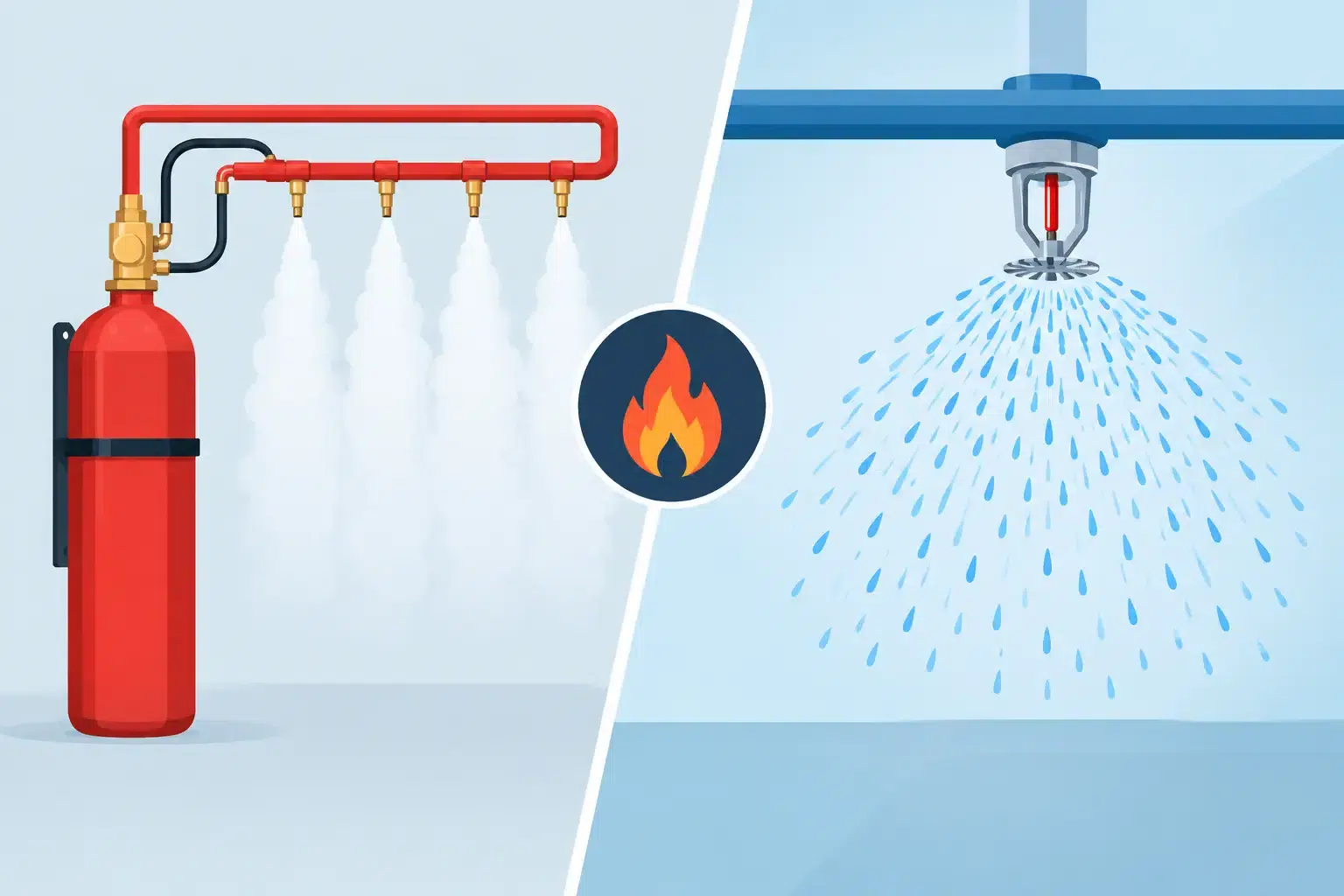
The comparison can be misleading because sprinklers are themselves automatic fire-suppression systems. A conventional sprinkler installation detects sufficient heat at an individual sprinkler head and releases water over the affected area. Its primary purpose is to control or suppress fire growth, support safe evacuation and reduce the likelihood of fire spreading through a building.
When organisations refer to automatic suppression separately from sprinklers, they usually mean dedicated systems for a defined hazard. These can use inert gas, clean agent, carbon dioxide, wet chemical or dry powder, selected to suit the room, fuel source, occupancy and operational consequences of a discharge. They are typically paired with early-warning detection, such as VESDA aspirating smoke detection, optical or multi-sensor detection, or flame detection.
The practical difference is response strategy. Sprinklers apply water where heat has activated a head. Special-hazard systems identify a developing event and discharge a calculated quantity of agent into a protected enclosure or directly onto a specific risk. Neither approach is universally superior. The right system follows a proper risk assessment and engineering design.
Where sprinklers are the stronger choice
Sprinklers are highly effective across warehouses, offices, hotels, retail premises, plant areas and many industrial environments. Their strengths are clear: they protect broad floor areas, operate without human intervention and use a readily available extinguishing medium. A sprinkler system does not usually discharge throughout the whole building. In most systems, only heads exposed to sufficient heat operate, which can greatly limit water use compared with the common image of every head activating at once.
For ordinary combustibles and larger open spaces, water is often an appropriate and economical suppression medium. A correctly designed installation can control a fire before it becomes unmanageable, limit structural damage and provide valuable time for occupants to escape.
There are, however, conditions that need careful consideration. Water may be unsuitable around energised electrical equipment, sensitive electronics, archive materials, certain chemicals or processes where contamination and clean-up would cause long downtime. A sprinkler system can save a building while still leaving a business with substantial recovery work. That is not a criticism of sprinklers – it is a recognition that building protection and asset continuity are not always identical objectives.
Sprinkler design also depends on the building arrangement, storage configuration, hazard classification, water supply and applicable standards. In the UK, this commonly involves design to BS EN 12845 or another relevant recognised standard, alongside insurer and approving-authority requirements.
When special-hazard suppression is a better fit
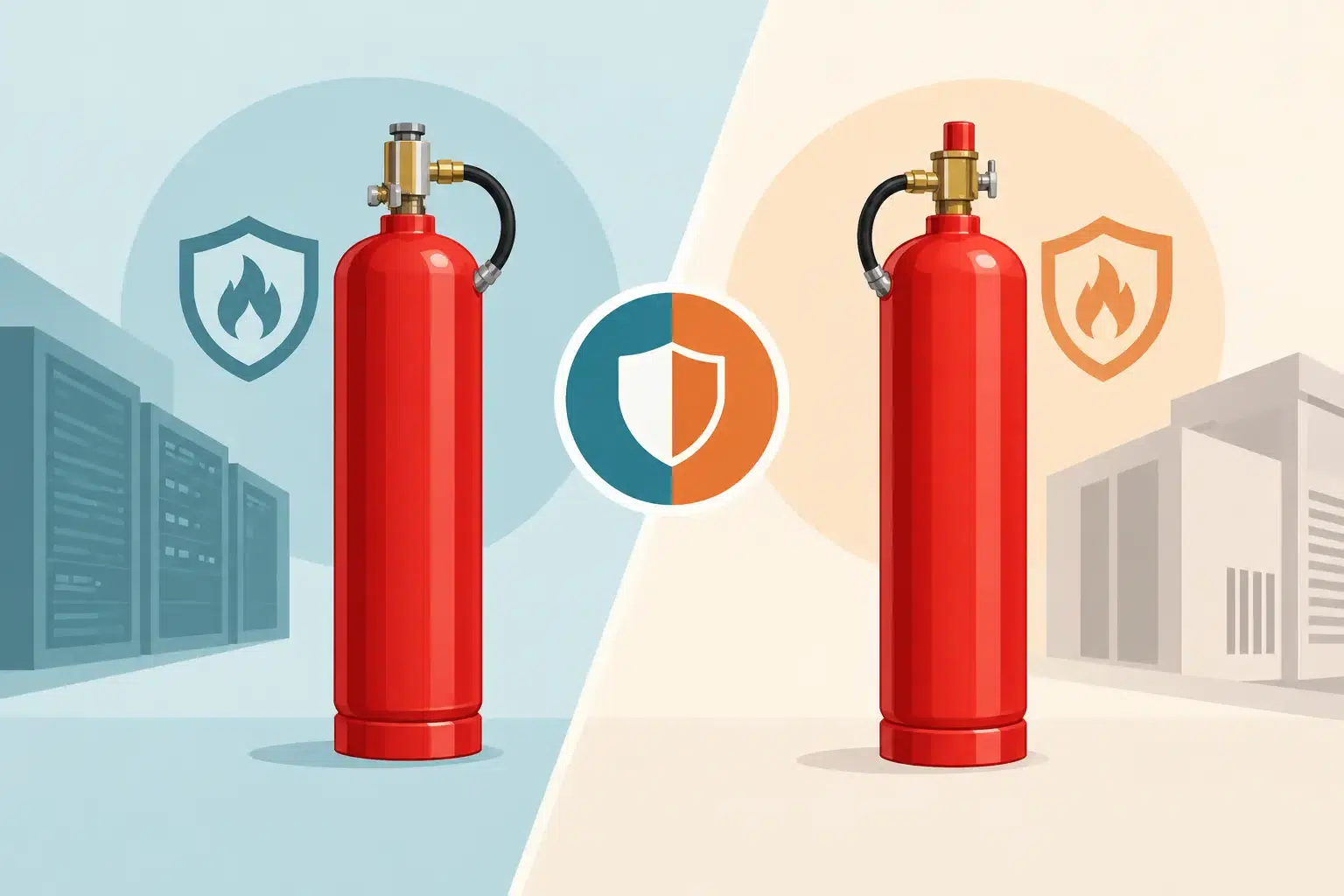
A special-hazard system is often considered where the protected space contains high-value equipment, supports a safety-critical process or cannot tolerate water damage. Data centres, server rooms, electrical switchrooms, control rooms, battery rooms, heritage stores, laboratories and industrial machinery enclosures are familiar examples.
Inert gas systems, including IG55, IG541, IG01, IG100 and INERGEN®, reduce the oxygen concentration in a sealed room to a level that will not sustain combustion while being designed for occupied spaces when applied correctly. They leave no residue, making them particularly suitable for electronics and clean environments. Their cylinders require space, and the enclosure must be sufficiently sound to retain the required concentration. Room-integrity testing and pressure-relief provision are therefore part of the engineering, not optional extras.
Clean-agent systems using Novec 1230 or HFC227ea, also known as FM200 or FE227, can provide fast extinguishing performance with no clean-up residue. They can be well suited to compact technical rooms where cylinder footprint, discharge time and equipment protection are key concerns. Agent selection must also account for environmental policy, current availability, regulatory position and the expected service life of the installation.
Carbon dioxide can be highly effective for certain unoccupied industrial hazards, including machinery spaces and process equipment. It presents a serious life-safety risk at extinguishing concentrations, so its use demands rigorous assessment, controls, warning arrangements, lock-off procedures and clearly managed access. It is not a casual substitute for a clean-agent or inert-gas system.
Wet-chemical suppression has a different role again. In commercial kitchens, it is designed around cooking oils and fats, applying agent to suppress flames and help prevent re-ignition while shutting down fuel or electrical supplies where appropriate. Dry powder systems may be specified for particular industrial risks but can create significant residue and clean-up requirements. The chosen agent must solve the actual fire risk rather than merely sound technically impressive.
Detection speed and enclosure performance matter
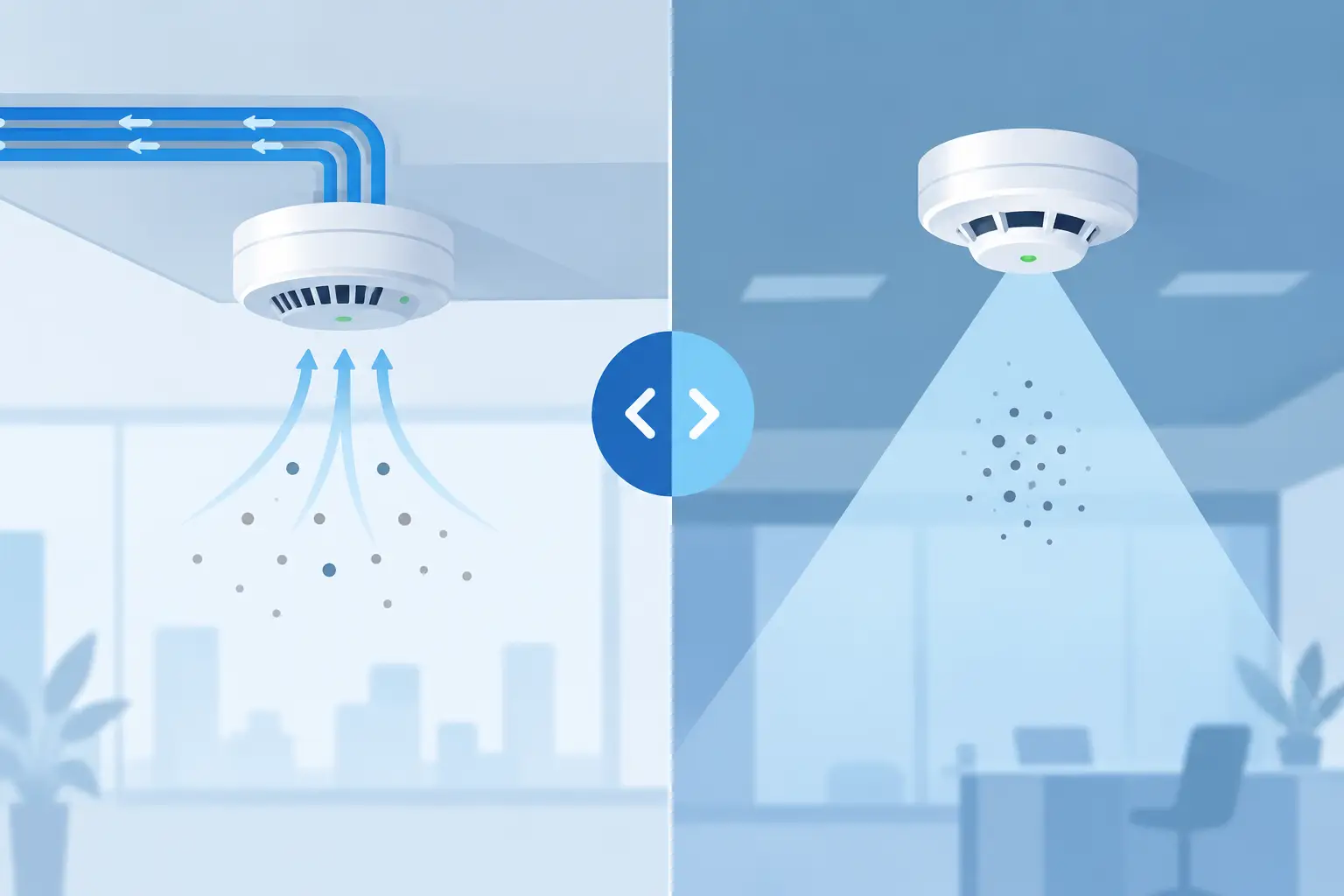
A sprinkler head operates in response to heat, which is reliable and purposeful but may occur after a fire has produced smoke. For a critical equipment room, the preferred intervention point may be much earlier. Aspirating smoke detection can identify minute combustion particles before visible flame or damaging heat develops, allowing investigation, alarm escalation and, where necessary, a controlled automatic discharge sequence.
That sequence must be designed around the people who use the space. A typical gaseous system may incorporate confirmed detection, audible and visual alarms, a time delay, manual release, abort controls and interfaces with ventilation, doors, dampers and power systems. The objective is not simply to discharge agent quickly. It is to ensure the enclosure is prepared, occupants can leave safely and the system acts predictably when every second matters.
Room integrity is a decisive issue for total-flooding gaseous systems. If the room has unsealed cable routes, open ceiling voids, poorly fitting doors or uncontrolled ventilation paths, the extinguishing concentration may not be retained for the required hold time. A system can be installed correctly yet fail to perform as intended if the room itself has not been assessed and tested.
Cost should include downtime, not just installation
Sprinklers will often have a lower cost per square metre for extensive building coverage. A specialist suppression system may involve detection controls, cylinders, pipework, nozzles, interface works, pressure vents and room sealing, making the initial project cost more concentrated. Comparing only capital cost can produce the wrong decision.
A better question is: what happens after a small fire? If a sprinkler controls a fire in a general storage area, water clean-up may be acceptable when weighed against the protection achieved. If water enters a live communications room or damages a production control panel, the recovery cost, lost trading time and reputational impact may far exceed the price difference between systems.
Maintenance should also be part of the decision from the start. Both sprinklers and special-hazard systems require planned inspection, testing and competent servicing. Gaseous systems also need attention to cylinder condition, control-panel functions, detection, enclosure changes and periodic integrity testing. Any refurbishment, new cable penetration or ventilation alteration can affect system performance.
A combined strategy is often the right answer
Many premises do not need an either-or decision. A building may have sprinklers for general areas and dedicated automatic suppression for its most critical rooms. For example, a data centre could use gaseous suppression in white space and electrical rooms while the wider building is sprinkler protected. A manufacturing site may protect production halls with sprinklers and specify local suppression for a high-value CNC machine, turbine enclosure or paint process.
This layered approach recognises that different hazards need different controls. Detection, compartmentation, fire stopping, emergency procedures, extinguishers and suppression all have a role. No suppression system removes the need for sound management of ignition sources, housekeeping and maintenance.
A capable specialist should review the fire load, equipment value, room geometry, ventilation, occupancy, insurer expectations and recovery target before recommending an agent. Active Fire Suppression can take that work from early risk discussion and design through installation, commissioning, demonstration, room-integrity testing and ongoing maintenance.
The useful starting point is not, “Which system is best?” It is, “What must this area still be able to do after a fire?” That answer will usually make the protection strategy much clearer.
Leave A Comment
You must be logged in to post a comment.