

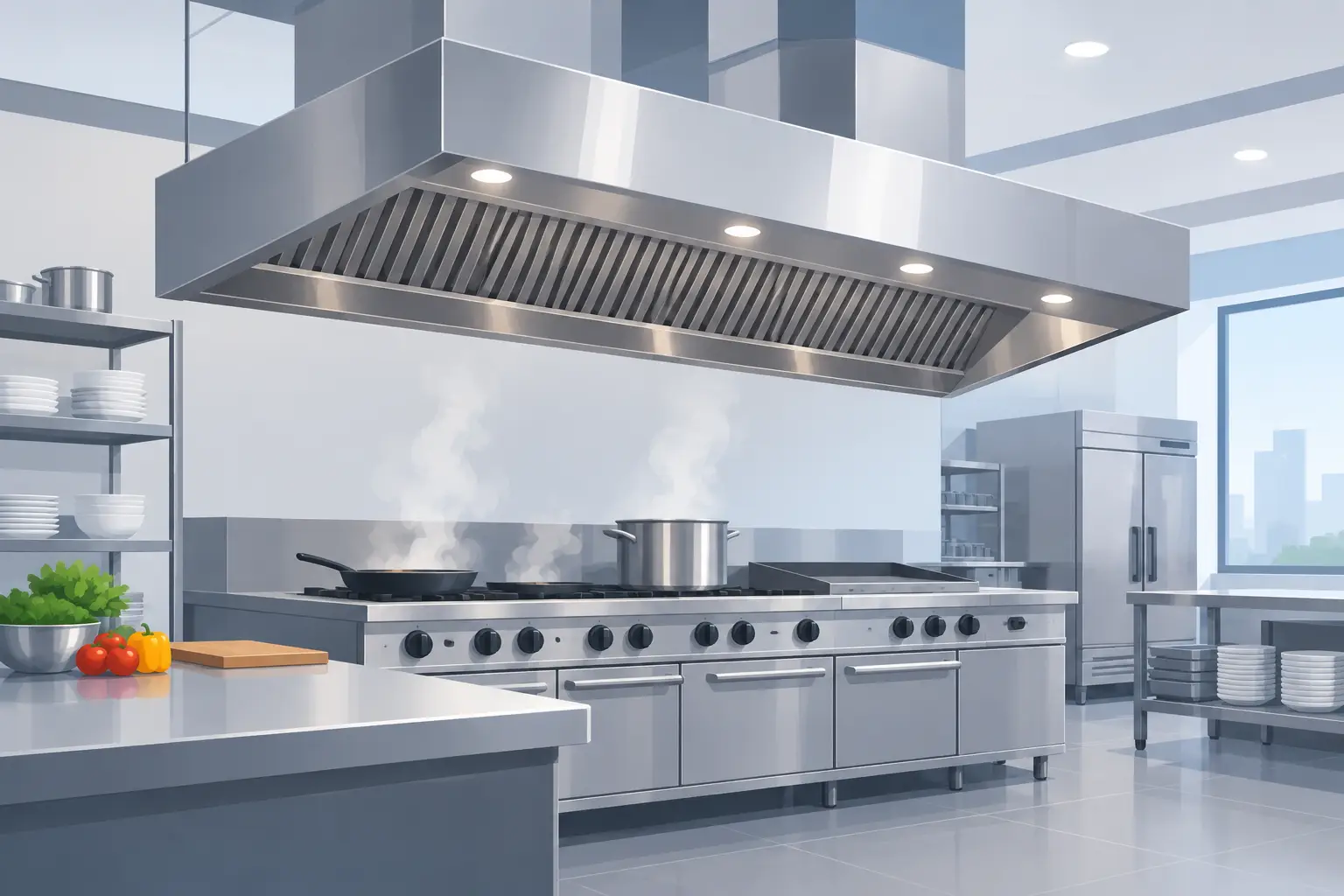
A commercial kitchen can produce a serious fire risk long before a visible flame reaches the room. Grease-laden vapours travel through the canopy, filters and ductwork with every service, creating a route for fire to spread above the cooking line. The best kitchen hood systems deal with that risk as a complete engineering problem: effective capture and extraction, suitable ductwork, automatic wet-chemical suppression and dependable isolation of fuel and electrical supplies.
For a restaurant, hotel, care setting or production kitchen, this is not simply a question of selecting a canopy that looks appropriate. The right system must suit the appliances below it, the cooking load, the building layout and the consequences of downtime. A poorly matched installation may clear heat inadequately, leave protected appliances outside a suppression zone or make ongoing cleaning and maintenance unnecessarily difficult.
What a commercial kitchen hood system needs to do
A kitchen hood system has two closely connected functions. First, it captures heat, steam, smoke and grease aerosols at source, preventing them from spreading into occupied areas and the building fabric. Second, where cooking equipment presents a grease-fire hazard, it supports a purpose-designed fire-suppression arrangement that acts automatically when manual firefighting is no longer safe or fast enough.
Extraction alone does not extinguish a deep-fat fryer, griddle or range fire. Equally, a suppression system cannot compensate for a canopy that does not capture contaminants effectively or ductwork that has been allowed to accumulate grease. Protection works when these elements are designed, installed and maintained as one coordinated system.
In practical terms, a well-considered installation should provide adequate hood overhang and capture, correctly sized airflow, filters suited to the duty, accessible ductwork for cleaning, and a fixed suppression system that protects the specific hazard. It should also shut down the relevant fuel or electrical supply on discharge, while allowing the safety controls needed for an orderly response.
Best kitchen hood systems start with the cooking risk
There is no single best arrangement for every commercial kitchen. A compact café kitchen with one electric griddle presents a different challenge from a hotel banqueting kitchen, a fish-and-chip operation or a high-output restaurant line using multiple fryers, chargrills and woks.
The design process should begin with the appliances, not a standard canopy size. The key questions are what is being cooked, which fuels are used, how much oil and fat are present, how intensively the equipment operates and whether the menu or layout may change. Charbroilers and solid-fuel cooking can generate particularly demanding grease and heat loads. Fryers require careful nozzle positioning because the extinguishing agent must be applied in a controlled way to the hot oil surface.
The hood must cover the actual hazard footprint. If equipment is moved, replaced or added after commissioning, protection can be compromised even though the suppression control panel still appears healthy. Any material change to the cooking line should trigger a review of extraction capacity, nozzle coverage, detector positions and fuel-isolation arrangements.
Canopy type and capture performance
Wall-mounted canopies are common where appliances sit against a rear wall. Island canopies can serve central cooking suites, but need particular attention because air movement around all sides can affect capture. Proximity or ventilated ceiling arrangements may be appropriate in some schemes, although they demand specialist assessment rather than assumption.
Canopy dimensions are not merely architectural details. The hood should extend beyond the appliances sufficiently to contain the thermal plume and grease vapour, while its mounting height must allow effective capture without obstructing kitchen operation. Excessive cross-draughts from doors, supply-air grilles or adjacent ventilation can pull contaminants beyond the canopy edge. This is a common reason why an otherwise capable extract system underperforms during busy service.
Airflow, make-up air and ductwork
High extract rates are not automatically better. If a kitchen extracts more air than the building can replace, doors become difficult to open, draughts increase and hood capture may become unstable. Properly introduced replacement air helps maintain balance without blowing across the cookline.
Ductwork must be suitable for grease-laden air, routed to permit cleaning access and installed with fire risk in mind. Long horizontal runs, inaccessible sections and poorly planned bends make grease management harder. The relevant requirements for commercial kitchen ventilation, including the BS EN 16282 series, should inform the design alongside building, local-authority and insurer expectations.
Filters are another practical consideration. They reduce grease entering the duct but do not eliminate the need for cleaning. They must be removable, durable and appropriate for the cooking duty. A filter arrangement that staff cannot easily remove and refit is unlikely to deliver its intended performance over time.
Why wet-chemical suppression is central to grease-fire protection
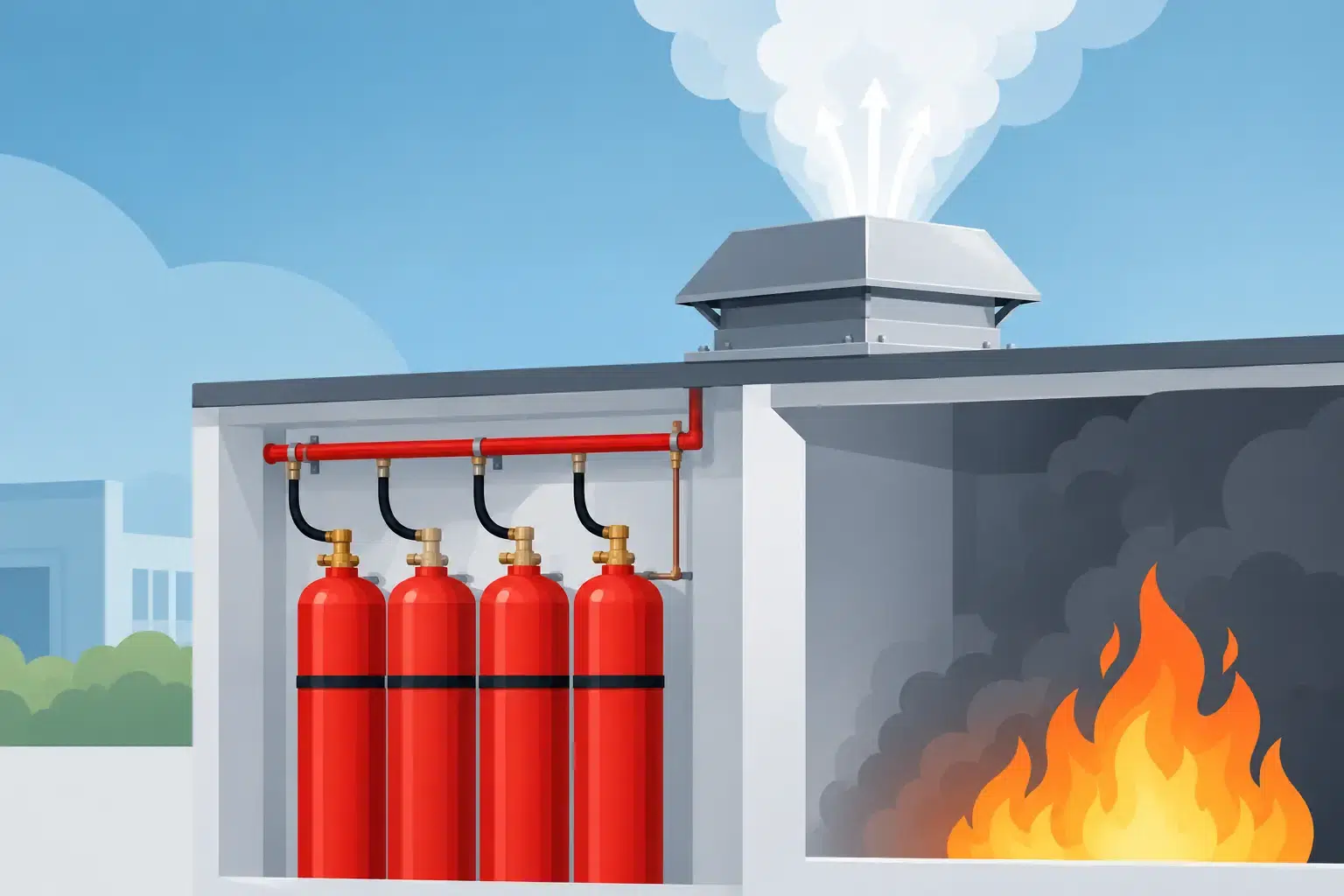
For commercial cooking hazards involving oils and fats, wet-chemical systems are widely used because their extinguishing action is suited to the fire class. On discharge, the agent is directed through fixed pipework and nozzles at the appliances and plenum area identified during design. It cools the burning surface and reacts with cooking oils to form a soap-like layer, helping suppress vapours and reduce the risk of re-ignition.
The system is normally initiated automatically by heat detection within the hood, with a manual release station provided for trained staff. Automatic operation matters because a kitchen fire can intensify quickly, particularly when it enters the hood or duct. Staff may be dealing with customers, evacuation or the immediate danger of heat and smoke. A fixed system should not rely on someone reaching a portable extinguisher at exactly the right moment.
Discharge must be coordinated with equipment shut-down. Continuing gas flow or electrical heating can defeat the suppression response and create a re-ignition risk. The installation should therefore be engineered to isolate the relevant fuel or power supply when the system operates, with the interfaces tested during commissioning.
Wet-chemical protection is not a substitute for the correct portable extinguishers, staff training or evacuation procedures. It is a layer of automatic intervention designed to control the fire at its source and limit damage before it affects the wider premises.
Design details that are often missed
The best kitchen hood systems are usually distinguished by the details that are not immediately visible. Nozzle caps must remain in place and clean, yet allow the agent to discharge correctly. Detection links or sensors need appropriate positioning, and the manual release must be accessible without requiring someone to reach through the hazard area.
System zoning deserves close attention in larger kitchens. One hood may cover distinct cooking banks with different fuel supplies and operating patterns. The suppression layout should make sense operationally, so that a discharge isolates the correct appliances and staff understand what has happened. Where there are several canopies, a staged or zoned approach may reduce unnecessary interruption, but only where this does not weaken life safety or fire performance.
Existing kitchens can be especially challenging. Ceiling voids, old ductwork, limited access and changes made by previous tenants often affect installation choices. A site survey should verify what is actually present rather than relying solely on drawings. It should also identify where cylinders, control equipment, pipework and interfaces can be installed and maintained safely.
Compliance, testing and maintenance are part of the system
A kitchen suppression system should be selected and installed against the applicable standards, manufacturer requirements and the project fire strategy. For fixed kitchen suppression, BS EN 16282-7 provides relevant guidance within the wider commercial kitchen ventilation standard series. Insurer requirements and the expectations of enforcing authorities may add further conditions, particularly where there is a high cooking load, sleeping accommodation or a significant business-continuity exposure.
Commissioning should demonstrate more than a control-panel indication. It should confirm detection operation, manual release, alarm interfaces, fuel or power shut-down, appliance coverage and the condition of pipework and nozzles. The responsible person should receive clear operating information and understand what must happen after a discharge, including isolation, clean-up, inspection and system reinstatement.
Maintenance is equally decisive. Grease deposits can obstruct filters and increase fire load. Kitchen alterations can invalidate the original nozzle layout. Components can be damaged by heat, cleaning activity or day-to-day work. Planned inspection, periodic servicing and professional duct cleaning should be treated as operational controls, not paperwork exercises.
A useful maintenance record will show when the system was inspected, what was tested, whether equipment beneath the hood has changed and when duct cleaning took place. This supports compliance, insurer discussions and, most importantly, a reliable response when the kitchen is at its busiest.
Selecting a system with continuity in mind
When comparing proposals, look beyond canopy appearance and initial cost. Ask whether the supplier has assessed the appliance schedule, cooking processes, duct route and air replacement strategy. Confirm what happens to gas and electrical supplies on discharge, how the system will be tested, and who takes responsibility for future maintenance and repairs.
The lowest-cost option can become expensive if it creates poor kitchen conditions, repeated false alarms, difficult cleaning access or a long closure after an incident. An engineered solution should balance capital cost with the likelihood of fire, the value of the operation and the time required to return safely to service.
For kitchens where interruption affects guests, residents, production schedules or contractual commitments, involving a specialist early makes the process more manageable. Active Fire Suppression can assess the specific cooking risk, coordinate wet-chemical protection with the hood arrangement and provide a clear route from design through commissioning and ongoing support.
The most useful next step is a site-based discussion around the appliances you operate, the way your team works and the downtime your business can realistically absorb. That is where a kitchen hood system becomes more than equipment above the cookline: it becomes a practical safeguard for people, premises and continuity.
Leave A Comment
You must be logged in to post a comment.