

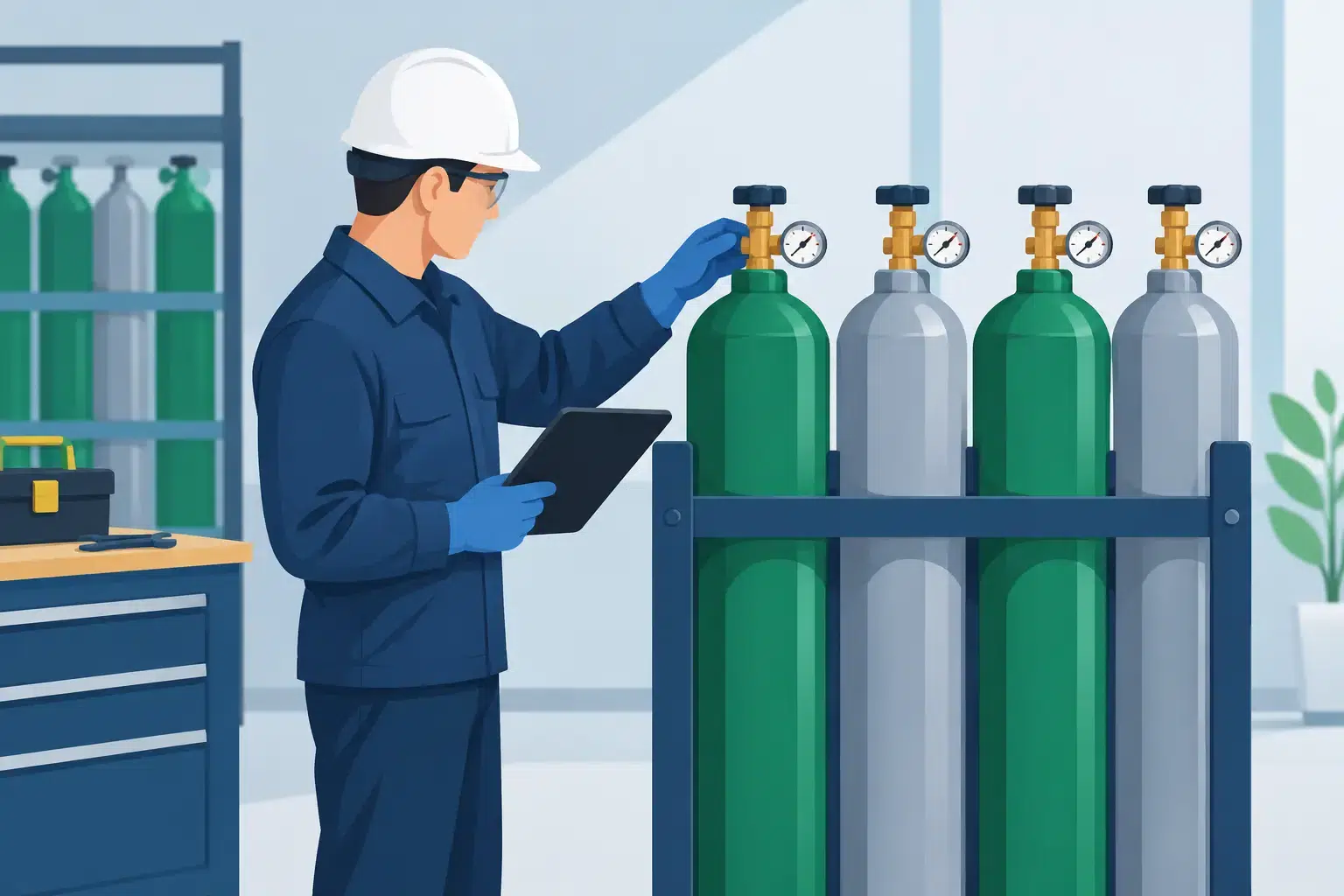
A cylinder bank can look unchanged for years while the room it protects, the controls around it and the conditions affecting it steadily change. That is why maintaining inert gas cylinders is not simply a matter of checking whether they remain in place. It is a planned engineering task that confirms the extinguishing agent will be available, released correctly and retained long enough to suppress a fire when critical assets are at risk.
For data centres, switch rooms, control rooms, manufacturing areas and other high-value environments, an inert gas system is installed to prevent a small fire becoming a major interruption. The cylinders are central to that outcome, but they are only one part of a coordinated system. Maintenance must consider the agent supply, pipework, release controls, detection interfaces, enclosure integrity and site operations together.
What inert gas cylinder maintenance is protecting
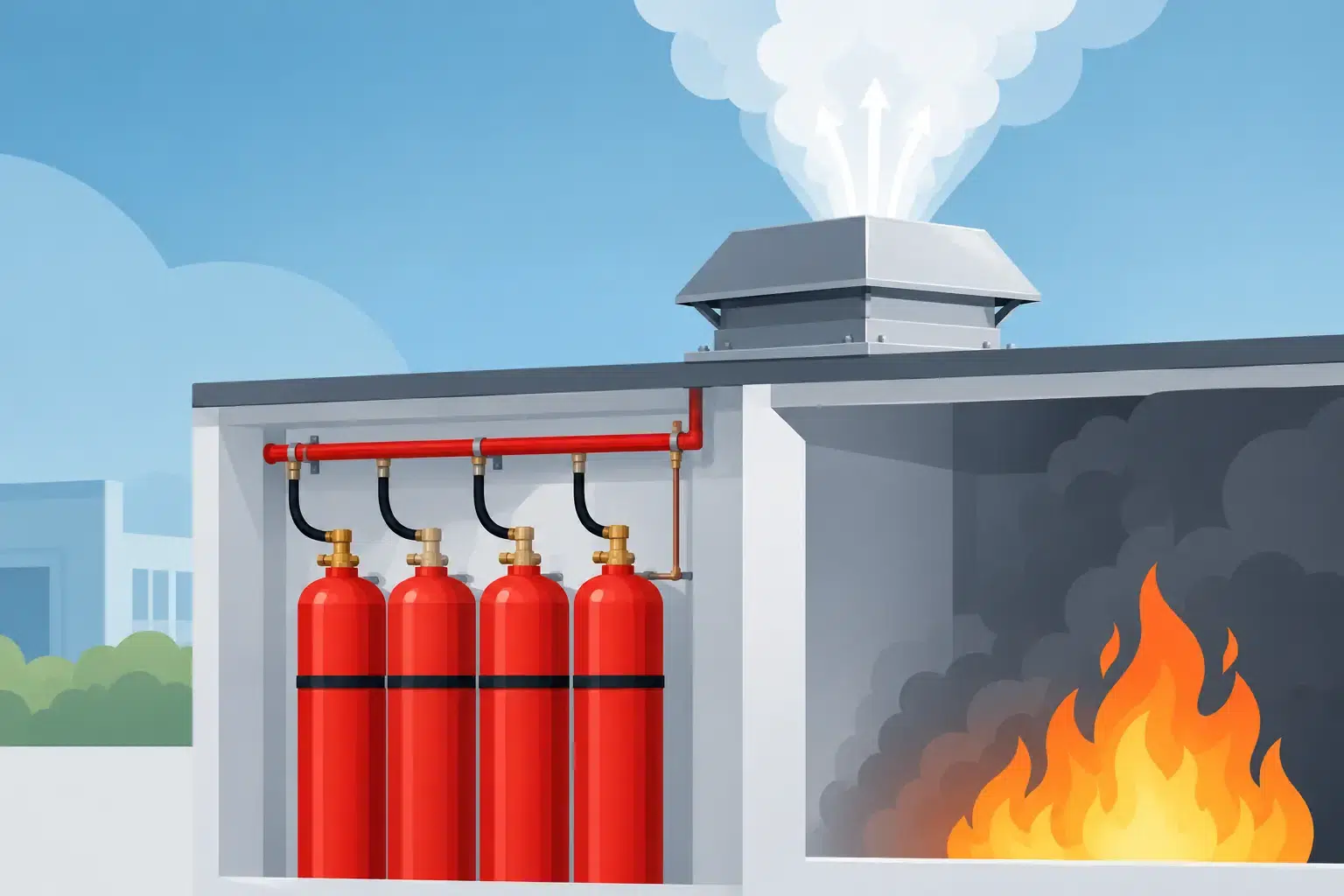
Inert gas agents such as IG55, IG541, IG01 and IG100 suppress fire by reducing the oxygen concentration within a protected enclosure to a level at which combustion cannot continue, while still allowing safe evacuation. They leave no residue, making them suitable where water, foam or powder would create unacceptable damage or recovery time.
The stored gas is held at high pressure. A loss of agent, a damaged valve, a disconnected actuation hose or an obstructed discharge route may mean the designed concentration is not achieved. Equally, a perfectly serviceable cylinder bank cannot compensate for a room that has been altered and no longer holds the agent. The practical objective is simple: the system must perform as designed, under the conditions now present on site.
This is also a life-safety matter. Inert gas systems require clear warning arrangements, appropriate lock-off and abort functions where specified, sound alarm interfaces and staff who understand what a pre-discharge warning means. Cylinder maintenance is therefore never isolated from the wider control and safety strategy.
Maintaining inert gas cylinders through planned inspections
A planned maintenance visit starts with a visual assessment of the cylinder bank and its surroundings. Cylinders should be accessible, correctly secured and protected from avoidable mechanical damage. The storage area should not have become a convenient place for stock, cleaning equipment or temporary building materials. Obstructed access delays inspection and can make emergency isolation difficult.
Engineers check for signs of corrosion, physical impact, unauthorised repainting, missing identification and compromised labels. They also inspect brackets, frames and restraints, particularly in plant rooms with vibration or frequent contractor activity. A cylinder that is secure on paper but loose at its mounting point is not acceptable in a pressurised life-safety installation.
Confirming agent quantity and pressure
The most critical check is whether each cylinder still contains the required usable quantity of extinguishing agent. Depending on the cylinder and manufacturer’s arrangements, this may involve reviewing pressure indications, checking supervisory devices and weighing cylinders where required. Pressure alone is not always enough to confirm content, particularly where temperature influences the reading or where the system design calls for a more direct verification method.
Readings should be assessed against the manufacturer’s tolerances and the approved system records, not against assumption. A cylinder that has fallen outside its permitted range needs investigation. It may indicate a leak, valve problem, prior discharge, accidental actuation or an issue with how the cylinder has been stored.
No one should attempt to top up, transfer or remove agent without the correct procedures, equipment and competence. Inert gas systems operate at substantial pressure, and poorly controlled work can introduce serious risk or leave the protected area impaired without anyone realising.
Checking valves, hoses and actuation equipment
The cylinder valve, discharge hose, manifold connections and pilot or electrical actuation components all require close attention. Maintenance should identify leakage, damage, corrosion, loose connections and evidence of tampering. Flexible hoses have a defined service life and must be replaced in line with the manufacturer’s requirements, even if they appear visually acceptable.
Electrical release circuits and pneumatic pilot lines must also be checked as part of the cylinder bank arrangement. A fault at this point can prevent a correctly charged system from discharging. Conversely, poorly managed work on controls can create an unwanted release risk. Competent maintenance includes safe isolation, verification of impairment and controlled reinstatement once testing is complete.
The cylinder bank is not the whole suppression system
A common weakness in maintenance planning is treating the cylinders as a standalone asset. In reality, the system’s discharge performance depends on every component between detection and the protected enclosure.
Detection and control panels need routine functional testing so that an alarm produces the correct sequence: warning, any required delays, shutdowns, release output and fault indication. Manual release and abort controls must be identifiable, functional and understood by authorised occupants. Audible and visual alarms must be sufficient for the location, including noisy plant areas or spaces with people working alone.
Pipework, nozzles and directional valves require inspection for damage, obstruction or alterations. Even minor room refurbishments can introduce a new partition, cable opening or suspended ceiling arrangement that changes the enclosure volume or discharge pattern. Any such change should trigger a review of the original system design rather than being left for the next annual visit.
Room integrity remains essential
An inert gas system needs the enclosure to retain its designed concentration for the required hold time. Open cable penetrations, unsealed pipe routes, damaged doors and changes to ventilation can all undermine that performance. A room-integrity test provides evidence of whether the enclosure can hold the agent as intended without a live discharge.
The frequency and need for retesting depends on the system design, applicable requirements and changes to the room. In practice, integrity should be reassessed whenever construction work, new services or operational alterations could affect leakage. It is usually far less disruptive to identify weak points through testing than to discover them after a fire.
Over-pressure venting must be considered alongside integrity. When gas discharges into a sealed room, pressure relief arrangements protect the enclosure structure. They must remain correctly sized, unobstructed and suitable for the room as it now exists.
Records turn inspections into assurance
A maintenance certificate is useful only when it reflects meaningful checks, recorded readings, defects and actions. Facilities teams should be able to establish the cylinder quantity and condition, the date of the most recent maintenance, outstanding remedial works, impairment history and the person responsible for returning the system to service.
This evidence supports internal governance, insurer discussions and audit requirements. More importantly, it prevents a known fault becoming an undocumented assumption. If a cylinder is removed for testing, refilling or service exchange, the site needs a clear plan for temporary protection and a confirmed reinstatement date.
A good maintenance partner will explain whether a defect needs immediate action, planned replacement or further investigation. Not every observation carries the same urgency. Surface marking on a cylinder cabinet may be cosmetic; a low cylinder content indication, impaired release circuit or inaccessible manual control is not. Prioritisation should be based on whether the system can still provide the intended protection.
Managing impairment without creating a bigger risk
Maintenance, refurbishment and contractor work can all impair a suppression system. The risk is highest when several changes happen at once: a room is opened up, detection is isolated, cylinders are being serviced and temporary equipment is introduced. A formal impairment process helps keep control of that situation.
Before work begins, identify what protection will be unavailable, who needs to know, whether the fire risk has changed and what compensatory measures are needed. This may include increased patrols, restricting hot works, pausing certain operations or arranging temporary detection. The system should be formally handed back only after the work is complete, faults are cleared and responsible site personnel understand its status.
Staff awareness matters here. Teams do not need to become suppression engineers, but they should know not to use cylinders as storage supports, isolate equipment without authority or conceal fault indications. They should also know how to report building changes that may affect a protected enclosure.
For organisations with high-value assets and little tolerance for downtime, the right question is not whether the cylinders passed a quick visual check. It is whether the complete inert gas system would still control a fire in the room as it operates today. Keeping that question at the centre of every inspection gives maintenance its real value: dependable protection when there is no time for a second attempt.

Leave A Comment
You must be logged in to post a comment.