

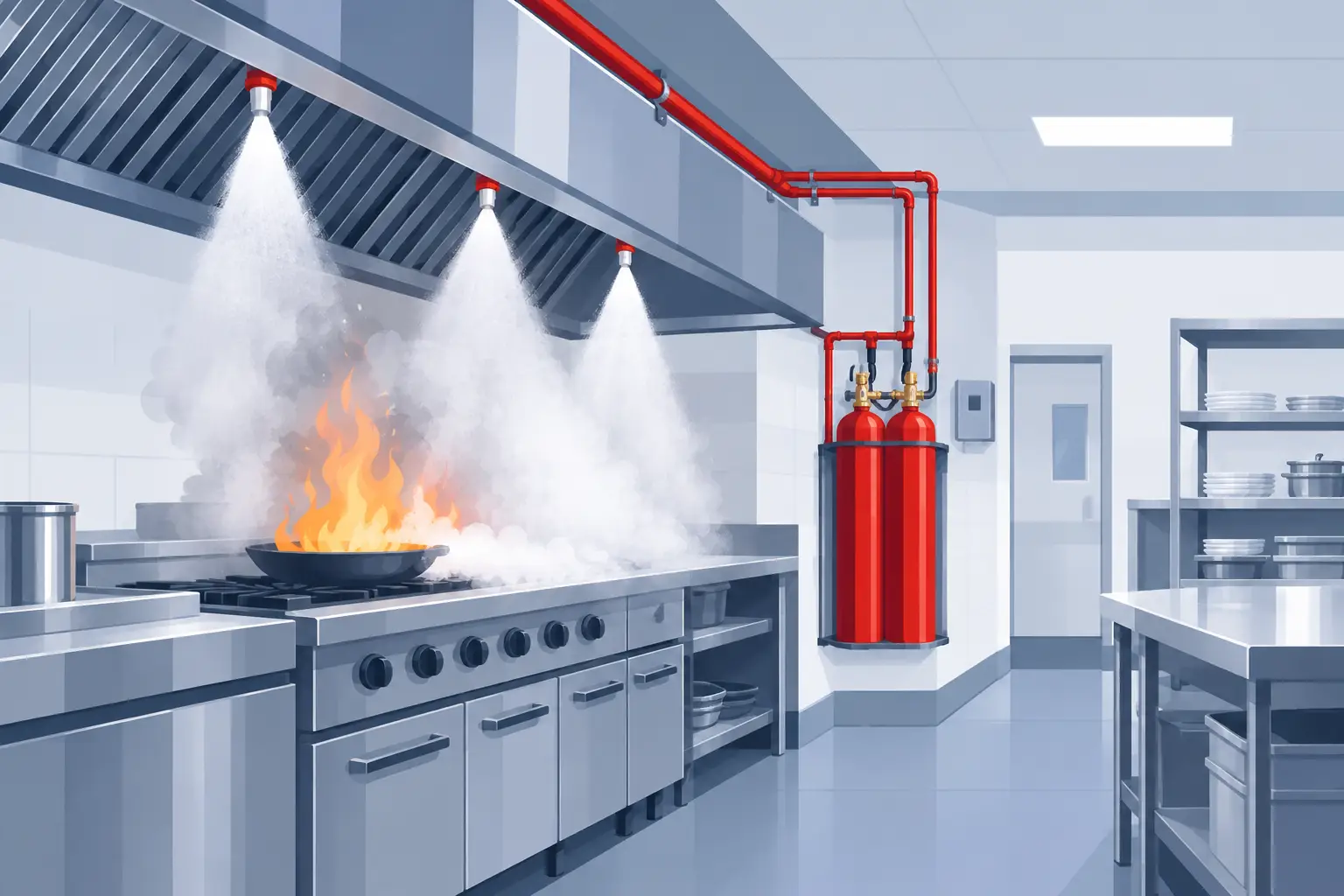
A fire in a commercial kitchen rarely stays confined to one appliance. Flames in a fryer, on a griddle or within a canopy can quickly involve grease deposits, ductwork and cooking equipment, forcing closure at the very point a restaurant, hotel or catering operation needs to trade. These kitchen suppression examples show how automatic wet-chemical protection is applied to real cooking risks and why the detail of the design matters.
What kitchen suppression is designed to do
Commercial kitchen suppression systems are purpose-built for cooking-oil and fat fires. Water alone is not a suitable first response to a burning fryer. It can spread burning oil and create a violent reaction. A wet-chemical system applies a measured agent directly to the hazard, cooling the fuel and forming a soap-like layer over the oil surface. This process, known as saponification, helps prevent re-ignition.
The system normally operates automatically when a heat-sensitive detection line reaches its design temperature. It can also be manually released. On operation, the system should shut down fuel or electrical supplies to relevant cooking equipment, while discharging agent through dedicated nozzles over appliances, plenum areas and, where required, the extract duct.
That sequence is vital. The objective is not simply to put out visible flames. It is to interrupt the conditions that allow fire to continue, restrict fire spread through the extract system and give staff and customers a safer route away from the area.
Kitchen suppression examples by cooking risk
A high-output fryer bank in a quick-service restaurant
Fryers are among the most common sources of severe kitchen fires because cooking oil operates at high temperature and can remain hot after power is isolated. In a busy quick-service restaurant, several adjacent fryers may sit beneath a single canopy, often alongside a griddle or range.
A suitable wet-chemical system would use appliance-specific nozzles positioned to discharge over each fryer vat. Detection is arranged across the canopy so that a fire is identified before it develops into a duct fire. On activation, the system isolates the electrical supply or fuel source to the protected equipment and releases agent across the oil surface.
The number of fryers is not the only design consideration. Vat dimensions, appliance arrangement, lid position, spacing beneath the canopy and the manufacturer-approved nozzle arrangement all affect coverage. Adding a new fryer later without reviewing the suppression layout can leave part of the risk inadequately protected.
A chargrill and solid-fuel cooking line
Chargrills create a different challenge. They generate high heat, airborne grease and frequent flare-ups, while solid-fuel appliances can retain heat long after the primary fuel supply is removed. The extraction canopy and ductwork may accumulate combustible grease more rapidly than in a lighter-use kitchen.
In this setting, the suppression design needs to protect the appliance and the canopy plenum, with careful attention to nozzle locations and detection coverage. A system may require a tailored shutdown arrangement, particularly where gas, electrical ignition and mechanical extraction controls are involved. Switching off the wrong element at the wrong time can affect smoke control, so the cause-and-effect sequence must be agreed as part of the design.
Operational controls remain essential. Regular extract cleaning, grease management and staff training reduce the likelihood of a fire. Automatic suppression provides the intervention needed when those controls are not enough.
A hotel kitchen with multiple cooking zones
A hotel kitchen may have a main cookline, breakfast station, banqueting equipment and separate preparation areas, each operating at different times. A single off-the-shelf arrangement rarely reflects that layout. One canopy may cover combi ovens and ranges, while another serves fryers used only for events.
This is a good example of why kitchen suppression is designed around hazards, not floor area. Each protected zone needs the right detection, nozzle count and shut-off interface. The system also needs to reflect how the kitchen is actually used. If the banqueting line is activated only on event days, its inspection and testing requirements do not disappear.
For hotel operators, the business impact goes beyond kitchen repair. A fire can affect guest safety, breakfast service, events, reputation and insurer confidence. Well-designed automatic suppression helps contain the incident before smoke and fire damage spread beyond the cooking line.
A school, hospital or workplace catering kitchen
Institutional kitchens often have predictable menus and managed staffing, but their risks can be no less significant. Large tilt pans, bratt pans, fryers and ranges can support high-volume meal production. In a hospital, kitchen downtime may affect patient services. In a school, it can disrupt meal provision for hundreds of pupils.
Suppression systems in these environments should be selected with practical maintenance in mind. Kitchen teams need clear manual-release access, staff must understand what happens after a discharge, and equipment isolation must be coordinated without compromising essential building systems. The design should also account for cleaning regimes and planned kitchen refurbishment, which can alter canopy layouts or introduce replacement appliances.
A production kitchen or food-manufacturing process
Some food-production operations use cooking processes that sit between a conventional commercial kitchen and industrial manufacturing. Frying lines, oil-heated kettles and specialist cooking equipment may operate for extended periods and use large volumes of oil.
These applications require a detailed hazard review. A standard kitchen wet-chemical system may be appropriate for canopy-protected appliances, but a larger process hazard may call for a different suppression approach, detection method or engineered control sequence. The right answer depends on the fuel, process temperature, enclosure, ventilation and consequences of unplanned shutdown.
This is where an early technical discussion is valuable. It helps separate a canopy fire risk from a wider process fire risk, ensuring neither is treated as an afterthought.
What a complete kitchen suppression design includes
The visible cylinder and pipework are only part of the system. Effective protection begins with a site survey that identifies every appliance under the canopy, its fuel source and its approved suppression nozzle arrangement. The design then considers detection routing, manual-release location, gas or electrical shut-off, alarm interfaces and duct protection.
The installation must be completed so that nozzles are protected from damage, pipework is secure and appliance changes can be managed properly. Following installation, commissioning verifies that the system has been fitted and configured in line with its design. Demonstration gives responsible staff a clear understanding of system operation, isolation arrangements and the steps to take after activation.
Relevant standards and manufacturer requirements should guide the work, including BS EN 16282-7 where applicable. Insurers may also set particular expectations around automatic extinguishing, duct cleaning, maintenance records and appliance shut-off. Compliance is not a paperwork exercise. It is evidence that the system remains capable of operating as intended.
Maintenance keeps protection available
Kitchen environments are demanding. Heat, grease, cleaning activity and routine equipment changes can all affect a suppression system. A nozzle cap knocked off during cleaning, an obstructed nozzle or a disconnected gas shut-off can undermine an otherwise sound installation.
Planned inspection and maintenance should therefore check the agent container, detection line, manual release, pipework, nozzles, mechanical links and electrical interfaces. The service visit should also identify changes to the cooking line. If an appliance has been moved, replaced or removed, the original suppression design may no longer match the risk.
For multi-site restaurant groups and hotel operators, consistent records matter. They help demonstrate to insurers, enforcing authorities and internal stakeholders that critical life-safety equipment is being managed rather than assumed to be ready.
Selecting the right example for your site
The best of these kitchen suppression examples is not necessarily the largest system. It is the one that provides approved coverage for the appliances and canopy in place, isolates the right fuel sources and can be maintained without disrupting the operation unnecessarily.
A practical assessment should start with the cooking equipment, extraction arrangement, operating hours, fire history, cleaning regime and business consequences of closure. Active Fire Suppression can take responsibility from initial risk discussion and design through installation, commissioning, testing and ongoing maintenance, helping operators protect their kitchen without leaving critical coordination between multiple contractors.
If your cooking line has changed, your extraction canopy has been upgraded or your current system has an uncertain service history, treating it as a design review rather than a simple maintenance task is often the safest next step.
Leave A Comment
You must be logged in to post a comment.