

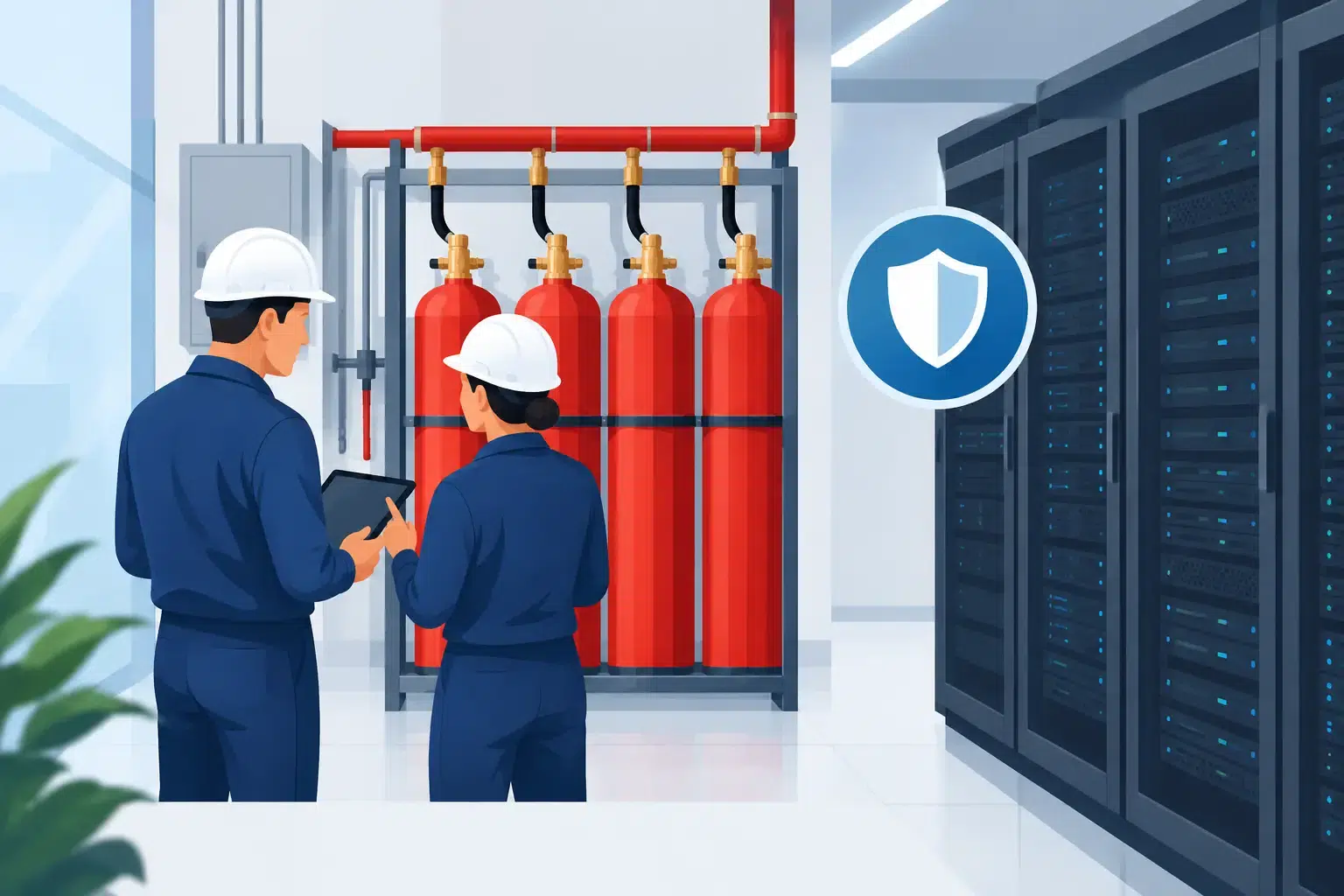
A server-room fire rarely begins as a dramatic event. It may start with a failing power supply, overheated cable or fault within a UPS, then develop into smoke contamination, equipment loss and an extended service outage. FM200 installers should be selected for their ability to engineer a complete, tested suppression solution around that operational risk, not simply fit cylinders and pipework.
FM200, also known as HFC227ea or FE227, is a clean-agent extinguishant commonly used where water damage would be unacceptable. It can suppress fire quickly without leaving residue, helping to protect IT hardware, electrical switchgear, control rooms and other valuable equipment. The result, however, depends on correct design, room integrity, detection and commissioning.
What competent FM200 installers should deliver
An FM200 system is an engineered life-safety installation. Each element has to work together during the short period between fire detection and discharge. A contractor should therefore take responsibility for the project from the first site discussion through installation, testing, handover and ongoing maintenance.
The process begins with understanding the room and its purpose. A data centre, for example, may have raised floors, ceiling voids, cable penetrations, air-conditioning plant and occupied working areas. A switch room may have different fire loading, enclosure volume and pressure-relief needs. These details determine whether FM200 is appropriate and, if it is, how the system must be configured.
A properly developed proposal should address the protected enclosure, the fire hazards within it, expected occupancy, business-continuity priorities and insurer or client requirements. It should also consider practical site constraints, including access for installation, cylinder location, shutdown interfaces and the effect of a discharge on connected ventilation systems.
The design should be produced in line with the relevant system approvals and applicable standards, commonly including BS EN 15004 for gaseous fire-extinguishing systems. The precise specification will depend on the agent, equipment manufacturer and site conditions. Good installers will explain the basis of the design in practical terms rather than treating the calculation as a black box.
Design is more than an agent quantity calculation
The quantity of FM200 required is calculated from the enclosure volume, the required design concentration, temperature and other system variables. But achieving the right concentration on paper is only one part of the job. The protected space must retain that concentration long enough for the fire to be controlled.
Unsealed penetrations around cable trays, pipes and ductwork can allow extinguishant to escape. Doors that do not close correctly, gaps beneath raised floors and unprotected ceiling voids can create the same problem. If these areas form part of the risk, they must be included in the enclosure strategy or addressed through appropriate sealing and detection.
This is why room-integrity testing matters. Often referred to as a door-fan test, it assesses whether the enclosure can retain the agent for the required hold time without carrying out a live discharge. It provides meaningful evidence that the physical room supports the suppression design. Where a test identifies leakage, remedial sealing work should be completed and the room retested.
Pressure relief is another issue that should not be overlooked. Releasing a gaseous agent can create pressure changes within a sealed enclosure. Where calculations show it is necessary, an over-pressure vent protects the structural integrity of the room while allowing the system to perform as intended. This is particularly relevant in lightweight partitions and tightly sealed technical spaces.
Detection, controls and shutdowns must be coordinated
Automatic suppression is only as effective as the detection and control logic behind it. FM200 systems commonly use automatic fire detection with a confirmed alarm arrangement before discharge, reducing the risk of an unwanted release from a single detector event. The final cause-and-effect sequence should suit the building, the risk and the people who use the space.
Depending on the application, this can include audible and visual warnings, time delays, manual release points, abort controls, remote alarm signalling, damper closure and shutdown of air-handling equipment. In a critical IT environment, controls may also interface with equipment shutdown procedures and a building management system.
These interfaces need early coordination with electrical, mechanical and fire-alarm contractors. A suppression contractor that becomes involved only after ceilings are closed and services are live may be forced into compromises that could have been avoided during design. For refurbishment work, a thorough survey is especially valuable because existing drawings do not always reflect the room as built.
Questions to ask FM200 installers before appointment
Price matters, but a low initial figure can hide omissions that become costly later. When comparing FM200 installers, ask who is responsible for the complete technical scope. That includes calculations, pipework and nozzle layout, detection interfaces, sealing requirements, pressure relief, integrity testing, commissioning and documentation.
It is also sensible to ask how the contractor will manage disruption. In live data rooms, control areas and production facilities, installation work may need to be phased around restricted access, outage windows and permit-to-work controls. Cylinder delivery, pipe installation, detector changes and functional testing should all be planned with the site team.
Competence should be evidenced through relevant manufacturer approvals, third-party certification where applicable, trained engineers and a record of comparable installations. Experience with gaseous suppression is significant because the work combines mechanical installation, electrical controls, fire detection and enclosure performance. General fire-alarm experience alone does not necessarily demonstrate that capability.
A clear proposal will state what is included, the assumptions made and any actions required from the client or principal contractor. For example, responsibility for builders’ works, fire stopping, electrical supplies or ventilation modifications should be agreed before work starts. Clarity at this stage protects the programme and avoids uncertainty at handover.
Commissioning proves that the system is ready
Commissioning is not a paperwork exercise. It is the point at which the installed system is checked against the approved design and its operation is demonstrated safely. The process should include verification of cylinder contents and pressure, pipework and nozzle installation, detection circuits, control-panel functions, warning devices, interfaces, manual controls and fault monitoring.
The team should also confirm that the room has passed integrity testing, that signage is in place and that relevant staff understand alarms, evacuation procedures and system controls. A discharge demonstration may be appropriate in some circumstances, although the method must be selected carefully to avoid unnecessary disruption or agent release.
At completion, the site should receive clear operating and maintenance information, design and calculation records, test results, cause-and-effect details and certificates relevant to the installation. These documents are useful for facilities teams, auditors, insurers and future contractors. More importantly, they provide a baseline for maintaining the system correctly over its life.
Maintenance protects the investment after handover
An FM200 installation is not fit-and-forget infrastructure. Room layouts change, cables are added, doors are replaced and ventilation arrangements are altered. Any of these changes can affect room integrity or the system’s ability to deliver the designed concentration.
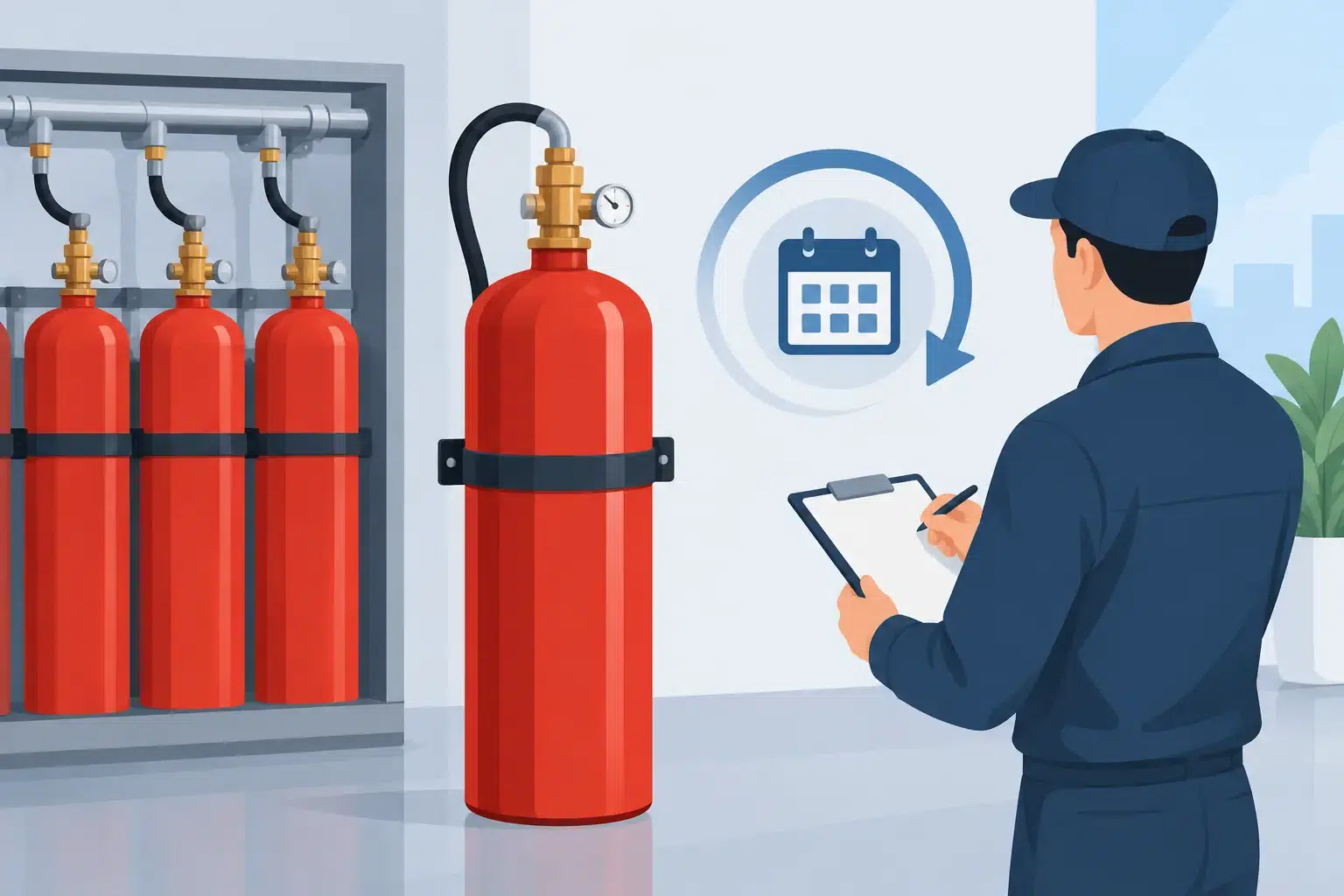
Planned maintenance should inspect the agent containers, pipework, nozzles, detection devices, control equipment, alarms, interfaces and enclosure condition. Service visits should identify faults, damaged components and changes in the protected risk before they become a problem. If construction work has introduced new penetrations, a further integrity test may be required.
Existing FM200 systems also deserve an informed review. HFC227ea remains in use in many protected spaces, but environmental policy, future asset plans and client sustainability commitments can influence long-term agent decisions. In some cases, maintaining an existing approved system is the practical route. In others, a lifecycle review may support a move to an inert gas or alternative clean-agent system. The right answer depends on the site, the enclosure, available space, operational requirements and the client’s wider policy.
Selecting a partner for critical protection
The best suppression projects are built around the consequences of failure. For one organisation, the priority may be avoiding water damage to a server estate. For another, it may be keeping a manufacturing process, communications network or safety-critical control system available after an incident. Those priorities should shape the agent selection, detection strategy, installation plan and maintenance regime.
Active Fire Suppression approaches FM200 projects as an integrated engineering responsibility, from risk discussion and technical design through room sealing, commissioning, demonstration and responsive aftercare. A detailed early conversation gives the project team the information needed to protect the room properly, while keeping the business operating with confidence.

Leave A Comment
You must be logged in to post a comment.