

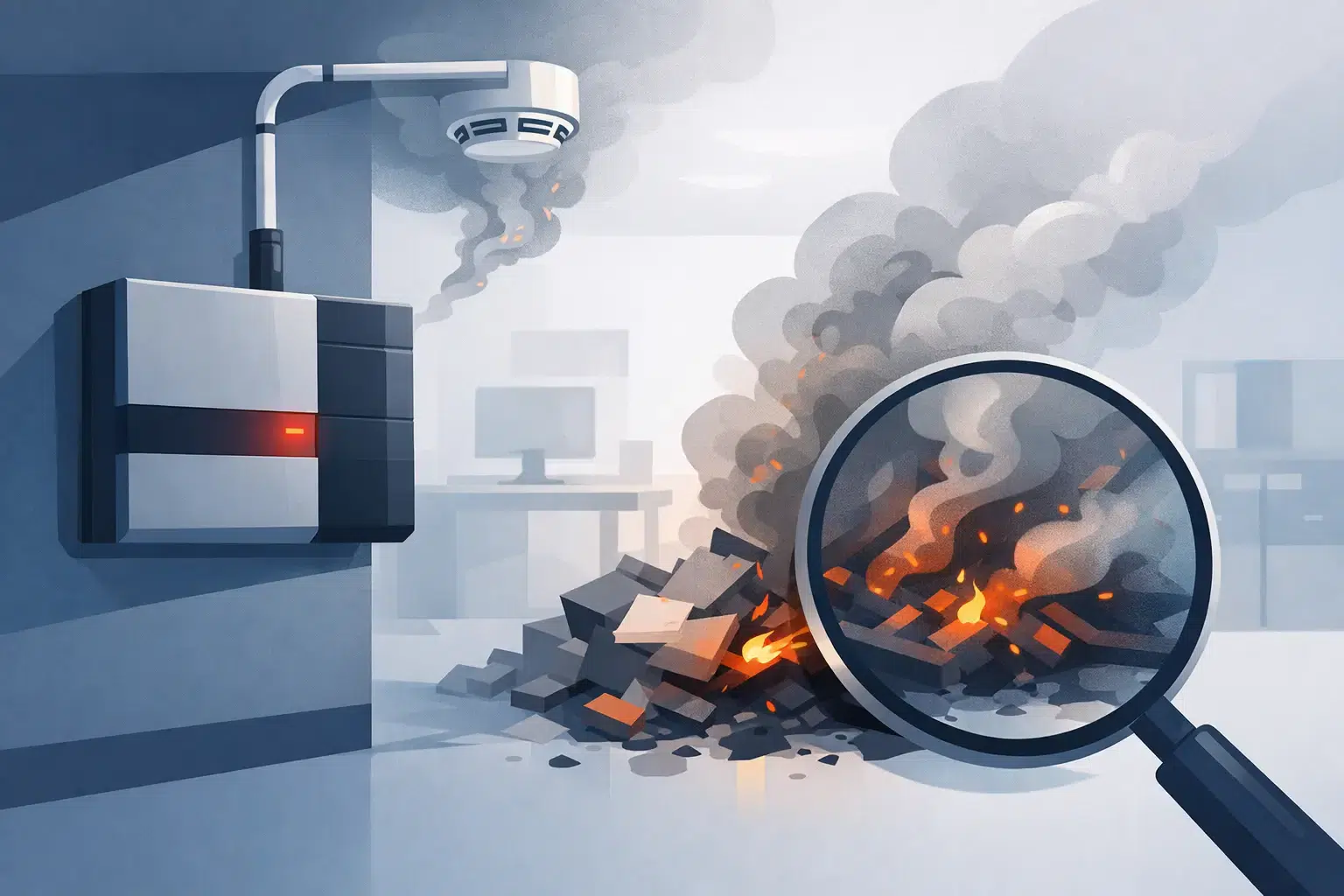
A smouldering fault in a server rack, electrical panel or cable void rarely announces itself with flame. It may begin with overheating insulation, a loose connection or a failing component, producing minute quantities of smoke long before conventional point detectors respond. So, can VESDA detect smouldering fires? In the right application, with a correctly engineered sampling network and suitable alarm strategy, it can provide exceptionally early warning of the airborne particles released during the incipient stage of a fire.
For organisations protecting critical equipment and processes, this earlier warning can create the time needed to investigate, isolate equipment and prevent an incident becoming a damaging fire event. It is not simply a matter of fitting a more sensitive detector, however. The environment, airflow, risk profile and planned response all determine whether an aspirating smoke detection system will deliver the protection required.
How VESDA detects a smouldering fire
VESDA is a form of aspirating smoke detection. Rather than waiting for smoke to rise to a detector fixed at one location, a continuous aspirator draws air through a network of small-bore sampling pipes. The air is passed through a highly sensitive detection chamber, where very low concentrations of smoke particles can be identified.
A smouldering fire commonly develops slowly. Materials such as PVC cable insulation, plastics, textiles, dust deposits and electronic components can thermally degrade for some time before sustained flaming occurs. This process can release particles at concentrations below the threshold of many conventional detectors, particularly in large rooms, high ceilings, areas with strong ventilation or equipment cabinets where smoke is diluted before it reaches the ceiling.
Because VESDA continuously samples air from selected points across the protected space, it can identify this developing condition at a very early stage. The detector does not identify a fire by seeing flame or measuring heat. It detects the products of combustion or thermal decomposition carried in the air. That distinction matters: if the fault produces little or no particulate matter, or air movement carries it away from the sampling points, detection performance will be affected.
Early warning is useful only when it leads to action
The value of early smoke detection is not merely an earlier alarm on a display panel. In a data centre, for example, an alert at the incipient stage may allow a facilities team to inspect a cabinet, shut down affected equipment in a controlled manner and avoid an unplanned outage. In a control room or manufacturing facility, it can support a rapid investigation before smoke contaminates sensitive electronics or interrupts production.
VESDA systems are commonly configured with multiple alarm thresholds. A typical strategy may include an advisory or alert level, an action level for investigation, a fire alarm level and a higher threshold that supports automatic suppression logic where appropriate. These levels must be agreed around the risk, the staffing arrangements and the consequences of unwanted alarms.
Very high sensitivity is not automatically the right answer. A room with frequent airborne contaminants, changing processes or poor housekeeping may generate nuisance alarms if alarm thresholds are set without proper assessment. Conversely, setting thresholds too high can lose the early-warning advantage that justified the system. Effective design balances sensitivity with the operating environment and a clear escalation procedure.
Where aspirating detection is particularly effective
VESDA is well suited to spaces where smoke must be detected before it can cause significant disruption. This includes data centres, server rooms, telecommunications spaces, electrical switchrooms, control rooms, battery rooms, archives, clean environments and high-value manufacturing areas.
It is also valuable where conventional detection has practical limitations. High ceilings can delay the arrival of smoke at point detectors. Strong air-conditioning and ventilation systems can dilute or redirect smoke. Ceiling voids, underfloor voids and equipment enclosures can conceal a developing fire from detectors installed in the main room. A sampling pipe network can be designed to draw air from these specific risk areas, rather than relying on smoke to find its own way to a detector.
For equipment racks and cabinets, sampling can sometimes be arranged to monitor return air paths or individual enclosures. This approach can identify overheating close to its source, though it requires careful coordination with the equipment layout, cooling design and access requirements. Pipework locations should never be treated as a generic layout exercise.
Can VESDA detect smouldering fires in every environment?
No detection technology is universal. VESDA can be highly effective for smouldering fires, but its performance depends on the smoke reaching the sampling network and on the detector being selected, designed and maintained for the application.
In areas with heavy dust, steam, aerosols, vehicle emissions or regular process fumes, standard high-sensitivity smoke detection may be unsuitable without filtration, adjusted thresholds or a different detection method. Warehouses with open doors, industrial areas with variable airflow and kitchens with cooking vapours each need their own assessment. In some cases, heat detection, flame detection or a multi-technology arrangement provides a more dependable result.
Flaming liquid fires can also develop differently from slow electrical overheating. They may produce heat and flame rapidly, leaving less time for smoke-based warning to influence the outcome. Where a rapid flame event is credible, optical flame detection or other complementary technology may be required alongside aspirating smoke detection.
The question should therefore be broader than whether VESDA can detect a particular fire type. The more useful question is whether the system will detect the credible fire scenario early enough, reliably enough and in a way that supports a practical response.
Designing the sampling network around the real risk
The aspirator itself is only one part of the system. Sampling pipe routes, hole sizes, transport times, airflow balance and the placement of sampling points directly affect performance. An installation designed for open-area coverage will not necessarily protect a cabinet, void or air-handling duct in the same way.
A competent design begins with the room and its operation. This includes ceiling height, ventilation rates, cooling units, pressure differentials, likely ignition sources, combustible materials, occupancy and access arrangements. It should also consider where smoke is expected to travel, not merely where it is most convenient to install pipework.
For critical facilities, detection zoning must align with the response plan. If an aspirating system is intended to initiate clean-agent or inert-gas suppression, the cause-and-effect strategy should be carefully developed. Commonly, a confirmed fire signal is required through coincidence detection or other safeguards before release, helping to reduce the risk of unnecessary discharge. Interfaces with shutdowns, dampers, alarms, door releases and emergency procedures must be tested as a complete system.
Design and commissioning should be undertaken in accordance with the applicable standards and manufacturer requirements. For UK fire detection installations, BS 5839-1 is frequently relevant, while aspirating smoke detectors are classified under BS EN 54-20. Where gaseous fire suppression is used, the suppression system, enclosure integrity and release controls require their own standards-led design and testing process.
Maintenance protects the early-warning advantage
A VESDA system cannot be regarded as fit for purpose indefinitely simply because it is powered and showing no faults. Dust loading, blocked sampling points, accidental damage to pipework, changes to room layouts and altered airflow can all compromise performance.
Routine maintenance should include inspection of the detector and pipe network, confirmation of airflow conditions, cleaning or replacement of filters where applicable, functional testing of alarm levels and verification of interfaces to the fire alarm and suppression controls. Any building change should trigger a review. A newly installed cooling unit, reconfigured racks or sealed cable openings can alter smoke movement enough to affect the original design assumptions.
For facilities that depend on automatic suppression, planned maintenance should consider the entire protection chain: early detection, control panel logic, warning devices, release mechanisms, extinguishing agent storage, distribution pipework and room integrity. The system only protects continuity when each element performs together.
Turning an early alert into a controlled outcome
Smouldering fires are precisely the type of threat for which aspirating smoke detection can make a meaningful difference. VESDA can identify very low smoke concentrations before flames, heat and visible damage become apparent, giving critical sites valuable decision time. But the outcome depends on engineering, alarm management and a response plan that people can carry out under pressure.
For a server room, electrical space or high-value process area, the right solution may combine VESDA with automatic clean-agent or inert-gas suppression, conventional detection and well-rehearsed operational procedures. Active Fire Suppression can assess the specific fire risk, room conditions and continuity requirements, then design protection that gives early warning a clear purpose: preventing a minor fault from becoming a major interruption.
Leave A Comment
You must be logged in to post a comment.