

A clean-agent system can stop a developing fire without soaking servers, switchgear, archive material or production equipment. That benefit only holds when the system is designed, installed and maintained for the protected risk. Clean agent regulations are therefore not a paperwork exercise: they shape the agent selected, the enclosure design, how people are protected and whether the system will perform when a critical room is under pressure.
For UK operators, the practical objective is clear. A suppression system should satisfy fire-safety duties, meet the applicable design and product standards, support insurer expectations and remain serviceable throughout its operating life. The exact route depends on the site, the agent and whether the area is occupied, but several principles apply to nearly every project.
What clean agent regulations mean in practice
UK fire-safety legislation does not prescribe a clean-agent system for every server room, electrical room or process enclosure. It requires the responsible person or dutyholder to assess fire risk and implement suitable precautions. Where the consequence of fire is severe – loss of data, prolonged operational downtime, hazardous process interruption or major asset damage – automatic suppression may be the proportionate control.
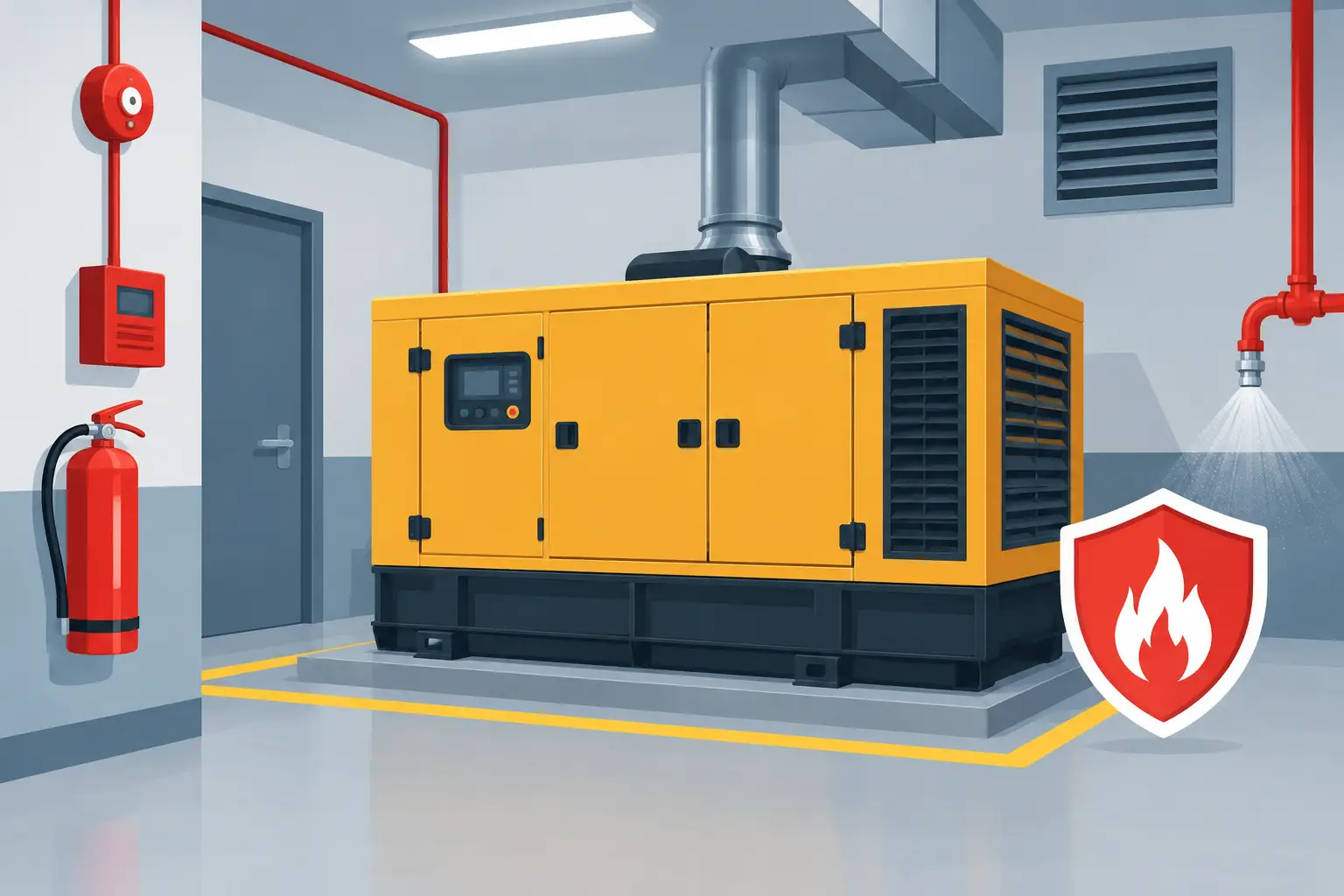
A suitable solution needs more than cylinders and pipework. The design should account for the fire hazard, room volume, ceiling and floor voids, ventilation, cable penetrations, occupancy, ambient temperature, discharge noise, pressure relief and the time needed to achieve the required extinguishing concentration.
For gaseous extinguishing systems, BS EN 15004 and the related ISO 14520 series provide the central technical framework for agent properties, design concentrations and system application. Components also need to be suitable for their intended purpose, with relevant product and installation requirements considered during specification. A competent contractor will also work to manufacturer-listed design rules and, where required, third-party approval requirements.
This matters because a system can look complete while still having a performance gap. A poorly sealed room may not retain the agent. An unprotected underfloor void can allow a fire to continue. A relief vent omitted from a high-pressure inert gas design may put the enclosure at risk during discharge. Compliance has to be engineered into the whole protected enclosure, not added after installation.
Agent choice and environmental obligations
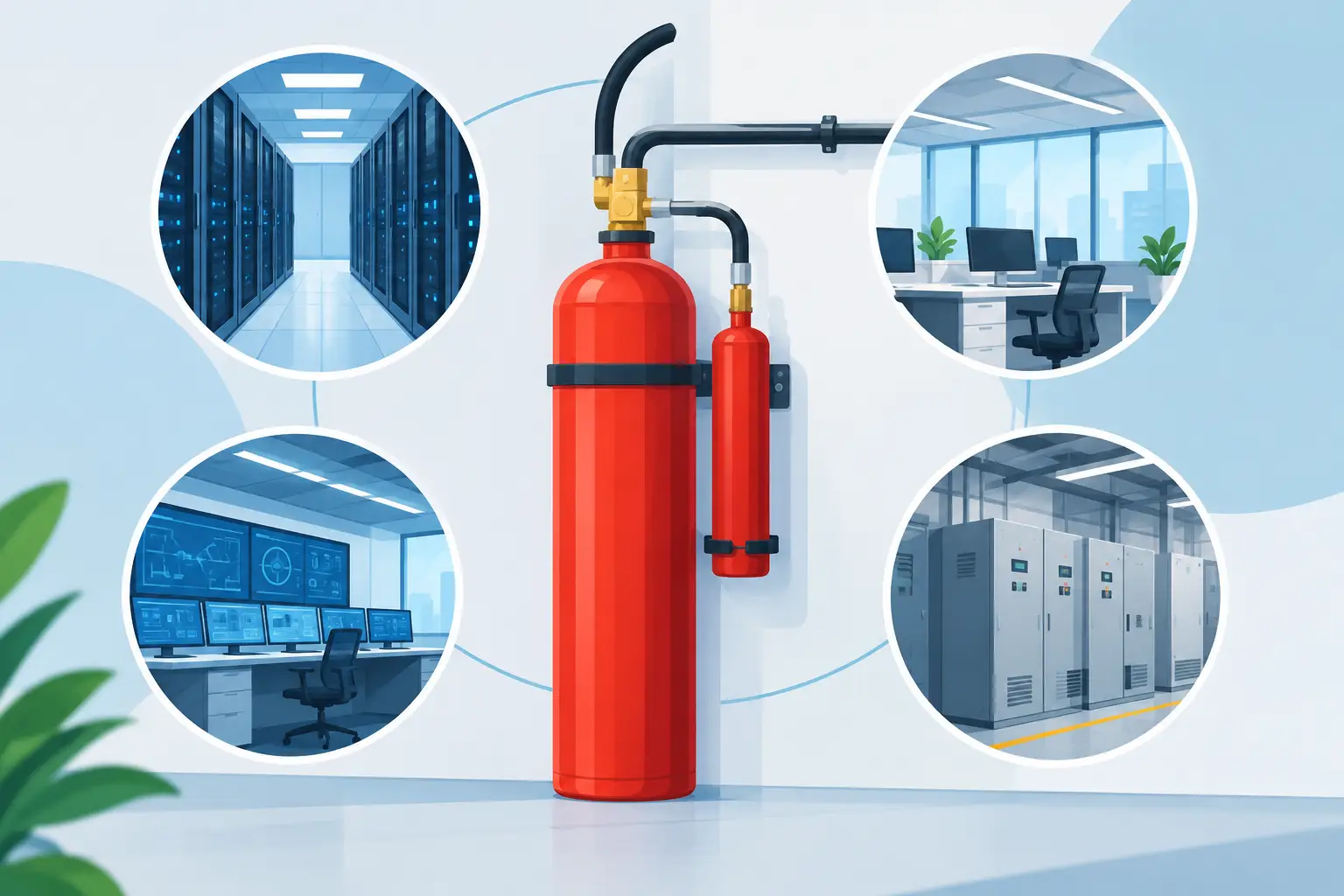
The term clean agent describes electrically non-conductive gaseous extinguishants that leave no residue after discharge. It includes inert gases such as IG-55, IG-541, IG-01 and IG-100, along with fluorinated agents including HFC-227ea, often known as FM-200 or FE-227, and fluoroketone systems commonly associated with Novec 1230.
They do not carry identical regulatory and commercial considerations.
HFC-227ea and F-gas controls
HFC-227ea has a high global warming potential and falls within UK fluorinated-gas controls. For operators, this means responsible handling is essential. The agent must be recovered where required rather than deliberately released during decommissioning or service work, and work involving the gas must be undertaken by appropriately certified personnel and businesses.
Leak prevention, accurate service records, cylinder management and proper end-of-life recovery all matter. The wider F-gas phase-down also affects availability and long-term planning. It does not automatically mean that every installed HFC-227ea system must be replaced, but it does mean system owners should consider future agent availability, environmental policy and replacement strategy before a major extension or refurbishment.
Fluoroketones and PFAS considerations
Fluoroketone agents have historically been selected where low environmental impact and occupied-space suitability are priorities. However, the market and regulatory environment around fluorinated substances is changing, including ongoing UK and European scrutiny of PFAS. Supply-chain decisions and manufacturer support should be reviewed as part of any new system specification or lifecycle plan.
A low global warming potential alone is not a complete procurement assessment. Facilities teams should ask about current agent availability, manufacturer support, environmental policy, servicing arrangements and realistic long-term replacement options. This is especially relevant for sites with a design life measured in decades.
Inert gases and carbon dioxide
Inert gas systems use naturally occurring gases and are not subject to F-gas controls. They can provide a strong long-term environmental case, particularly for data centres, electrical rooms and other high-value enclosures. The trade-off is physical: cylinders require more storage space and discharge pressure must be managed through correctly sized over-pressure relief.
Carbon dioxide remains highly effective for specific unoccupied or tightly controlled industrial hazards, but its risks to life are significant. Its use demands rigorous safeguards, warning arrangements, evacuation procedures and controls that prevent discharge where people may be exposed. It is never an agent to select on cost alone.
Occupant safety is part of compliance
Every total flooding system must be assessed for the people who may be in or near the protected enclosure. This includes normal occupants, contractors, cleaners and responders who may enter during an alarm condition.
The selected concentration must extinguish the defined fire while remaining within applicable human exposure limits for the intended occupancy. Detection logic, pre-discharge alarms, warning signs, manual abort arrangements, time delays and emergency procedures must work together. A suppression release should be preceded by a clear, audibly and visually recognisable warning that gives occupants time to leave where the risk assessment requires it.
There is no universal delay setting or warning arrangement. A normally occupied control room needs a different assessment from an unmanned electrical enclosure. Likewise, an abort control has to be positioned and operated in a way that supports safe evacuation without creating confusion or allowing a developing fire to become unmanageable.
Staff training is often overlooked after commissioning. People do not need to become suppression engineers, but they should know what an alarm sequence means, how to leave the space, who can authorise re-entry and what action to take after a discharge.
Room integrity and pressure relief cannot be assumed
The enclosure is effectively part of the suppression system. For a total flooding design, the extinguishing concentration must be achieved and held for the specified retention period. Open doors, unsealed cable routes, damaged fire stopping and unplanned ventilation changes can all undermine that outcome.
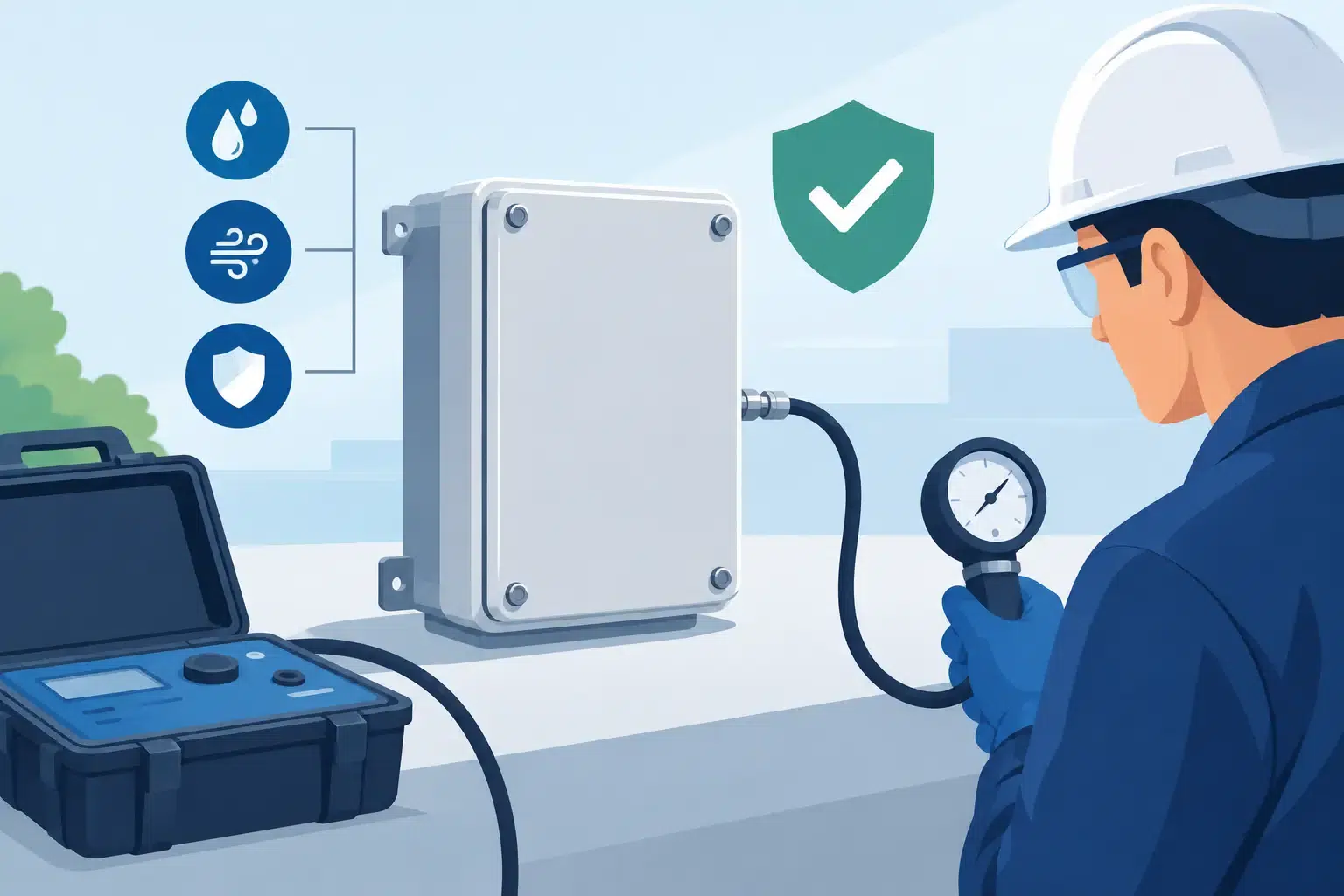
Room-integrity testing, commonly called a door fan test, provides evidence of enclosure leakage and predicted agent retention. It should be completed after installation and repeated when material changes affect the room. A new cable tray, altered air-conditioning route or wall penetration may appear minor, yet it can invalidate the original performance assumptions.
Pressure relief deserves the same attention. Inert gas systems discharge rapidly and can create substantial positive and negative pressure changes. The enclosure, doors, ceilings and partitions need protection from those forces. Correct vent selection requires calculation, not guesswork, and should be coordinated with the building fabric and mechanical services.
Installation, commissioning and handover
A compliant project is not complete when the pipework has been painted and the control panel energised. Commissioning should verify the cause-and-effect sequence from detection through alarms, shutdowns, release controls and system discharge logic. Interfaces with ventilation, dampers, fuel isolation, building management systems and remote monitoring must be tested rather than assumed.
The handover information should give the site team a usable record of what has been installed and how it is to be managed. This normally includes system drawings, design information, operating instructions, alarm and release logic, test records, agent and cylinder details, room-integrity results, maintenance requirements and details of any impairments or limitations.
Where a site is operational during the works, change control is equally important. Temporary isolation of suppression, a period with incomplete detection coverage or an open enclosure boundary needs to be understood and managed. The priority is to avoid creating an unprotected window while upgrading protection.
Ongoing maintenance and system records
Clean agent regulations continue to matter after commissioning. Detection devices can become contaminated, control panels can develop faults, cylinders can lose pressure, interfaces can be altered by other contractors and enclosure integrity can deteriorate over time.
Planned inspection and maintenance should follow the applicable standard, manufacturer requirements and the site risk assessment. Any faults, isolations, missing signage, changes to occupancy or alterations to the room should be recorded and addressed promptly. For HFC systems, records relating to the agent and any recovery work are particularly important.
The system owner should also be clear about who has authority to isolate, reset or place the system on test. In a critical environment, that responsibility needs to be available outside normal working hours, not buried in an operations manual.
For complex rooms, the best approach is to bring fire-suppression specialists into the conversation before the layout, ventilation strategy and equipment loads are fixed. Active Fire Suppression can assess the risk, agent options, enclosure requirements and operational constraints as one coordinated engineering task. A well-specified system gives facilities teams more than a compliance file: it gives them a realistic plan for protecting people, assets and continuity when a fire starts.
Leave A Comment
You must be logged in to post a comment.