

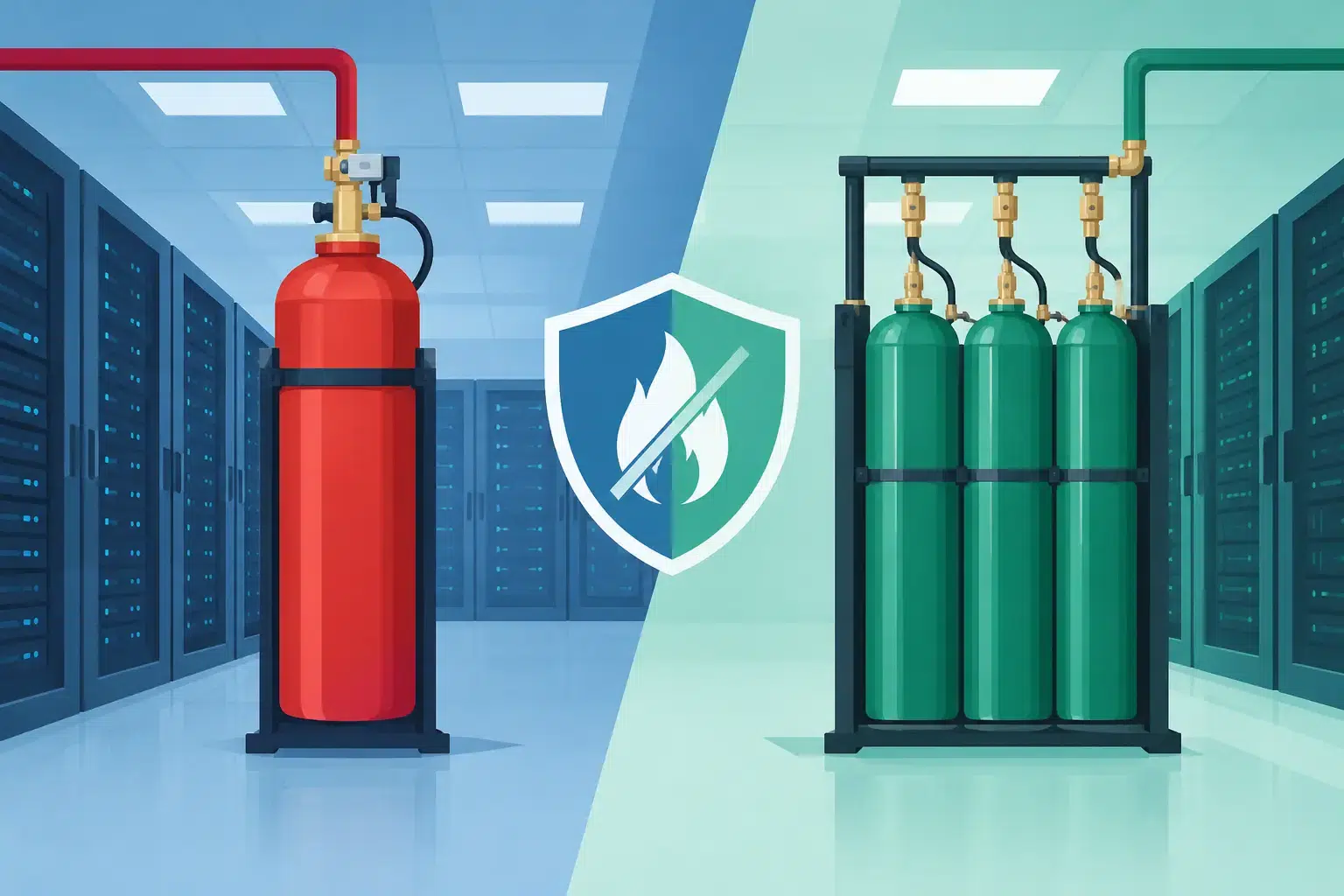
A fire in a server room, control room or production enclosure is not simply a property-loss event. It can stop customer services, compromise critical equipment and leave teams managing a costly recovery. The choice between HFC227ea versus IG100 therefore needs to start with the protected risk, not with a preferred cylinder type or an assumed lowest installation cost.
Both agents are clean gaseous fire-suppression solutions. Both can extinguish a developing fire quickly without the water damage, clean-up burden or conductive residue associated with sprinklers and many portable extinguishers. The practical differences lie in how they extinguish, the storage space they need, their environmental profile and how each system fits the building and operating environment.
HFC227ea versus IG100: the essential difference
HFC227ea, also commonly known as FM-200 or FE-227, is a chemical clean agent stored as a liquefied gas under pressure. When discharged, it suppresses fire primarily by absorbing heat from the flame. It is widely used where rapid suppression, compact storage and protection of sensitive electronic equipment are required.
IG100 is an inert gas system containing 100% nitrogen. It extinguishes by reducing the oxygen concentration in the protected enclosure to a level at which combustion cannot continue, while remaining within carefully defined limits for human exposure and safe evacuation. Nitrogen is naturally present in the atmosphere, non-conductive and leaves no residue after discharge.
Neither option should be treated as a universal replacement for the other. Both must be designed for the specific fire hazard, enclosure volume, anticipated occupancy, ventilation arrangements and business-continuity requirements.
Where HFC227ea can be the better fit
HFC227ea is often attractive where plant-room space is constrained. Because the agent is stored in liquid form, a system can usually protect a given room with a smaller cylinder footprint than an equivalent inert-gas installation. This can be decisive in existing data centres, communications rooms, heritage buildings and occupied commercial premises where a large cylinder bank cannot be accommodated.
The agent also works at relatively low extinguishing concentrations compared with an inert gas system. This means less agent volume enters the room during discharge. Although every system still requires pressure calculations and may need pressure-relief venting, the physical effect on the enclosure can be less demanding than a high-pressure inert gas discharge.
For normally occupied enclosures, HFC227ea can be suitable when designed within recognised exposure limits. The system design must account for the intended concentration, likely time people may remain in the space, warning arrangements and evacuation procedures. A clean-agent system is not a substitute for safe escape: audible and visual alarms, time delays where appropriate, abort controls and clear operating instructions remain essential.
The key strategic consideration is environmental policy. HFC227ea has a high global warming potential compared with inert gases. It remains a proven and effective suppression agent, and installed systems require competent inspection and maintenance. However, organisations planning long-term capital investment increasingly assess future agent availability, corporate environmental commitments and the implications of UK F-gas regulation before selecting an HFC-based system.
Where IG100 makes more sense
IG100 is a strong option for organisations that place particular weight on environmental performance and long-term agent strategy. Nitrogen has no ozone-depletion potential and no global warming potential. Following a discharge, it dissipates naturally and does not create a chemical clean-up issue.
It is especially well suited to critical environments where a clean, non-conductive agent is required and adequate storage space is available. Typical applications include data centres, electrical switchrooms, control rooms, archive stores, laboratory spaces and specialist industrial enclosures.
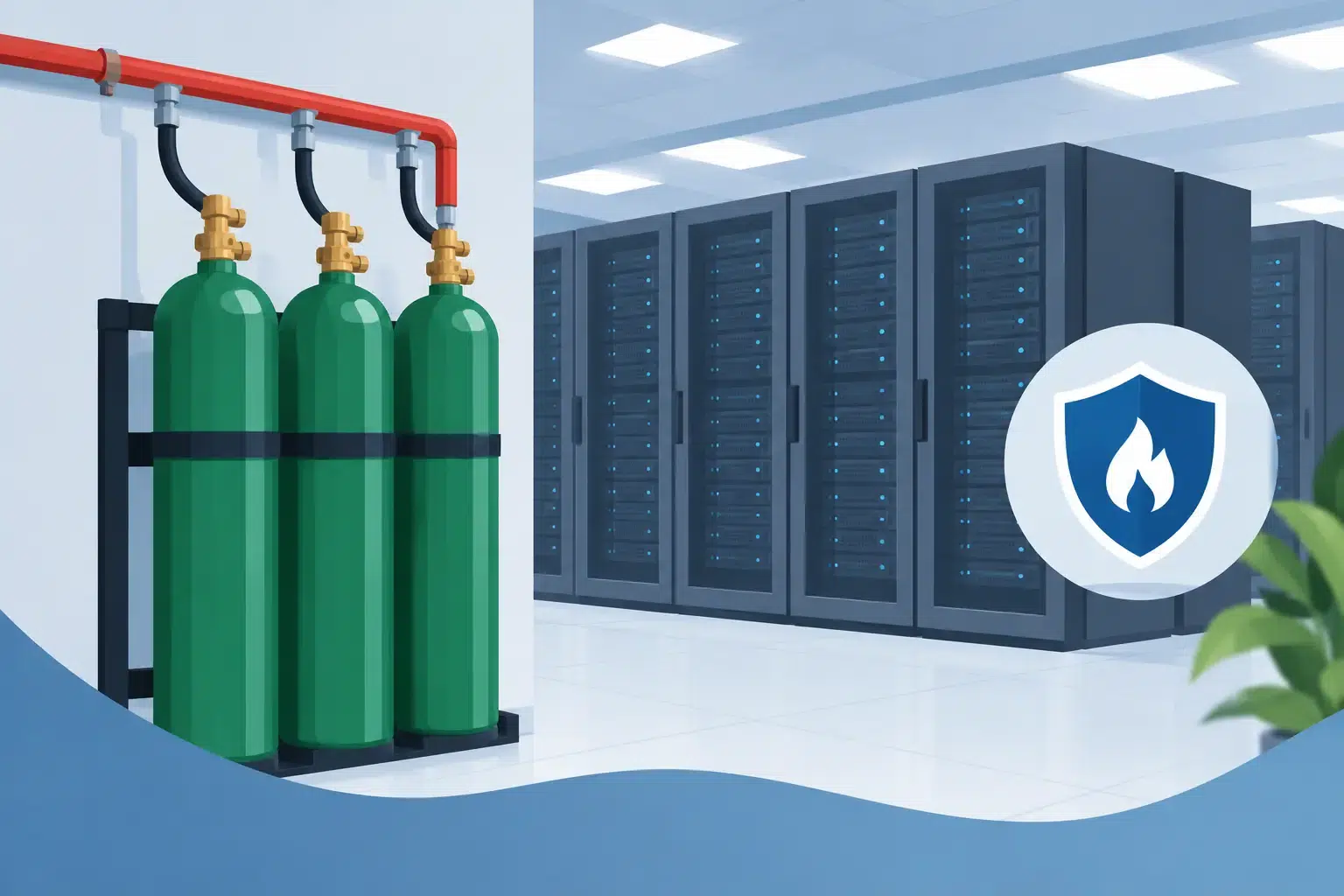
The trade-off is storage. IG100 is commonly stored in high-pressure cylinders, and a larger quantity of cylinders is generally needed than for HFC227ea protecting the same room. The cylinder bank may be located in an adjacent fire-rated enclosure, but this introduces practical questions about floor loading, pipe routes, access for installation and future cylinder replacement.
Discharge pressure also matters. An IG100 system releases a significant volume of gas rapidly, so the room must be evaluated for pressure effects. Properly sized pressure-relief venting protects walls, ceilings, doors and other building elements from excessive positive or negative pressure. This is not an optional add-on or a rule-of-thumb exercise: it is part of an engineered system design.
Occupancy requires equally careful consideration. IG100 reduces the oxygen concentration in the room to suppress the fire. The design standard allows for human safety parameters, but the suitability of the system depends on who may be present, whether they can evacuate promptly and whether there are medical, mobility or operational factors that need special attention. A permanently occupied control room may require a different solution from an intermittently accessed electrical room.
Room integrity is not negotiable
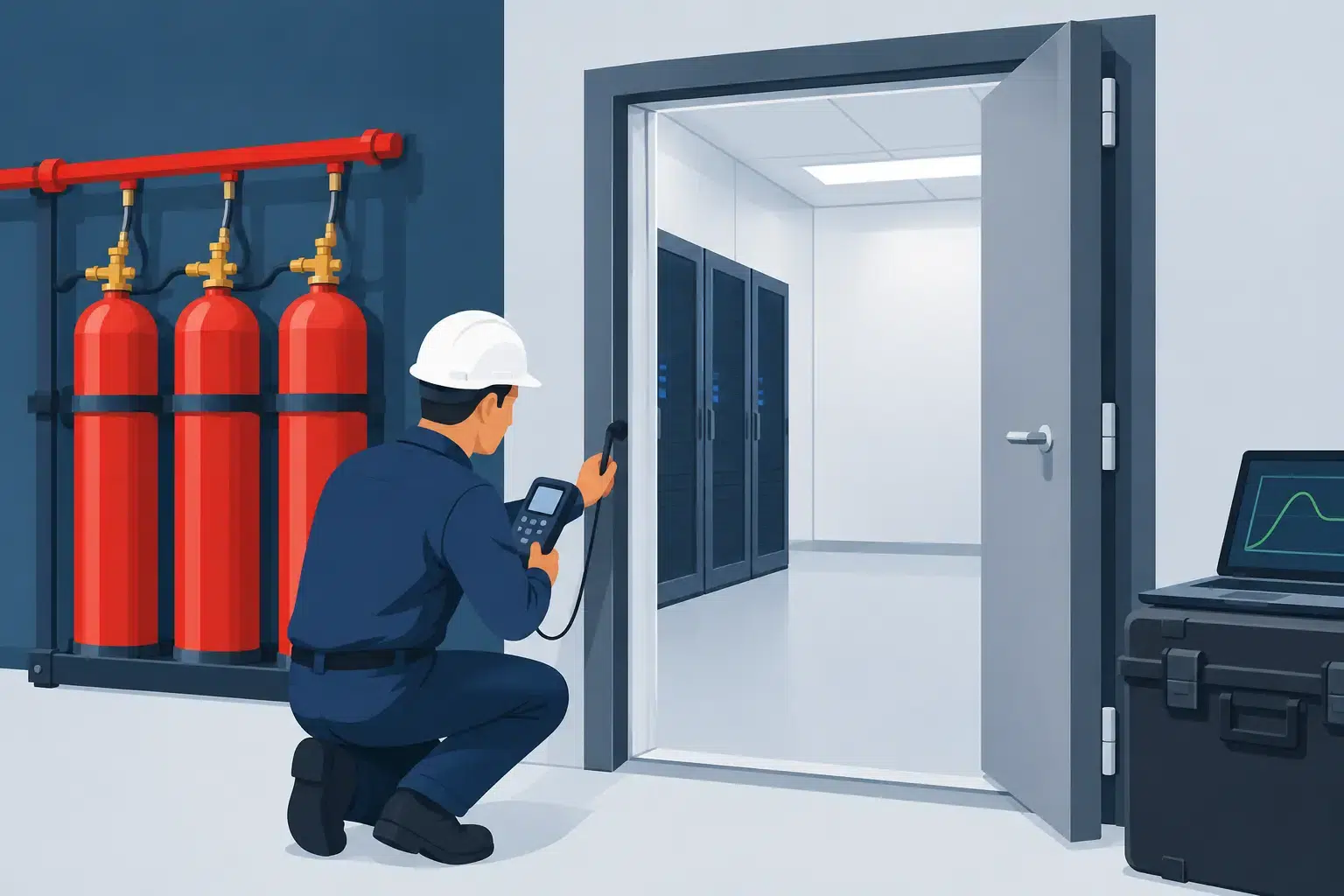
For either agent, the protected room must hold the extinguishing concentration for the required period after discharge. Gaps around cable penetrations, unsealed floor voids, open dampers, poorly fitting doors and air-handling systems can allow the agent to escape before the fire is fully controlled.
A room-integrity test, often called a door-fan test, measures the enclosure’s leakage characteristics and estimates how long the required concentration will be retained. It should be considered during design, not left until commissioning. Where leakage is identified, sealing works, damper interfaces and penetrations need to be addressed before the system can be relied upon.
Ventilation must also be controlled. Air-conditioning and extract systems may need to shut down automatically on confirmed fire, while fire dampers or purpose-designed dampers help contain the agent. The detection, suppression, ventilation and control interfaces must operate as one coordinated sequence.
Comparing project cost and whole-life value
The initial cost comparison is rarely as simple as the cost of cylinders. HFC227ea may reduce the space needed for agent storage and can be easier to accommodate in a constrained building. IG100 may require more cylinders, stronger consideration of floor loading and additional space, but avoids the environmental concerns associated with an HFC agent.
Whole-life planning should include routine inspection, cylinder testing and replacement requirements, system alterations following room changes, room-integrity retesting, agent availability and the cost of business interruption if protection cannot be restored promptly after discharge. If a new partition, cable route or ventilation alteration compromises room integrity, neither system will perform as designed.
Insurer expectations may also influence the choice. Some sites have a prescribed approach based on the hazard, occupancy or client standards. Others allow flexibility but expect the selected system to be supported by appropriate calculations, certification, commissioning records and maintenance arrangements.
The fire risk should decide the agent
For a compact, high-value server room where every square metre of plant space matters, HFC227ea may remain the most practical route, provided its environmental profile aligns with the organisation’s policy and future planning. For a new-build data centre or an industrial control environment with sufficient cylinder space and a strong sustainability requirement, IG100 may offer the more suitable long-term solution.
There are cases where neither is automatically right. A room with frequent occupancy, significant leakage, unusual ventilation, combustible metals, deep-seated fire risks or a complex combination of hazards may need a different agent, a revised enclosure strategy or additional local protection. Fire suppression design should never be based solely on the room name.
The most useful next step is a site-specific assessment that considers the enclosure, fire load, people, equipment, operational downtime and maintenance access together. Active Fire Suppression can take responsibility from initial risk discussion and design through installation, integrity testing, commissioning and ongoing support, so the selected agent is not merely specified but capable of protecting the operation when it is needed.


Leave A Comment
You must be logged in to post a comment.