

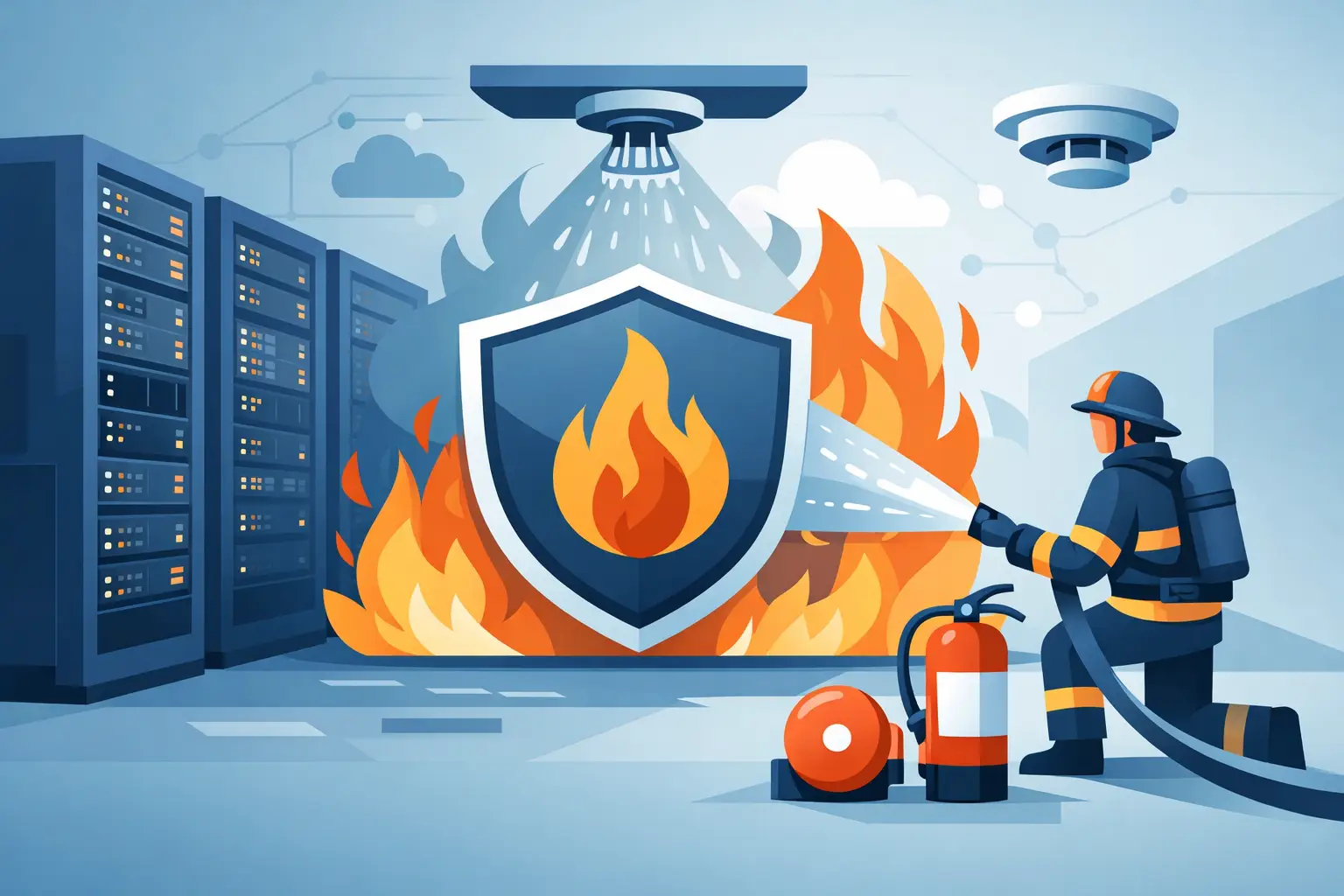
A data centre can tolerate a component failure. It may even tolerate the loss of a rack, a power feed or a cooling unit when its design has sufficient redundancy. Fire is different. Smoke can contaminate electronics well beyond the point of origin, water can turn a contained incident into widespread equipment damage, and an evacuation can interrupt critical services before flames are visible. Data centre resilience therefore depends on preventing a small fire event from becoming an operational outage.
For operators, facilities teams and project managers, the aim is not simply to satisfy a fire-safety requirement. It is to protect people while preserving the equipment, services and recovery options the business relies upon. Automatic detection and suppression form a critical part of that plan, alongside compartmentation, power management, maintenance and documented incident response.
What data centre resilience means in a fire event
Resilience is the ability to continue operating, or recover predictably, when conditions depart from normal. In a data centre, that includes failures affecting power, cooling, connectivity, physical security and fire safety. Each system needs to be considered in relation to the others.
A fire response that protects life but leaves server halls, switchgear or storage arrays heavily contaminated may meet one objective while creating a lengthy business interruption. Equally, a system selected purely to avoid equipment damage is not acceptable if it does not properly account for occupants, warning arrangements, evacuation and safe operation.
The best outcome is early identification of abnormal conditions, automatic action before fire grows, and a controlled return to service. This requires more than fitting cylinders or detectors. It requires an engineered system designed around the room, hazards, occupancy and operational priorities.
Why conventional protection may not be enough
Sprinkler systems have a vital role in many buildings and may be required as part of the wider fire strategy. However, in areas containing high-value electronic equipment, their discharge can cause extensive water damage and delay recovery. A server room or data hall often needs a faster, cleaner first response that can control a developing fire before heat causes a sprinkler head to operate.
The risk is not limited to racks. Potential ignition sources include UPS equipment, battery rooms, switchgear, power distribution units, cable routes, generators and cooling plant controls. Lithium-ion battery risks in particular require separate, hazard-specific assessment. A gaseous system may be suitable for the protected enclosure, but it is not a universal answer for every battery chemistry, configuration or fire scenario.
Protection also needs to account for concealed spaces. Raised floors, suspended ceilings and cable voids can allow smoke to travel or a fire to develop away from visible equipment. If these areas are within the protected volume, the detection and suppression design must address them accordingly.
Early warning provides valuable response time
Very early smoke detection is frequently the first line of defence in critical environments. Aspirating smoke detection, commonly known by the VESDA name, draws air through pipework to identify minute quantities of smoke at a stage when investigation may still prevent escalation.
This early warning can support a staged response. Facilities staff may be alerted to investigate an incipient fault, while a separate alarm threshold initiates automatic suppression only when defined fire conditions are met. The exact cause-and-effect arrangement should be agreed with the responsible persons, fire strategy and operational team. It must not rely on a rushed decision during an incident.
Cross-zoned detection is often used before releasing a gaseous agent. In practical terms, this means confirmation from more than one detection zone or signal, reducing the likelihood of an unnecessary discharge while retaining automatic intervention where it is needed. Manual release, abort controls, audible and visual warning devices, shutdowns and interfaces with building systems all need careful coordination and clear labelling.
Detection must be maintained, not assumed
Detection sensitivity can be affected by dust, airflow changes, alterations to room layout and building works. Regular inspection, testing and review are essential, particularly after changes to racks, cooling arrangements, containment, cabling or partitions. A system commissioned for one room configuration cannot automatically be assumed to perform as intended after significant alterations.
Choosing suppression around the actual risk
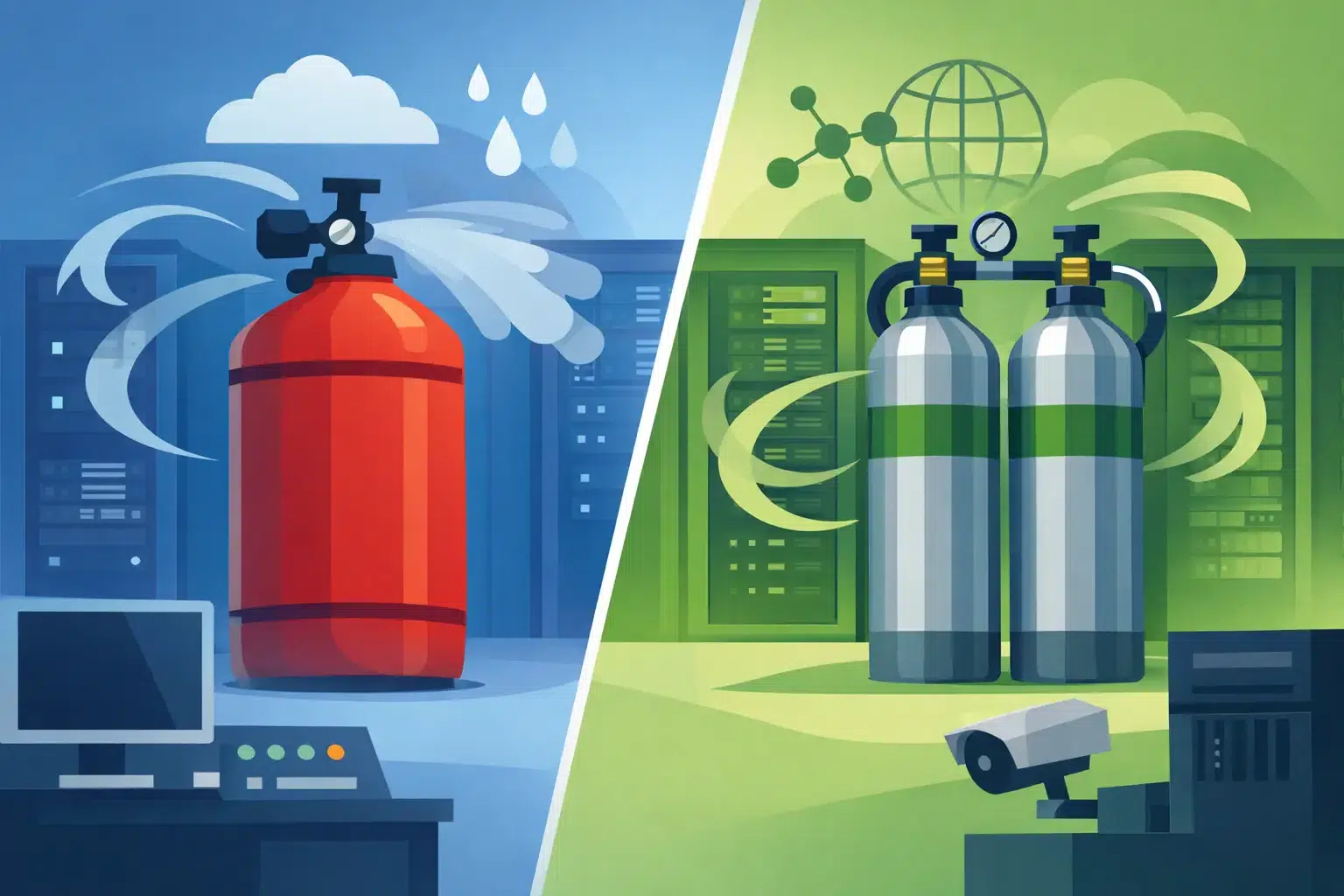
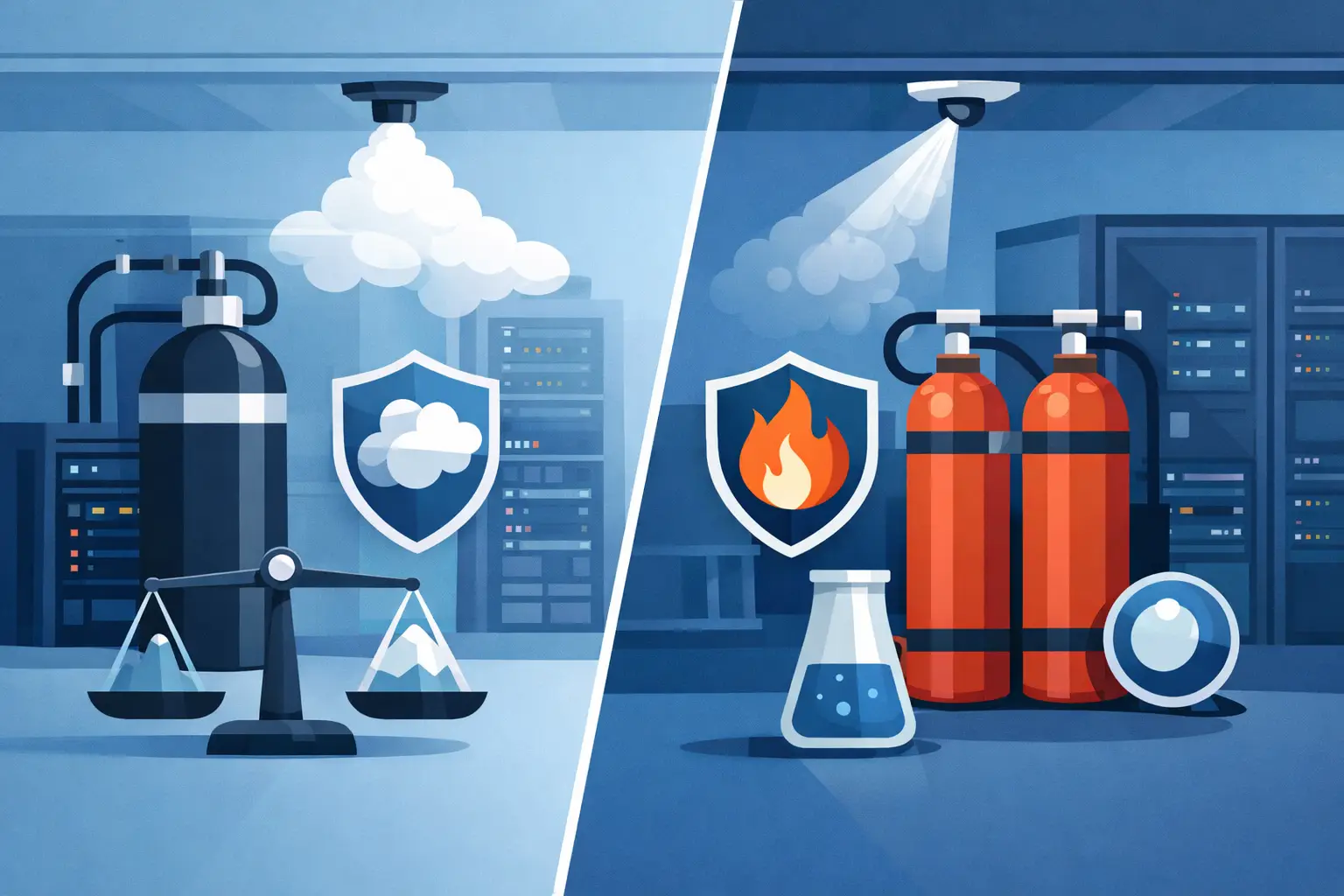
For enclosed data centre spaces, clean-agent and inert-gas systems are commonly considered because they suppress fire without the residue associated with dry powder or foam. The right agent depends on the protection objective, room size, available cylinder storage, discharge pressures, environmental policy, future servicing considerations, insurer expectations and whether people may be present.
Inert gases such as IG55, IG541, IG01, IG100 and INERGEN® reduce the oxygen concentration in the enclosure to a level that will not support combustion, while remaining suitable for occupied spaces when designed and used within the relevant limits. They are proven agents for many critical-room applications, but require adequate storage space and careful consideration of pressure relief during discharge.
Clean-agent systems using agents such as Novec 1230 or HFC227ea can offer different storage and installation characteristics. Their selection should be based on current technical, environmental and regulatory considerations, not a generic preference for one agent. Availability, long-term service support and the organisation’s environmental commitments should be part of the decision from the outset.
CO2 is highly effective for certain industrial hazards but presents a serious life-safety risk in occupied areas. It is generally not the default choice for a data hall. Where it is considered for machinery spaces or other specific applications, the design must include the appropriate safeguards, warning arrangements and operating procedures.
Room integrity is part of the system
A gaseous extinguishing system can only hold its design concentration for the required period if the enclosure is sufficiently sealed. Doors, cable penetrations, dampers, raised-floor gaps and ceiling voids all influence retention time.
Room integrity testing verifies whether the enclosure is likely to retain the agent following discharge. It should be completed after installation and repeated when building fabric or services are altered. If testing identifies excessive leakage, remedial sealing work is needed. Simply adding more agent is not a substitute for a sound enclosure and may create additional pressure, cost and storage implications.
Over-pressure vents are another key element. Rapid gaseous discharge changes room pressure. Correctly sized venting protects the room structure and helps the system operate as designed. This is a design calculation, not an optional finishing item.
Design for continuity, not just discharge
Fire suppression is most effective when it is integrated with the site’s operational controls. On discharge, it may be appropriate for the system to shut down or isolate air-handling equipment to prevent agent loss, close dampers, release access controls and signal a monitored alarm receiving centre. Yet every automatic action involves a trade-off.
Shutting down cooling may help retain agent, but it can also affect live equipment if recovery takes time. Disconnecting power may limit ignition sources, but the decision must align with the data centre’s electrical design, service commitments and safe shutdown procedures. There is no universal cause-and-effect matrix that suits every facility.
This is why the project should start with risk discussions involving facilities, IT, electrical, mechanical, security and fire-safety stakeholders. A specialist contractor can then translate those requirements into a coordinated design, including detection zones, agent concentration, cylinder location, pipework, interfaces, signage and commissioning tests.
Relevant standards commonly include BS EN 15004 for gaseous fire-extinguishing systems, alongside applicable fire detection, electrical and building requirements. Insurer requirements and the building’s fire strategy may impose additional conditions. Compliance should be evidenced through design documentation, installation records, commissioning results and ongoing maintenance records.
Testing proves that protection will perform
A fire system that has not been tested, demonstrated and maintained is an assumption rather than a resilience measure. Commissioning should confirm the detection sequence, alarm devices, release logic, shutdowns, interfaces, pressure relief provisions and agent discharge arrangements. Where a live discharge demonstration is not appropriate, the testing approach should still prove every relevant function in a controlled manner.
Following handover, planned maintenance keeps the system dependable. This includes inspection of cylinders, pipework, nozzles, detectors, control panels, batteries, warning devices and interfaces, as well as periodic room-integrity testing. Service visits are also an opportunity to identify changes that may have undermined the original design.
For sites with no tolerance for prolonged disruption, consider how quickly faults can be repaired and whether service exchange arrangements are available for key equipment. Records should be accessible, accurate and usable by the people who will need them during an incident or audit.
Build fire protection into every change
Data centres evolve continuously. New racks, additional battery capacity, revised cold-aisle containment, changes to cable routes and plant upgrades can all alter the fire risk or the performance of an installed system. Fire protection should therefore be included in change-control procedures rather than reviewed only after a project is complete.
The practical question is straightforward: if a fire began in this altered environment tonight, would detection identify it early, would suppression reach the hazard, would the room retain the agent, and would the team know what happens next? Answering that question before changes go live is one of the most effective ways to protect continuity.
Active Fire Suppression approaches these projects as an end-to-end engineering responsibility, from initial risk discussion and design through installation, integrity testing, commissioning and maintenance. For data centre operators, that joined-up approach turns fire protection from a standalone compliance item into a credible part of operational resilience.
Leave A Comment
You must be logged in to post a comment.