

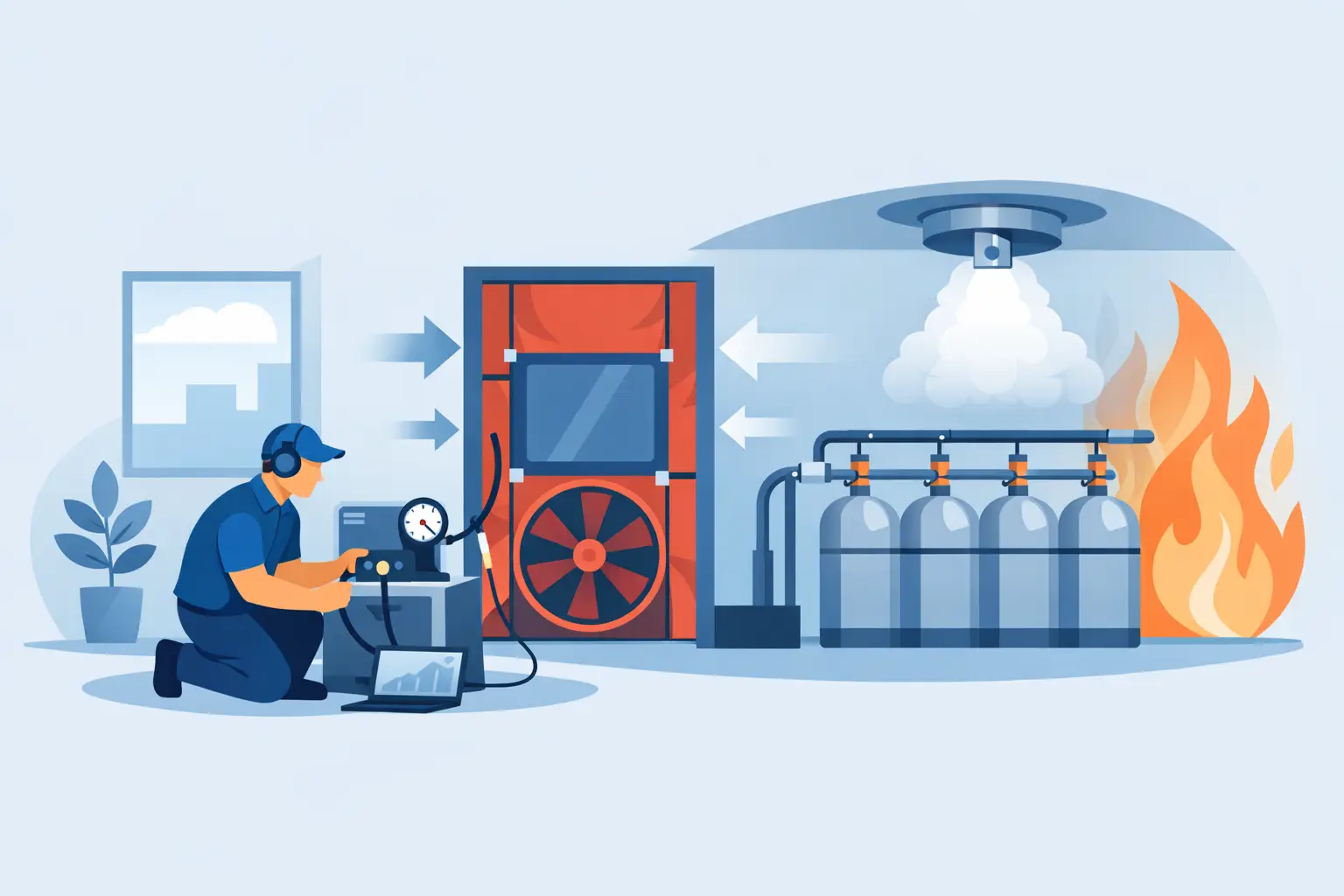
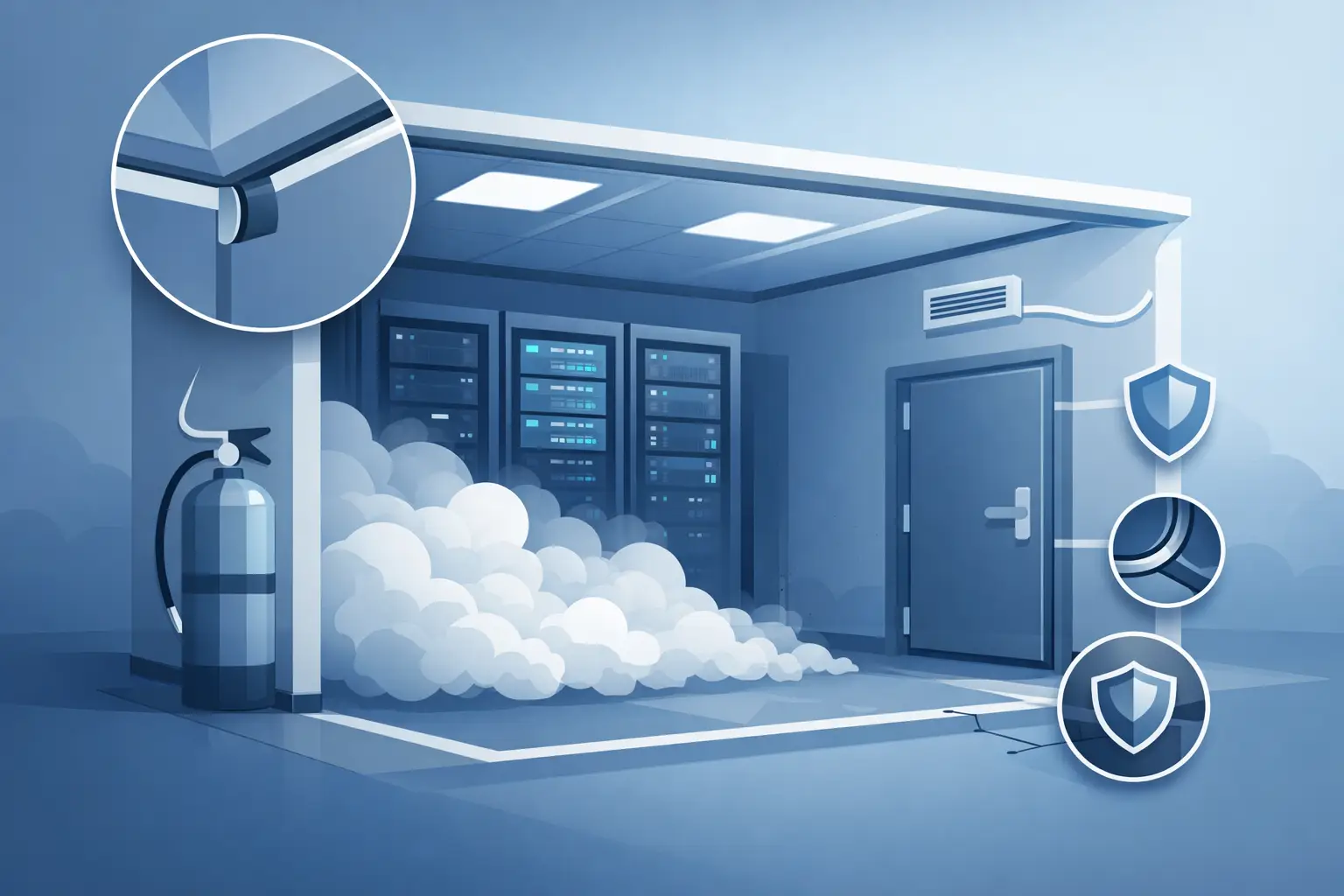
A clean-agent or inert-gas system can be correctly designed, installed and commissioned, yet still fall short if the protected room cannot retain the agent after discharge. Room integrity testing addresses that risk. It establishes whether an enclosure is sufficiently sealed to hold the designed extinguishing concentration for the required period, giving the system a realistic opportunity to control a fire before it escalates.
For a server room, data centre, control room, electrical switchroom or other critical enclosure, this is not a minor finishing task. It is a core part of system performance. A discharge into a leaky room can mean lost concentration, avoidable equipment damage, extended interruption and difficult questions from insurers, auditors and stakeholders after an incident.
What room integrity testing proves
Room integrity testing, often called a door fan test or enclosure integrity test, measures the leakage characteristics of a protected enclosure. Rather than discharging extinguishing agent, a calibrated fan is fitted into an external doorway and used to pressurise and depressurise the room. Test software records the airflow needed to create a range of pressure differences and uses those results to predict how quickly agent concentration would decay following a real discharge.
The key result is the predicted retention time. For gaseous fire suppression systems, the enclosure must retain the design concentration at the required protected height for long enough to meet the applicable system standard and fire strategy. The precise requirement depends on the agent, hazard and system design. In many applications, the target is a minimum ten-minute hold time, but this must never be treated as a universal figure without checking the project specification and relevant standard.
The test is commonly associated with systems using IG55, IG541, IG01, IG100 and INERGEN®, as well as clean agents such as Novec 1230 and HFC227ea. The principle is the same: the agent concentration calculated during design only delivers protection if the enclosure holds it where the hazard is located.
Why leakage affects business continuity
Gaseous suppression is selected where water damage could be as disruptive as the fire itself. In a data environment, a small electrical room or a manufacturing control area, fast automatic suppression can prevent a local incident becoming a prolonged operational outage. However, agent retention depends on the condition of the room as well as the cylinders, pipework, nozzles, detection and control panel.
Leakage can occur in places that are easy to overlook during a refurbishment or equipment change. Common examples include cable penetrations beneath raised floors, gaps around containment, unsealed pipe and duct openings, ceiling voids, poorly fitting access panels, door perimeters and building joints. Air-handling systems can also create a route for loss if dampers do not close as intended when the suppression system operates.
A room may look finished and still fail an integrity test. Conversely, a failed test does not automatically mean major construction work. The value of testing is that it replaces assumptions with measured evidence, allowing remedial work to be focused on the leakage paths that matter.
Retention time is only one part of performance
A successful test does not replace a full commissioning process. It does not prove that detection devices are correctly located, that release controls operate, that manual abort arrangements work, or that dampers and shutdown interfaces respond correctly. It also does not determine whether the selected extinguishing agent is appropriate for the fire risk.
The enclosure test sits within a wider engineered solution. System design should consider the fire class, room volume, ceiling and floor voids, occupancy, pressure relief, operational processes, environmental requirements and insurer expectations. This is particularly relevant where a room contains lithium-ion battery equipment, high-energy electrical infrastructure or a process with a more complex fire profile.
When room integrity testing is needed
Testing is normally completed as part of commissioning for a new gaseous suppression installation. It should also be considered whenever the enclosure changes in a way that could affect leakage or volume. In operational buildings, this is often more frequent than expected.
A retest is sensible after alterations such as new cable routes, replacement air-conditioning equipment, ceiling works, installation of access-control hardware, raised-floor changes, construction works affecting adjoining spaces or modifications to doors and dampers. A change in protected volume can also require the suppression design itself to be reviewed, not merely the integrity test repeated.
For occupied sites, planned maintenance provides a useful opportunity to confirm that room sealing has not deteriorated since handover. Doors receive daily use, contractors make penetrations to support IT and building-services changes, and minor defects can accumulate. Retesting intervals should reflect the building’s change control, criticality and maintenance plan rather than follow a one-size-fits-all timetable.
How the test is carried out on site
A competent engineer begins by reviewing the enclosure and system information. This includes room dimensions, protected height, agent design concentration, expected hold time, raised-floor and ceiling-void arrangements, pressure-relief provision and the status of ventilation dampers. These details are needed for an accurate calculation.
The room is then prepared. Doors and service openings are placed in their normal fire-condition state, while items that would automatically close on discharge, such as dampers, should be represented accordingly. The test fan and calibrated pressure gauges are installed in a doorway, creating a controlled temporary test arrangement without releasing agent or creating unnecessary downtime.
During the test, the fan produces a series of pressure readings. The engineer uses the measured airflow and enclosure data to calculate equivalent leakage area and predicted retention time. If the test passes, the results form part of the commissioning and compliance records. If it does not, the report gives a clear basis for investigating and sealing leakage routes before retesting.
The room can usually remain in service during testing, subject to site procedures and the specific environment. In sensitive areas, testing should be coordinated with operations teams so that temporary pressure changes, access restrictions and interface checks do not interfere with critical activity.
The relationship between sealing and pressure relief
It can appear contradictory to seal a room tightly while also fitting pressure-relief vents. Both are necessary, but they solve different problems.
During the rapid discharge of an inert gas or clean agent, the protected enclosure may experience a temporary pressure increase or decrease. Over-pressure vents are designed to relieve that transient force and help protect walls, ceilings, doors and glazing. They are sized as part of the suppression design and must operate in the correct direction for the system and enclosure conditions.
Room sealing, by contrast, reduces uncontrolled leakage once discharge has occurred. A properly designed pressure-relief vent should not be treated as a hole that undermines the integrity result. Its behaviour is accounted for within the system design and test calculation. Problems arise when vents, dampers or other openings are incorrectly specified, badly installed or left in a condition that does not match the intended fire scenario.
What happens when a room fails
A failed result is useful engineering information, not a reason to bypass the test. The next step is to identify likely leakage routes and complete proportionate remedial work. This may involve fire-stopping around service penetrations, sealing floor and ceiling voids, adjusting door seals, improving access panels or correcting damper arrangements.
The practical approach matters. Over-sealing without considering maintenance access, ventilation duties or future cable additions can create new operational problems. Equally, using unsuitable sealants can make later works harder or compromise the intended fire-stopping detail. Remedial work should be coordinated with the building fabric, M&E services and the fire-suppression design rather than treated as a standalone decorating exercise.
Following repairs, the enclosure should be retested and the final result documented. Where the target cannot be met because of the room’s design or operational use, the answer may involve reviewing the enclosure strategy, protection boundaries, extinguishing system design or application itself. It depends on the hazard and the business need to protect it.
Choosing a specialist testing partner
The quality of room integrity testing depends on more than the fan equipment. It requires accurate project data, an understanding of gaseous agent behaviour, sound judgement around room boundaries and the ability to coordinate findings with suppression, detection, ventilation and building works.
Active Fire Suppression Ltd approaches room integrity as part of the complete protection system, from early risk discussions and agent selection through installation, commissioning, demonstration and ongoing maintenance. That joined-up responsibility reduces the risk of a system being handed over with unresolved gaps between trades.
For facilities and engineering teams, the most useful test report is one that clearly states the enclosure assumptions, measured result, required retention time and any remedial actions. It should give you confidence that the protected room is prepared to perform as designed, while also providing a practical record for insurers, compliance reviews and future change management.
A protected enclosure changes over time. Treat room integrity testing as a disciplined check after installation and whenever the room evolves, and it becomes a straightforward way to protect the performance of the fire-suppression system your operation depends on.

Leave A Comment
You must be logged in to post a comment.