

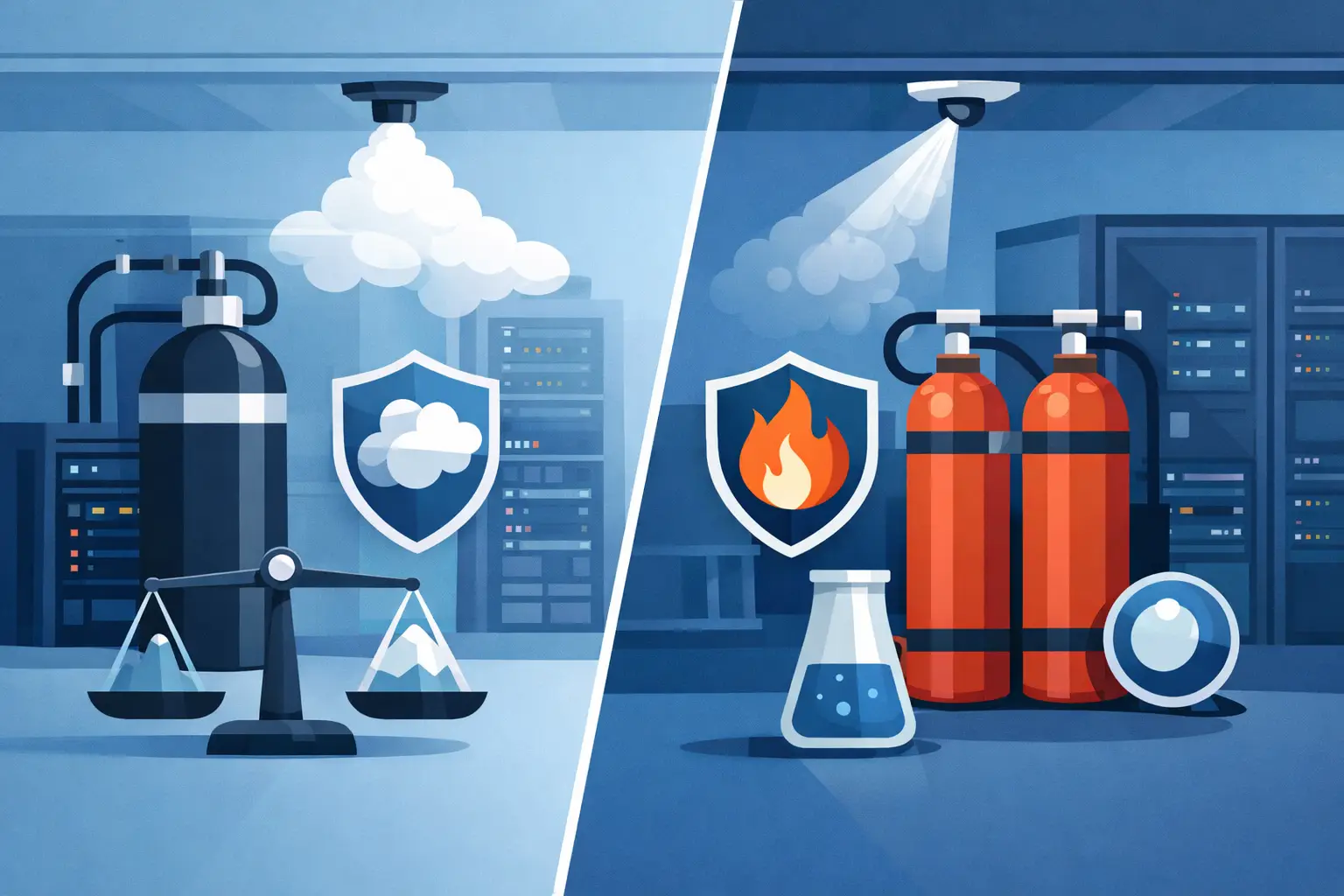
A suppression system for a server room, control room or electrical enclosure has one job that sprinklers cannot always perform: stop a developing fire without soaking the assets that keep the business running. The question of inert gas versus clean agents is therefore not simply about the cylinders on the wall. It affects room layout, safety arrangements, environmental policy, recovery time and the practical cost of protecting a critical operation.
There is also a useful technical clarification. Inert gases are, in the broad fire-protection sense, a type of clean gaseous extinguishing agent. In everyday project discussions, however, “clean agent” often means a halocarbon agent such as FK-5-1-12, commonly known as Novec 1230, or HFC227ea, also known as FM200 or FE227. This article uses that common distinction: inert gas systems compared with halocarbon clean-agent systems.
How the two suppression methods work
Inert gas systems use naturally occurring gases to reduce the oxygen concentration in a protected enclosure below the level at which ordinary combustible materials can sustain combustion. Options include IG55, IG541, IG01, IG100 and INERGEN®. The design concentration is selected to extinguish the expected fire hazard while allowing a suitable margin for people to evacuate.
Halocarbon clean agents work differently. They extinguish mainly by absorbing heat from the flame zone, with some chemical interruption of the combustion process depending on the agent. Because they are effective at lower concentrations by volume, they generally require less storage volume than an inert gas system protecting the same room.
Both approaches are designed for total flooding applications. They rely on early, dependable detection, controlled release, correctly positioned discharge nozzles and a room that can retain the agent concentration for the required hold time. Neither is a substitute for managing ignition sources, combustibles and maintenance issues within the protected area.
Inert gas versus clean agents: the practical differences
The right choice usually becomes clearer once the building constraints are set alongside the fire risk. For an operational team, the most significant differences are cylinder space, discharge effects, environmental considerations and future servicing strategy.
Cylinder storage and pipework
Inert gases need a larger quantity of agent by volume, so the cylinder bank can take up more space. This is often straightforward in a purpose-built data centre or plant building with an adjacent cylinder room. It can be more difficult where a compact comms room sits within an occupied office, hotel or older building with little spare floor area.
Halocarbon clean agents usually offer a smaller cylinder footprint. That can make them attractive for retrofits, multi-room installations or sites where storage space is commercially valuable. The decision should not be based on cylinder-room size alone, though. Pipe routes, structural loading, access for maintenance and safe cylinder replacement all need to be assessed before a system is specified.
Pressure relief during discharge
Every gaseous extinguishing system changes the pressure inside the enclosure when it discharges. Inert gas systems release a substantial volume of gas quickly and may create significant positive pressure. A correctly sized over-pressure vent is often central to the design, particularly in lightweight partitions, raised-floor rooms and enclosures with limited structural tolerance.
Halocarbon systems also require pressure-relief assessment, but the forces involved may be different due to the agent quantity and discharge characteristics. The vent cannot be treated as an optional add-on. Without suitable pressure relief, discharge may damage walls, doors, ceilings or services, compromising the very enclosure needed to contain the extinguishing agent.
People safety and occupied areas
Life safety comes first with any automatic suppression system. Inert agents lower oxygen concentration, so system design, warning arrangements, time delays, manual release controls and abort facilities must all reflect the occupancy and evacuation plan. A normally occupied control room may require a different solution from an intermittently accessed electrical switchroom.
Halocarbon clean agents are also subject to exposure limits. Their suitability depends on the intended design concentration, room volume and whether people may be present at the time of discharge. Neither category should be described as universally safe for every occupied space. The relevant exposure guidance, the fire strategy and the actual way staff use the room must inform the design.
Environmental policy and long-term planning
Inert gases have no ozone-depletion potential and no global-warming potential. For organisations with demanding sustainability commitments or a preference for naturally occurring agents, this can be a compelling advantage. Their long-established chemistry can also make future environmental planning more straightforward.
Halocarbon agents have strong operational benefits, especially where space is constrained, but their environmental profile varies by agent. HFC227ea has a comparatively high global-warming potential, while FK-5-1-12 has been widely selected for its very low global-warming potential. Regulations, manufacturer availability and corporate environmental policy can change over the service life of a system. A responsible specification considers not only current compliance, but the practicality of maintaining, refilling and supporting the chosen agent for years ahead.
Where each option tends to fit best
Inert gas is frequently well suited to larger critical rooms, data halls, industrial control areas, archives and electrical spaces where there is adequate cylinder storage and a preference for an environmentally neutral agent. It is particularly worth considering when the project can accommodate pressure-relief measures from the outset.
Halocarbon clean-agent systems can be a strong fit for smaller server rooms, communications rooms, heritage-sensitive spaces and retrofit projects where the available cylinder footprint is limited. They are also often selected where a rapid, compact installation is needed around high-value electronic equipment.
That said, application labels can be misleading. A small room may still be unsuitable for a particular agent because of occupancy, leakage paths or unusual ceiling geometry. A large room may be impractical for inert gas if no viable cylinder location exists. Battery rooms add another layer of assessment: the fire scenario, off-gassing, ventilation arrangements and any potential for thermal runaway must be understood before selecting a suppression approach.
Room integrity is not optional
An extinguishing agent only works as designed if the protected enclosure holds it at the required concentration. Door undercuts, cable penetrations, suspended ceilings, floor voids, unsealed ductwork and poorly closing doors can allow the agent to escape too quickly.
Room sealing and an enclosure integrity test should form part of the project, not an afterthought at commissioning. The test identifies whether the room is likely to retain the agent for the specified hold time and highlights leakage routes that need attention. It can also prevent a costly situation where an otherwise well-designed system passes functional discharge checks but cannot provide the expected protection in a real incident.
Changes made after installation matter just as much. New data cables, ventilation modifications, access panels and building works can alter room integrity. Ongoing inspection and periodic retesting help ensure the original performance is maintained as the site evolves.
Detection and controls determine how early intervention happens
The agent choice is only one part of the solution. For high-value assets, early warning detection can provide the time needed to investigate an abnormal condition before automatic release becomes necessary. Aspirating smoke detection, including VESDA systems, is often used where very early warning is required, while point detection, flame detection and other methods may suit the specific hazard.
The release control panel should integrate the detection logic, alarms, sounders, visual warnings, shutdowns and manual controls required by the fire strategy. In many installations, ventilation must be shut down or dampers closed before discharge so the agent is not immediately removed from the room. These interfaces require coordination with electrical, mechanical and building-management systems – a common source of avoidable project risk when suppression is treated as a standalone package.
Design against standards, not assumptions
A suitable gaseous system is engineered around the protected hazard, not selected from a generic room-size table. Design work should consider the fire class, enclosure volume, ambient conditions, maximum and minimum temperatures, altitude where relevant, room leakage, nozzle coverage, pipework hydraulics and anticipated occupancy.
In the UK, gaseous extinguishing systems are commonly designed and installed in accordance with BS EN 15004, supported where appropriate by recognised product approvals and insurer requirements. The standard is not a shortcut to a decision, but it provides the technical framework for concentration, discharge time, enclosure integrity and safety provisions.
Active Fire Suppression Ltd can take that responsibility from initial risk discussion and budget design through installation, integrity testing, commissioning, demonstration and long-term maintenance. This joined-up approach is valuable where a critical room has several interfaces and there is little tolerance for disruption or uncertainty.
The best system is the one that fits the real room, the real risk and the way people work in the building. Before committing to inert gas or a halocarbon clean agent, assess the enclosure, occupancy, cylinder space, environmental policy and recovery priorities together. A short technical survey early in the project can turn a difficult trade-off into a protection strategy that supports continuity when it matters most.



Leave A Comment
You must be logged in to post a comment.