

A server room fire rarely gives an operations team time to weigh up options. Smoke can contaminate electronics, sprinkler discharge can extend the damage, and a short outage can disrupt customers, production or essential services. For organisations reviewing FM200 alternatives, the right answer is not simply the agent with the lowest environmental impact or smallest cylinder footprint. It is the system that will extinguish the credible fire risk safely, retain protection in the room and support recovery when it matters.
HFC227ea, commonly known as FM200, remains installed in many UK critical facilities. It is a proven clean agent that leaves no residue and can be effective in occupied enclosures when correctly designed. However, environmental policy, long-term agent availability, insurer expectations and refurbishment plans are causing many building operators to assess alternatives rather than automatically replacing like for like.
Why organisations are considering FM200 alternatives
The main driver is the global warming potential of HFC agents. HFC227ea has a substantially higher environmental impact than inert gases, and fluorinated agents are under increasing regulatory and commercial scrutiny. This does not mean every existing FM200 system must be removed. A maintained, serviceable system may continue to provide valuable protection, and any decision should account for its condition, agent availability, the protected risk and the disruption associated with replacement.
The position changes when a system requires major repair, cylinders need replacing, a protected room is being altered or a business is setting a lower-emissions procurement policy. At that point, it is sensible to compare the whole-life implications of alternative suppression technologies.
A proper review also considers the reason the original system was specified. A compact clean-agent installation may have been selected because plant-room space was limited. An inert gas system may now be preferred for its environmental profile, but it needs more storage volume. Neither point is minor when a live data centre, control room or manufacturing facility is involved.
Inert gas systems: the principal long-term option
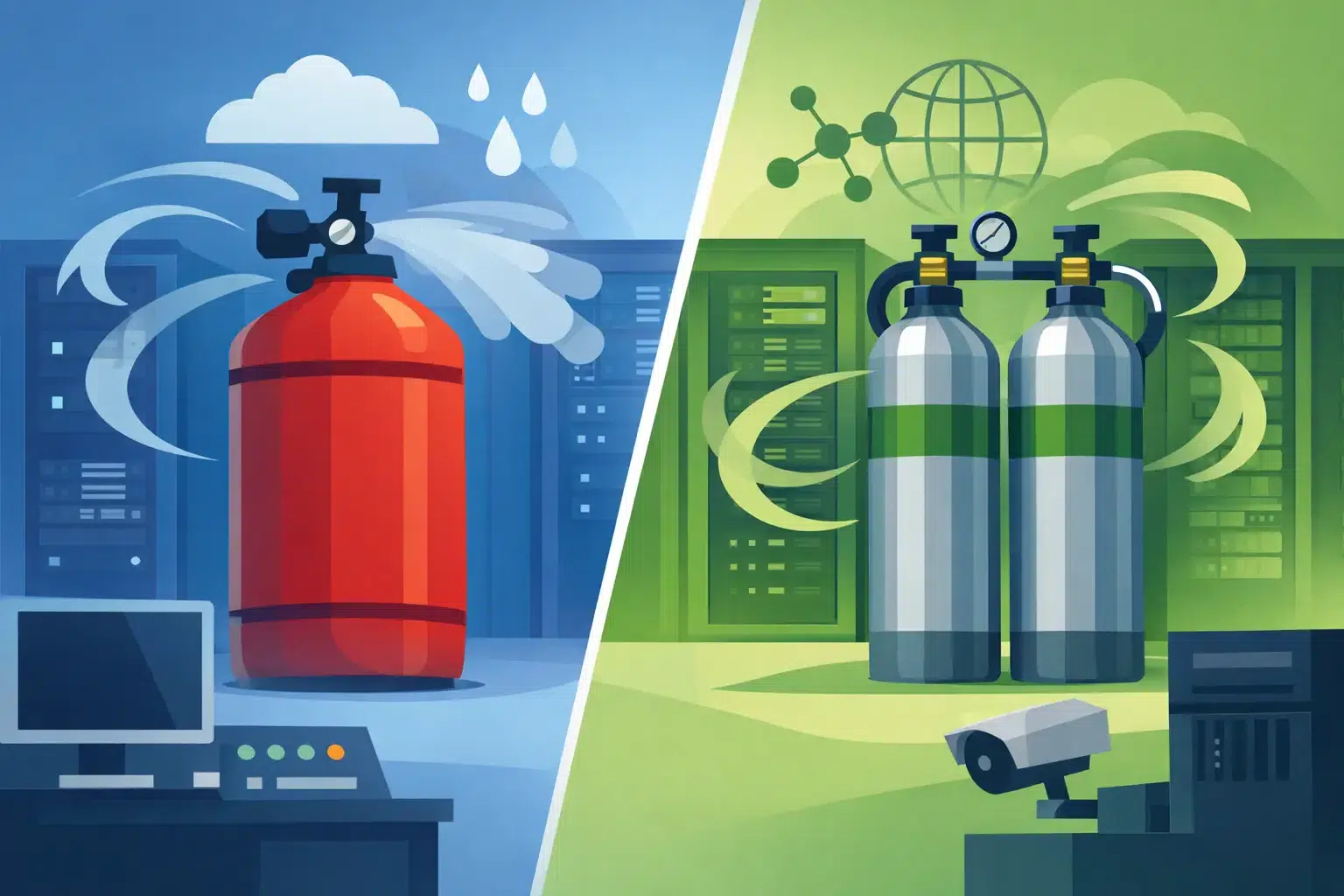
For many critical rooms, inert gas is the most established alternative to FM200. Systems using IG55, IG541, IG01 or IG100 extinguish fire by reducing the oxygen concentration below that needed for combustion while maintaining a level intended to support safe evacuation by people.
These agents are naturally occurring gases. They do not create residue, do not damage sensitive electronics through discharge, and have no ozone-depletion potential or global warming potential in the way HFC agents do. This makes them particularly attractive for server rooms, data centres, switch rooms, archives, control rooms and high-value industrial equipment.
Choosing between IG55, IG541, IG01 and IG100
The best inert gas is determined by the room, the required design concentration and the available cylinder storage arrangement. IG55 is a blend of argon and nitrogen. IG541, often known as INERGEN®, combines nitrogen, argon and carbon dioxide. IG01 is argon, while IG100 is nitrogen.
From an operational perspective, all can provide effective total flooding protection when engineered to the appropriate standard. The meaningful differences usually concern cylinder quantity, storage pressure, pipework design, discharge characteristics and project constraints. A detailed hydraulic calculation is essential; agent choice cannot be made from a product comparison sheet alone.
Inert gas discharge can create significant pressure changes within an enclosure. Correctly sized over-pressure venting is therefore part of the protection system, not an optional extra. The room also needs sufficient integrity to retain the extinguishing concentration for the required holding period. Door fan testing identifies leakage paths around doors, cable penetrations, dampers, raised floors and building joints before the system is relied upon.
The trade-off is physical space. Inert gas cylinders generally require more storage than an equivalent clean-agent system. For an existing building with a small riser cupboard or no nearby cylinder room, this can influence the design significantly. High-pressure cylinder technology and carefully planned layouts can help, but the constraint must be assessed early.
Clean-agent options and their limitations
Fluorinated ketone clean agents, widely recognised through Novec 1230 applications, have also been used as an alternative where space is limited and a residue-free discharge is required. They offer a low global warming potential compared with HFC227ea and can be suitable for occupied, high-value spaces when designed at the correct concentration.
However, procurement and support conditions for fluorinated ketone agents have changed in recent years. Organisations should not assume that an agent historically specified for a project will have the same long-term availability, supply chain or manufacturer support. For new installations, the decision should include a clear discussion of agent sourcing, future servicing, environmental policy and the practical availability of refill or replacement stock.
HFC227ea itself may remain the pragmatic choice in certain situations, particularly where a compatible existing system needs a proportionate repair rather than wholesale replacement. The correct approach is to document why that decision is appropriate, including system condition, risk reduction, environmental considerations and planned asset life.
Are CO2, water mist or aerosol suitable replacements?
They can be, but they are not direct substitutes for FM200 in every enclosure.
Carbon dioxide is highly effective on specific fire risks and can be a sound solution for unoccupied machinery spaces, industrial processes and certain local-application hazards. It presents a serious life-safety risk at extinguishing concentrations, so it requires carefully controlled design, warning, lock-off and evacuation arrangements. It is not generally the first choice for normally occupied server rooms or electrical spaces.
Water mist can limit fire growth with much less water than conventional sprinklers. It may suit turbine enclosures, heritage settings, plant rooms and some industrial hazards. Yet even fine droplets introduce water into the protected area, which may not be acceptable around exposed electronics or sensitive processes. It also performs differently according to nozzle type, pressure, enclosure geometry and fuel hazard.
Condensed aerosol systems are compact and can be useful in small enclosures, electrical cabinets or plant applications. Their discharge can leave particulate residue, however, so they need careful consideration where sensitive IT equipment, clean processes or difficult post-incident cleaning are involved.
The room and fire risk decide the system
A suppression agent should be selected after defining the fire scenario, not before. The starting point is whether the system must deal with Class A materials such as cable insulation and plastics, flammable liquids, electrical equipment, cooking oils or a localised machinery hazard. The volume and construction of the enclosure, normal occupancy, ventilation strategy, temperature range and downtime tolerance all shape the design.
For a data centre, the priority may be preventing smoke damage and avoiding unnecessary discharge while maintaining service continuity. This often calls for multi-stage detection, such as aspirating smoke detection, pre-discharge warning and a controlled automatic release sequence. For a battery room, the assessment must consider the battery chemistry, ventilation, gas generation and the possibility of thermal runaway. Suppression may reduce the spread of fire, but it does not remove every hazard associated with failing battery cells.
A kitchen requires a different approach again. Wet-chemical suppression is designed to tackle cooking-oil fires at the appliance, while automatic fuel and electrical isolation forms part of the overall response. Trying to use a general clean-agent solution where a purpose-designed kitchen system is required would be poor engineering.
Design, testing and maintenance are part of the decision
An agent is only one element of an effective system. A replacement project should include detection and control logic, manual release and abort arrangements where appropriate, sounders and visual warning, interface with ventilation and fire alarm systems, pressure-relief provision, signage and emergency procedures.
For total flooding gaseous systems, design should be undertaken in accordance with the relevant requirements of BS EN 15004 and ISO 14520, alongside applicable fire alarm, electrical and building requirements. Insurer conditions and site-specific standards may add further requirements. The final installation should be commissioned, demonstrated to responsible staff and supported by clear operating information.
Room integrity testing is particularly important after refurbishment. A new cable route, altered ceiling, unsealed penetration or changed door can compromise retention time without being obvious during a visual inspection. Regular maintenance should therefore cover cylinders, valves, actuators, nozzles, detection, control panels, interfaces and enclosure integrity as applicable.
Planning a sensible transition from FM200
There is no benefit in rushing a replacement that leaves a critical room under-protected. Begin with a survey of the existing installation: identify the agent, cylinder condition, room volume, pipework, detection arrangements, service history and any changes to occupancy or equipment. Then establish whether the objective is to extend the life of an existing system, replace it at end of life or improve protection as part of a wider upgrade.
A staged project can often reduce operational risk. Detailed design and room-preparation works can be completed before the outage window, followed by installation, testing and commissioning under an agreed change-control plan. Active Fire Suppression Ltd can manage this process from initial risk discussion and design through installation, integrity testing, demonstration and ongoing maintenance.
The most useful next step is a site-specific conversation: what must be protected, how quickly must the operation recover, and what constraints does the building impose? Those answers will usually point more clearly to the right suppression system than the name on the cylinder ever could.


Leave A Comment
You must be logged in to post a comment.