

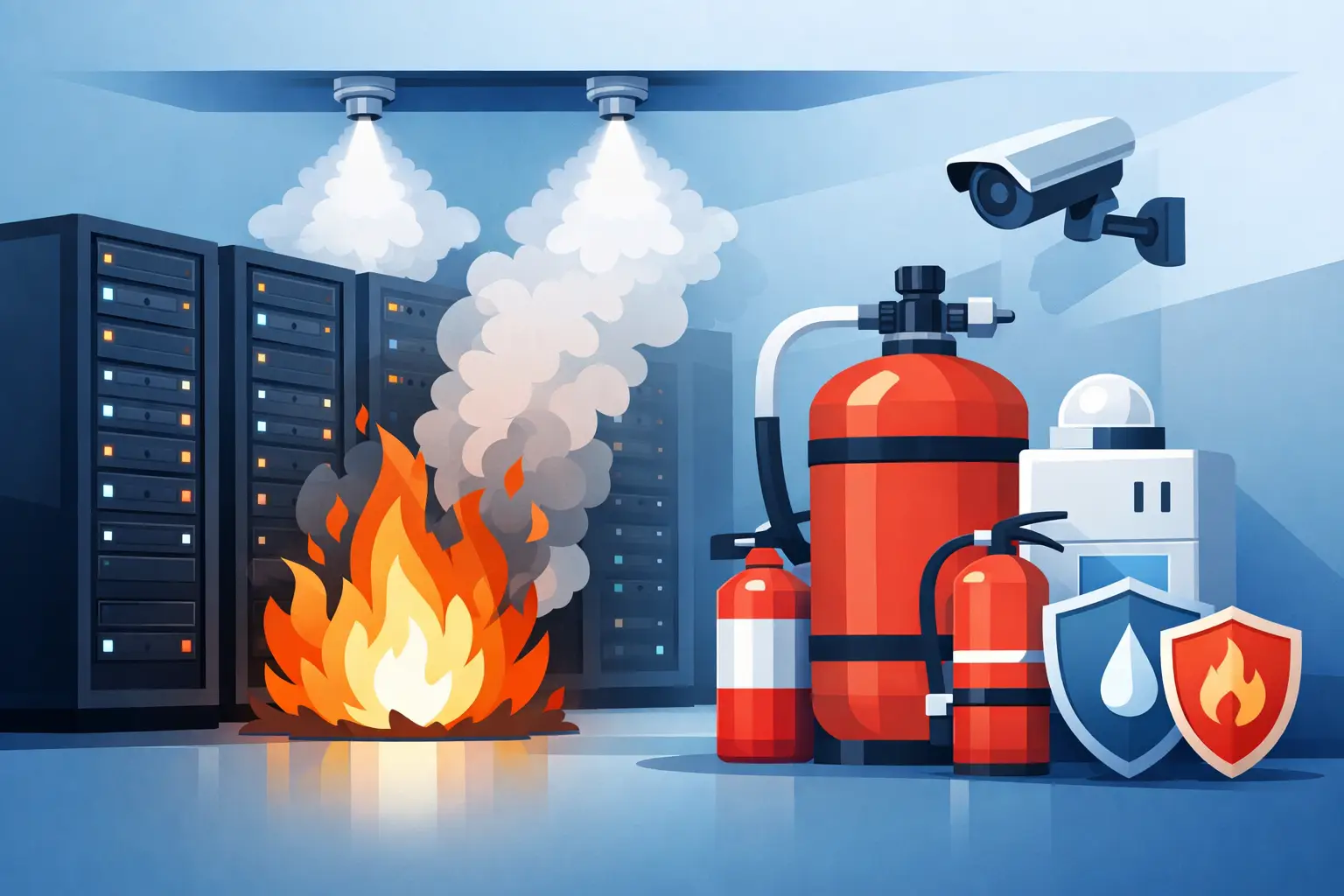
A server room fire suppression system is designed for a very particular problem: a small fire can take critical IT offline long before flames cause visible structural damage. Smoke contamination, heat damage, emergency power-down and water from conventional sprinklers can all turn a contained incident into prolonged business interruption. For organisations relying on servers for operations, customer services, security, communications or production, automatic detection and suppression is a business-continuity measure as much as a life-safety provision.
The right solution is not simply a matter of selecting an extinguisher cylinder. It requires a properly engineered combination of early warning detection, a suitable extinguishing agent, correctly sized pipework and nozzles, room sealing, safe controls and ongoing maintenance. Each element has to work as part of one coordinated system.
Why ordinary fire protection may not be enough
Portable extinguishers, manual response and building-wide sprinkler protection all have a role within a wider fire strategy. They may not, however, provide the speed or asset protection required in a server room. An electrical fault, failing power supply, overloaded component or cable fire can develop when the room is unattended, including overnight or during a reduced staffing period.
Conventional sprinklers are highly effective at controlling many building fires, but water discharge within an IT environment can damage servers, switches, storage equipment and associated electrical infrastructure. Even equipment not directly affected by fire may need to be isolated, inspected or replaced. Recovery can depend on the availability of replacement hardware, validated backups and specialist cleaning.
A fixed gaseous suppression system is intended to detect a developing fire quickly and discharge an agent that extinguishes it without leaving residue. This can reduce the spread of smoke, avoid unnecessary water damage and give the organisation a far better chance of restoring service promptly. It does not remove the need for sensible housekeeping, resilient backups, staff procedures or an appropriate overall fire-risk assessment. It provides automatic intervention when time matters most.
The components of a server room fire suppression system
A successful system starts with detection. Standard point smoke detectors can be appropriate in some rooms, but high-sensitivity aspirating smoke detection, commonly known as VESDA, is often specified where early warning is required. By continuously drawing air through sampling points, it can identify very low levels of smoke before a fire reaches the stage where conventional detection operates.
Early warning gives facilities and IT teams time to investigate, isolate a failing item and, where possible, prevent an avoidable discharge. Detection should also be positioned with the room layout in mind. Airflow from cooling units can move smoke away from ceiling detectors, while underfloor voids, ceiling voids and equipment cabinets can each present separate detection considerations.
The releasing control panel receives signals from the detection system and manages the suppression sequence. A common arrangement uses coincident detection, where two independent detection signals are required before automatic release. This helps reduce the risk of an unwanted discharge while maintaining rapid response to a confirmed fire condition.
Before agent discharge, the system may operate visual and audible alarms, shut down air-conditioning or close dampers to limit agent loss, and send status signals to a building management system or monitoring service. A manual release control can allow trained personnel to initiate discharge where justified, while an abort facility can delay release if it is safe to do so and the alarm has been investigated. These controls must be designed carefully. They are life-safety functions, not generic electrical accessories.
Selecting the extinguishing agent
Inert gas and clean-agent systems are common choices for server rooms. The most suitable agent depends on room volume, enclosure characteristics, occupancy, environmental policy, available cylinder space, insurer expectations and continuity requirements.
Inert gas agents such as IG55, IG541, IG01 and IG100 extinguish fire by reducing the oxygen concentration within the protected enclosure to a level that will not support combustion. They are naturally occurring gases, leave no residue and are widely used for occupied areas when designed to the relevant standards. Their principal practical consideration is cylinder storage: inert gas systems can require a larger cylinder footprint than some clean-agent alternatives.
Clean agents including Novec 1230 and HFC227ea, also known as FM200 or FE227, extinguish principally by removing heat from the fire. They can be effective at relatively low concentrations and may suit sites where space for cylinders is limited. Agent choice should not be based on cylinder size alone. Environmental policy, lifecycle planning, applicable regulations and availability all need to be considered as part of a long-term solution.
Carbon dioxide systems are highly effective in suitable unoccupied or controlled industrial applications, but their use carries significant life-safety implications. They are not generally the default choice for an occupied server room. Any proposal must address occupancy, warning arrangements, lock-off procedures and the applicable design standards in full.
Room integrity is part of the system, not an afterthought
A gaseous agent can only maintain its extinguishing concentration if the protected room is sufficiently sealed. Open cable penetrations, unsealed service routes, poorly fitting doors, ceiling voids and ventilation paths can allow agent to escape too quickly. In that situation, correctly specified cylinders and detection may still fail to achieve the required hold time.
Room integrity testing, often referred to as a door fan test, assesses whether the enclosure is capable of retaining the extinguishing concentration for the required duration. It should be carried out after room sealing works and repeated when significant changes are made to the room fabric, cabling or ventilation.
This is particularly relevant in live IT estates, where new data cabling, cooling upgrades and equipment changes are routine. A fire-suppression contractor should coordinate with the electrical, mechanical and IT teams so that necessary alterations do not compromise the protected enclosure. Over-pressure relief vents may also be required to manage the pressure changes created during agent discharge.
Design around the real room, not a drawing alone
Server rooms vary widely. A compact comms room with a single rack has different risks from a data hall with raised floors, multiple cooling units, battery backup, cable voids and 24-hour remote monitoring. The system design must account for the actual enclosure volume, hidden voids, equipment arrangement, airflow, fire load and likely ignition sources.
The scope should also establish what happens after discharge. Critical equipment may need controlled shutdown, while other systems must remain live to preserve monitoring, access control or communications. Facilities managers should agree these cause-and-effect actions in advance rather than discovering them during an incident or annual test.
Design and installation should follow relevant standards, commonly including BS EN 15004 for gaseous fire-extinguishing systems, alongside applicable British Standards, manufacturer requirements and insurer conditions. Compliance is not merely a certification exercise. It provides a disciplined framework for concentration calculations, nozzle placement, alarms, control logic, pressure relief and acceptance testing.
Commissioning, maintenance and practical readiness
Commissioning is the point at which the system is proved, not simply switched on. This typically includes checking detection zones, control-panel programming, alarm functions, interfaces, cylinder supervision, release circuits and the agreed cause-and-effect sequence. Site teams should receive a clear demonstration of normal, fault and fire conditions, including what they should do when alarms operate.
After handover, the system needs planned inspection and maintenance. Cylinders, actuators, pipework, nozzles, detection devices, control panels, batteries and interfaces all require periodic checks. Faults should be addressed promptly, particularly where a room has been altered or the system has been isolated for works.
Maintenance records are valuable evidence for insurers, auditors and responsible persons, but their greater value is operational. They confirm that an asset-protection system will perform when the room is empty, the pressure is high and there is no opportunity for a second attempt.
Active Fire Suppression Ltd can take responsibility from initial risk discussion and system design through installation, room sealing, integrity testing, commissioning, demonstration and continuing maintenance. That joined-up approach avoids the common gaps between the contractor installing the system, the team altering the room and the people expected to respond to alarms.
A server room is often treated as a small technical space, yet its failure can affect an entire organisation. The most useful next step is to review the room as it operates now: its equipment, airflow, voids, occupancy, planned changes and the real cost of downtime. From there, a properly engineered suppression solution can be matched to the risk rather than fitted as a standard package.


Leave A Comment
You must be logged in to post a comment.