

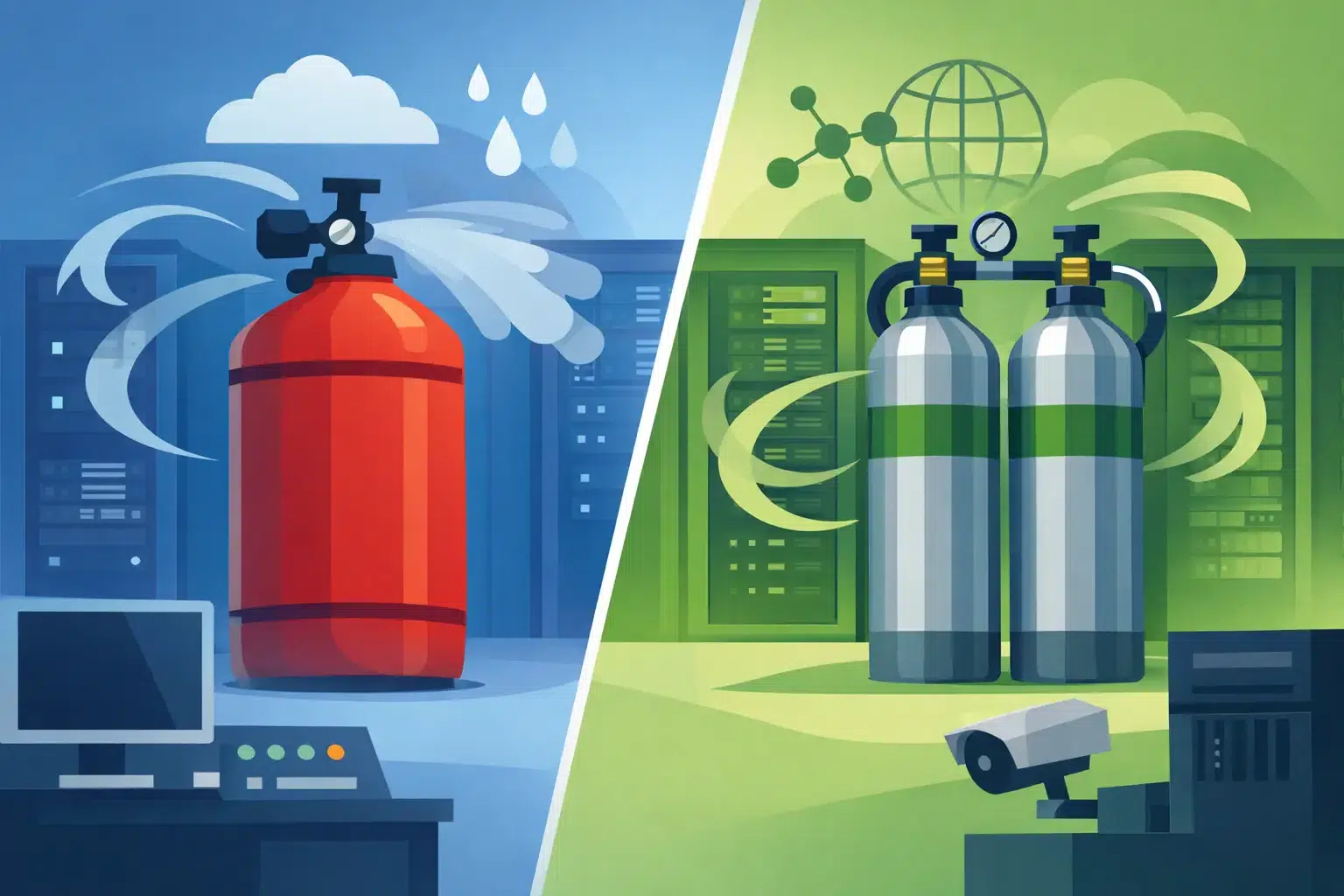
A server-room fire does not need to become a fully developed blaze to cause serious disruption. Smoke contamination, corrosive residues, water damage and a prolonged shutdown can all affect the outcome. When considering Novec 1230 versus IG55, the right choice is not simply about extinguishing performance. It is about the hazards in the room, the people who use it, the building constraints, environmental policy and how quickly the operation needs to recover.
Both agents are proven options for total flooding fire suppression in enclosed commercial spaces. Both can protect sensitive equipment without the collateral damage associated with water-based systems. Their method of operation, storage requirements and long-term considerations are, however, materially different.
Novec 1230 versus IG55: the essential difference
Novec 1230 is a clean-agent extinguishant, commonly identified in system standards as FK-5-1-12. It is stored as a liquid under pressure and discharges as a gas. It suppresses fire principally by absorbing heat from the combustion process, rapidly reducing the temperature needed for the fire to continue.
IG55 is an inert gas agent made from equal parts nitrogen and argon. It works by reducing the concentration of oxygen in a protected enclosure to a level where combustion cannot continue, while remaining within defined design limits for occupied spaces.
This difference affects almost every aspect of a project. Novec 1230 systems generally require less cylinder storage space and operate at lower discharge pressures than inert gas systems. IG55 requires larger cylinder banks and careful management of the pressure created during discharge, but its constituent gases occur naturally in the atmosphere and it has no ozone-depletion potential or global-warming potential.
Neither option is automatically better. A well-designed system begins with the room and operational risk, rather than selecting an agent first.
Where Novec 1230 can be the practical fit
Novec 1230 has historically been selected for compact, high-value rooms where cylinder footprint is limited. Typical applications include server rooms, telecoms spaces, control rooms, archives, electrical switchrooms and specialist equipment enclosures.
Because it is stored as a liquid, a relatively compact cylinder arrangement may be possible compared with an inert gas installation protecting the same volume. This can be valuable where a building has limited plant-room capacity, where floor loading restricts the location of cylinders or where a retrofit must work around existing services.
The agent is non-conductive and leaves no residue, which makes it suitable for sensitive electronic equipment. Following a verified discharge and appropriate safety checks, recovery activity can focus on investigating the cause of the fire, cleaning affected equipment and restoring the protected operation rather than managing water contamination.
Occupancy is also an important consideration. Systems are designed to recognised concentration limits and exposure guidance. In any occupied enclosure, the detection, warning, abort, release and evacuation arrangements must form part of the engineering design. Clean-agent suppression does not remove the need for people to leave promptly when alarms activate.
There is an additional procurement and environmental point. The market for fluorinated clean agents has changed significantly, and many organisations now assess clean agents against broader PFAS policies, corporate sustainability commitments and future supply considerations. For existing Novec 1230 installations, maintenance planning should take account of agent availability, cylinder testing, system condition and an organisation’s longer-term replacement strategy. For new systems, these factors should be discussed early rather than treated as an afterthought.
Where IG55 offers clear advantages
IG55 is often a strong choice for organisations seeking an inert-gas solution with a straightforward environmental profile. Nitrogen and argon are naturally occurring atmospheric gases, so the agent does not create the same environmental policy questions associated with fluorinated clean agents.
It is particularly well suited to larger enclosures and sites that can accommodate a dedicated cylinder bank. Data centres, industrial control areas, electrical rooms, museums and critical process spaces may all be appropriate, subject to detailed risk assessment and system design.
An IG55 system has no residue and is non-conductive. It can therefore protect electrical and electronic assets while avoiding the clean-up and business interruption that may follow sprinkler operation or hose-reel firefighting. For a business operating vital infrastructure, this difference can be substantial.
The trade-off is physical space. Inert gas is stored in high-pressure cylinders, so an IG55 installation can demand more storage volume, greater cylinder weight capacity and more substantial distribution pipework. The discharge also changes the pressure inside the enclosure. Pressure-relief venting must therefore be calculated and installed correctly to protect walls, ceilings, doors and other room elements.
IG55 may be the more sensible long-term selection where environmental procurement rules are strict, available plant space is adequate and the organisation values an agent based on naturally occurring gases. It is not a shortcut, though. Its performance depends on accurate enclosure volume calculations, pipework design, room integrity and properly commissioned controls.
Room integrity matters to both systems
A total flooding system only works as designed if the protected enclosure can retain the extinguishing concentration for the required period. Gaps around cable penetrations, unsealed raised floors, poorly fitting doors and unprotected ventilation routes can allow agent to escape too quickly.
For Novec 1230, inadequate integrity can prevent the required agent concentration from being maintained. For IG55, it can allow oxygen levels to recover too rapidly. In either case, the fire may reignite or the system may not deliver the expected protection.
Room integrity testing is therefore not an optional final check. It should be part of the project from the outset, particularly on refurbishment schemes where new cabling, air-conditioning modifications or building works may compromise a previously tested enclosure. Hold-time testing identifies whether the room will retain the design concentration and highlights the sealing work needed before handover.
Ventilation and air-conditioning must also be interlocked with the suppression system. On confirmed fire conditions, equipment may need to shut down or dampers close to prevent the agent being removed from the room. These interfaces should be agreed with mechanical, electrical, building-management and IT teams early in the programme.
Comparing installation and operational requirements
The most useful comparison is not agent against agent in isolation. It is system against site.
Novec 1230 can reduce the cylinder-space challenge, which may lower the disruption of a retrofit. IG55 can require more accommodation for cylinders, but may be attractive where environmental credentials and agent longevity are given greater weight. Both need suitable detection, usually with cross-zoned automatic detection arrangements, manual release where appropriate, warning devices, control panels, discharge nozzles and safety signage.
Both systems also need a disciplined maintenance regime. Visual inspections alone are not enough. Maintenance should cover control equipment, detection interfaces, cylinder pressures and weights where applicable, pipework, nozzles, warning indicators, manual controls, abort functions, room condition and any changes to the protected risk.
A server room that gains a new UPS, a larger battery installation or a different cooling arrangement is not necessarily protected by the original design. Similarly, a process room altered by new machinery or partitions may need a revised suppression calculation. Protecting business continuity means managing these changes, not assuming the original commissioning certificate covers every future condition.
Standards, life safety and insurer expectations
UK systems should be designed, installed, commissioned and maintained in line with the relevant standards and manufacturer requirements. For gaseous extinguishing systems, BS EN 15004 and the ISO 14520 series provide key design principles, while the wider fire strategy, electrical interfaces and site procedures also need to be coordinated.
Life safety remains central to the choice. IG55 reduces oxygen concentration, while Novec 1230 is deployed at a specified extinguishing concentration. Each requires correct hazard analysis, occupant exposure assessment, warning arrangements and evacuation procedures. Areas with regular occupancy, restricted escape routes or vulnerable occupants deserve particular scrutiny.
Insurers may also have a view on the protected hazard, detection arrangement, system approval and maintenance evidence. Early engagement avoids a situation where an otherwise capable system does not meet the insurer’s risk-improvement requirements.
Making the right selection for your site
Choose Novec 1230 only after considering the practical benefit of compact storage against the organisation’s environmental and supply-chain position. Choose IG55 where the space, structural capacity and venting arrangements support an inert-gas system and its environmental profile aligns with long-term policy.
The decision may also lead elsewhere. A very small enclosure may favour another agent or a local-application approach. A battery room may require a strategy that addresses thermal runaway, toxic gas management and fire detection as well as suppression. An open or poorly sealed space may not be suitable for total flooding without building alterations.
Active Fire Suppression Ltd can assess these issues as one connected engineering task: risk, detection, agent selection, enclosure condition, installation, commissioning, room-integrity testing and ongoing support. The most useful next step is to review the actual room, its assets and the consequences of downtime, then design protection around the risk that exists rather than the system that happens to fit a catalogue.
Leave A Comment
You must be logged in to post a comment.